

Cycle syncing workouts help most women mainly through better pacing and self-knowledge, not dramatic performance gains. Track your cycle, keep a baseline strength routine running year-round, and adjust intensity around how you feel each phase.
TL;DR:
- Most women experience only minor performance differences across menstrual cycle phases, making strict phase-based training unnecessary for non-elite athletes.
- Tracking cycle symptoms and energy levels for one to two months allows personalized adjustments rather than relying on generic phase calendars.
- During menstruation and the luteal phase, lower-intensity workouts, such as walking and recovery focus, help maintain consistency without overexertion.
- High-intensity or maximal effort sessions are best scheduled during the follicular and ovulatory phases when estrogen peaks and strength and coordination are at their highest.
- Flexible, responsive training adjustments based on individual logs outperform rigid, hormone-based plans for most recreational and intermediate exercisers.
Table of Contents
- What Is a Cycle Syncing Workout Routine?
- What You Actually Gain From Training With Your Cycle
- Phase-by-Phase Workouts: What to Actually Do
- How to Start Syncing Your Workouts With Your Cycle
- What the Research Actually Says About Cycle Syncing
- Fueling, Recovery, and Safety Tips Worth Knowing
- Common Mistakes That Undermine Cycle Syncing Workouts
- Sample Weekly Plans for Each Phase
- Adjusting Cycle Syncing for Your Fitness Level and Goals
- The Psychology of Training Around Your Cycle
- Combining Cycle Syncing With HIIT and Strength Training
- Making Cycle Syncing Work in Real Coaching Practice
- Support Your Training Consistency With Florvahealth
- Sources
What Is a Cycle Syncing Workout Routine?
A cycle syncing workout means adjusting exercise type and intensity to match where you are in your menstrual cycle instead of running the same training plan every week regardless of hormones. Cleveland Clinic frames this as aligning nutrition and exercise with your four cycle phases, each with a rough day range in a typical 28 day cycle:
- Menstrual phase (days 1 to 5): Bleeding begins; estrogen and progesterone are both low.
- Follicular phase (days 1 to 13, overlapping with menstruation): Estrogen rises steadily.
- Ovulatory phase (around day 14): Estrogen peaks, then a luteinizing hormone surge triggers ovulation.
- Luteal phase (days 15 to 28): Progesterone rises, then both hormones drop before your period starts.
Estrogen and progesterone shift more than mood. They influence carbohydrate metabolism, core temperature, and how hard a workout feels at the same actual effort, which is the physiological basis for phase-based training adjustments.
What You Actually Gain From Training With Your Cycle
The biggest win from cycle syncing fitness isn’t a bigger squat max. It’s fewer workouts skipped out of guilt and better pacing on days your body is clearly asking for less.
Women who track their cycle alongside training tend to report:
- Less anxiety about missing a hard session during a low-energy week.
- Reduced period symptoms when they swap high-intensity work for walking or mobility during heavy flow days.
- A clearer sense of their own patterns after a few months of logging.
On the numbers: a 2020 systematic review of 78 studies found exercise performance might be trivially lower in the early follicular phase compared with other phases, but the overall evidence quality was rated low, and individual responses varied widely. For most recreational exercisers, that performance difference is not something you would notice in a normal training week. Elite athletes chasing marginal gains are the group most likely to benefit from precise phase-based periodization. For everyone else, the behavioral benefit, showing up consistently and understanding your own body, tends to matter more than any hormone-driven edge.
Phase-by-Phase Workouts: What to Actually Do
Here’s how to structure training across a typical cycle without overengineering it.
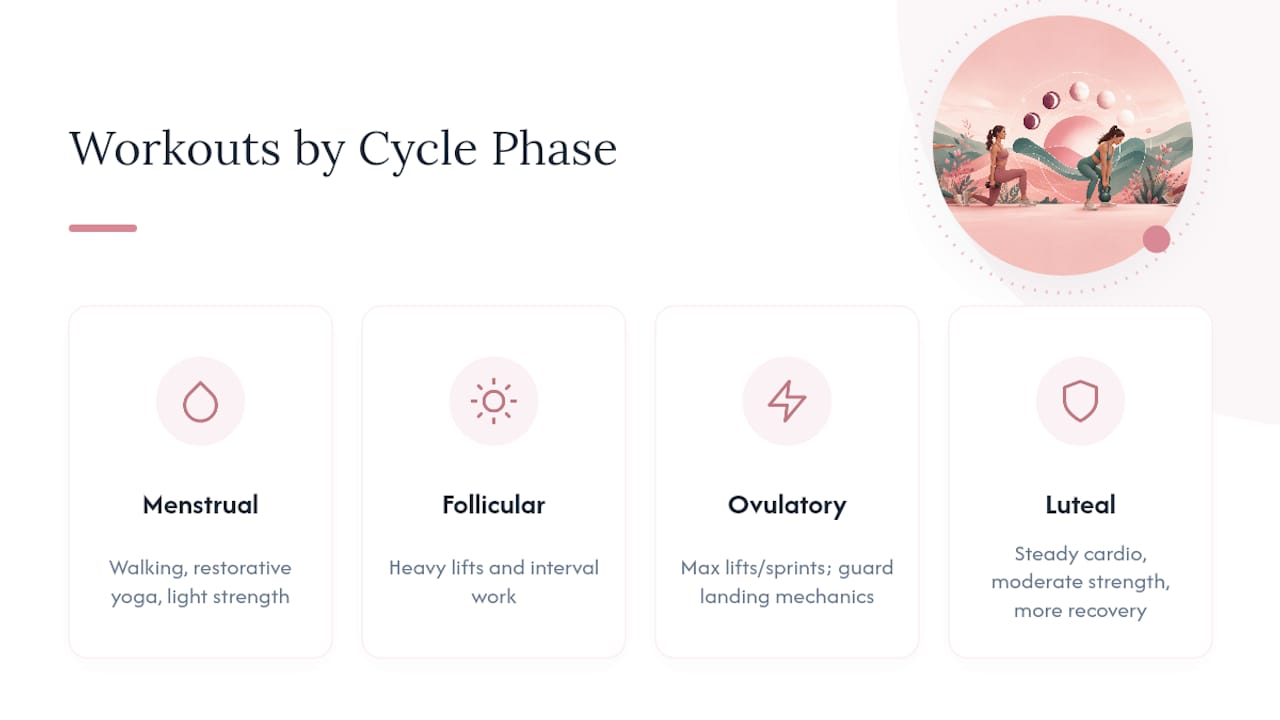
1. Menstrual phase (roughly days 1 to 5). Energy often dips here, especially days one and two. Walking, restorative yoga, and light full-body strength work with moderate weight keep you moving without forcing a personal record. The Office on Women’s Health notes that exercise during your period is generally fine and can actually ease cramps and mood symptoms for many women. If you want to keep lifting, drop your rate of perceived exertion (RPE) by one or two points rather than skipping the session entirely.
2. Follicular phase (days 1 through roughly 13, picking up steam after bleeding tapers). Rising estrogen tends to correlate with better mood and more willingness to push. This is the window to progress your heaviest lifts and add interval work. Some controlled trials suggest concentrating resistance training in the follicular phase can produce stronger strength gains than evenly spread programming, though results aren’t consistent across every study design.
3. Ovulatory phase (around day 14, give or take). Estrogen peaks right before ovulation, and many women feel their most powerful and coordinated here. It’s a good window for max-effort lifts, sprint work, or a power-focused session. One caveat worth taking seriously: some research points to slightly higher ligament laxity around ovulation, which is relevant for ACL risk in cutting or jumping sports. Prioritize clean landing mechanics and controlled tempo on plyometric work rather than chasing height or speed at the expense of form.
4. Luteal phase (days 15 through the start of your next period). Progesterone rises, then both hormones fall in the final days, which is when PMS symptoms tend to peak. Shift toward steady-state cardio, moderate strength work with tighter volume control, and more deliberate recovery. This is also the phase to pay attention to nutrition cues. Slightly increased carbohydrate needs and appetite are common as your metabolic rate ticks up.
Pro Tip: *Don’t treat the luteal phase as a write-off.
How to Start Syncing Your Workouts With Your Cycle
Before changing anything, spend one to two months just watching the pattern. Coaches and practitioners commonly recommend this window because it reveals your actual pattern rather than a generic template.
Log four things daily:
- Period start and flow intensity
- Subjective energy on a 1 to 10 scale, plus sleep quality
- Workout type and RPE (how hard the session actually felt)
- Any symptoms: cramps, bloating, mood shifts, breast tenderness
A flexible weekly template might rotate like this: two strength days every week regardless of phase, one interval or sprint session concentrated in the follicular or ovulatory window, and one lower-intensity cardio or mobility day that expands during the luteal or menstrual phase. Some coaches use what’s informally called the 3-3-3 rule: three days of higher intensity, three moderate, three lighter, remapped loosely onto your cycle rather than a fixed weekly grid. It’s a useful starting heuristic, not a law. If your actual energy pattern doesn’t match a 3-3-3 split, follow your logged data instead. A structured cyclical living approach can help turn that daily log into a repeatable habit.
What the Research Actually Says About Cycle Syncing
The honest answer is that cycle syncing has a real but modest evidence base, and the size of the effect depends heavily on who you are.
The PubMed meta-analysis covering 78 studies found only trivial average performance differences across phases, with low overall evidence quality and wide variation between individuals. A separate narrative review reports that aerobic performance tends to run slightly higher in the follicular phase than the luteal phase in some studies, tied to estrogen’s role in carbohydrate metabolism, though findings are inconsistent across research designs. Individual randomized trials have found that concentrating resistance training in the follicular phase can sometimes produce stronger strength gains, but that result isn’t universal, and it depends on specifics like training age and program length.
Clinician guidance leans cautious. Cedars-Sinai researchers note that rigid cycle-based scheduling adds complexity most people don’t need.
Consistent strength and cardiovascular training across the whole cycle matters more for long-term health outcomes than shifting individual sessions to match a hormone chart. Flexible, responsive adjustment beats a strict calendar for the vast majority of exercisers.
Elite athletes with tight performance margins are the exception where phase-tailored periodization is worth the added complexity.
Fueling, Recovery, and Safety Tips Worth Knowing
Small adjustments here go further than most people expect.
- Eat carbohydrates before longer cardio sessions, especially in the luteal phase when your resting metabolic rate rises slightly.
- Keep protein intake steady across the whole cycle rather than only around lifting days.
- Watch iron intake around menses if you notice heavier flow or fatigue, since blood loss can affect iron stores over time.
- Prioritize sleep and light active recovery (walking, easy cycling) during the luteal and menstrual phases rather than full rest days.
- Heat therapy or gentle stretching can ease cramping enough to keep a lighter session on the schedule instead of skipping it outright.
Pro Tip: When picking a tracking app, look for one with simple daily symptom logging, an RPE field for workouts, and a visual chart of your cycle over time. Complicated dashboards you won’t open every day defeat the purpose.
Pay attention to landing mechanics and joint control near ovulation, when slightly increased ligament laxity has been linked to ACL risk in some research. Good technique coaching matters more than at any other point in the cycle.
Common Mistakes That Undermine Cycle Syncing Workouts
The most common mistake is treating a 28 day textbook cycle as universal. Real cycles run anywhere from 21 to 35 days, and stress, travel, or illness shift the timing further. Following a printed phase calendar instead of your actual symptoms produces advice that doesn’t match your body that week.
A second mistake is dropping strength training entirely during the luteal or menstrual phase. Scaling volume down by a quarter or a third preserves the adaptation; skipping lifting for two weeks out of every cycle does not.
Overcomplicating tracking is another trap. Logging six data points daily for three months before making a single change leads most people to quit tracking altogely. Four simple metrics, logged consistently, beat an elaborate spreadsheet abandoned after two weeks.
Some women also swing too far toward permissiveness, using “low energy phase” as a blanket excuse to skip every session in the back half of the cycle. The data doesn’t support that level of pullback for most people. It supports adjusting intensity, not abandoning training.
Finally, ignoring individual variation is a real problem. Because the meta-analysis on cycle phase performance shows wide differences between people, copying a friend’s or influencer’s exact phase-based plan without checking it against your own logged data is likely to disappoint you.
Sample Weekly Plans for Each Phase
These templates assume four to five training days a week and a roughly 28 day cycle; adjust the day count to your own cycle length.
Follicular week (higher capacity): Monday heavy lower-body strength, Tuesday interval running or cycling, Thursday heavy upper-body strength plus core, Friday moderate steady-state cardio, Saturday optional mobility or an easy hike.
Ovulatory window (peak power): Keep the follicular structure but move your hardest single session, a max-effort lift or sprint day, to land near day 14, with careful attention to landing and joint control cues.
Luteal week (recovery focus): Monday moderate full-body strength at reduced volume, Wednesday steady-state cardio at an easy pace, Friday light strength or mobility, Saturday walking or yoga. Two sessions here can drop to RPE 5 or 6 without losing the training habit.
Menstrual week (lowest capacity, first 2 to 3 days): Walking, restorative yoga, or a light full-body circuit at reduced weight. Resume normal loading as flow tapers, usually by day three or four.
Adjusting Cycle Syncing for Your Fitness Level and Goals
A beginner and a competitive lifter need different applications of the same framework.
If you’re new to structured training, focus first on building the habit of two to three consistent sessions a week before layering in phase-based intensity changes. Cycle awareness matters less than showing up when you’re just establishing a baseline.
Intermediate exercisers get the most practical value from this approach: enough training history to notice performance patterns across phases, but still enough headroom that follicular-phase progressive overload produces visible gains.
Advanced athletes and competitive lifters are the group where phase-concentrated periodization, six to eight week blocks that load more heavy work into the follicular window while holding a minimum strength dose during the luteal phase, has the clearest research support, per phase-targeted resistance training trials. If fat loss or a physique goal is the priority rather than raw performance, keep total weekly training volume more stable across phases and adjust primarily through intensity and recovery, since large volume swings can work against consistent progress.
The Psychology of Training Around Your Cycle
Hormonal fluctuations affect motivation as much as muscle. Falling estrogen and progesterone in the days before your period are linked to lower mood and higher irritability for many women, and that shift alone can make a normally enjoyable workout feel like a chore.
Recognizing this pattern changes how you interpret a bad training day. A missed personal record during the luteal phase isn’t a sign you’re losing fitness. It’s often a hormone-driven dip in motivation and perceived effort that will resolve on its own within days. Practitioners increasingly frame cycle syncing as a self-awareness tool rather than a strict prescription, and that framing does real psychological work: it removes the guilt of comparing today’s workout to last week’s follicular-phase session.
The flexibility angle matters more than most fitness content gives it credit for. Athletes who build in permission to adjust intensity without judgment tend to stick with training longer than those chasing an identical number every single week.
Combining Cycle Syncing With HIIT and Strength Training
Cycle syncing isn’t a replacement for a structured training methodology. It’s a modifier layered on top of one.
If HIIT is a fixture in your week, keep it there year round, but shift the hardest intervals toward the follicular and ovulatory windows and swap one HIIT session for a steady-state or technique-focused session during the luteal phase. Strength training should stay in your plan every single week regardless of phase. Cedars-Sinai researchers point out that consistent resistance training across the whole cycle matters more for long-term outcomes than shuffling individual sessions by hormone phase.
For runners or cyclists following a periodized endurance plan, treat cycle phase as a fine-tuning layer on your existing build and taper weeks rather than a separate system. A well-designed balance between strength and cardio work already accounts for recovery need; cycle tracking just tells you which week to lean slightly harder on one side of that balance.
Bone-loading strength work deserves special mention. Because resistance training is central to long-term bone density, the guidance on safe strength training patterns that applies broadly to women’s training also applies here: don’t let a low-energy phase talk you out of your minimum effective dose of loaded lifting.
Making Cycle Syncing Work in Real Coaching Practice
In practice, the workflow that holds up is simple: track two full cycles before changing anything, test one variable at a time (say, shifting hard intervals to the follicular window), log the result, then adjust. A client who feels wrecked during week three of every cycle usually needs a strength baseline protected, not abandoned, while intensity work gets dialed back. The instinct to overhaul an entire program around hormones usually backfires; the instinct to protect two solid strength sessions a week while flexing everything else around them tends to hold up over a full year of training.
— Zamanee
Support Your Training Consistency With Florvahealth
Training around your cycle only works if symptoms don’t derail the plan entirely. Some wellness brands take an inside-out approach to the bloating, cramping, and hormonal shifts that make a follicular-phase interval session feel impossible during a rough luteal week, combining probiotic support, pH-balanced intimate care, and targeted relief patches designed to ease the physical friction points of your cycle. If bloating regularly costs you a workout or two every month, a PMS and bloating relief routine may help close that gap so your training log looks more like your plan and less like a list of skipped sessions. Browse the full Florvahealth product system to find the combination that fits your own cycle pattern.
Sources
- Exercise performance at different phases of the menstrual cycle: measurements, differences, and mechanisms - PubMed
- Exercise performance at different phases of the menstrual cycle: measurements, differences, and mechanisms - PMC
- Nutrition and Exercise Throughout Your Menstrual Cycle - Cleveland Clinic
- What Is Cycle Syncing, and Does It Work? - Cedars-Sinai newsroom


