

The menstrual cycle is defined as four distinct hormonal phases — menstruation, follicular, ovulation, and luteal — that regulate your reproductive system and directly shape your mood, skin, and energy every month. Getting the hormonal cycle phases explained clearly is the first step toward understanding why you feel energized one week and exhausted the next. The four key hormones driving these shifts are estrogen, progesterone, FSH, and LH, and each one rises or falls on a predictable schedule. A normal cycle runs 21–35 days, with 28 days as a common average. Knowing which phase you are in gives you real power over your self-care choices.
What are the hormonal cycle phases explained in simple terms?
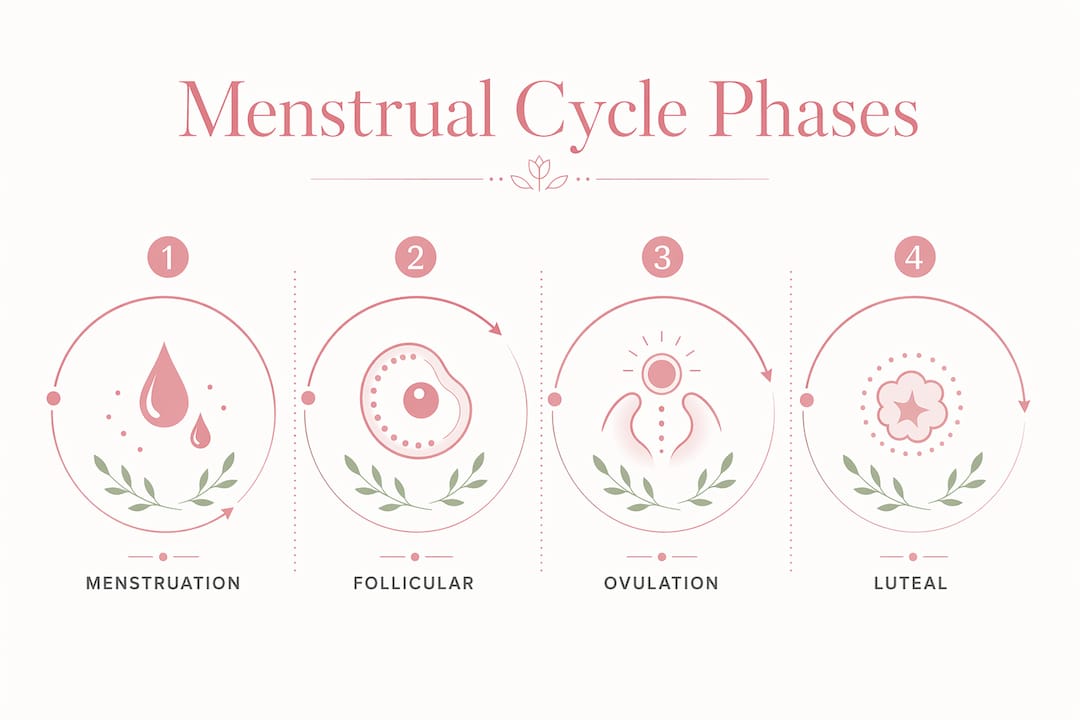
The menstrual cycle divides into four phases, and each one has a distinct hormonal fingerprint. Menstruation opens the cycle. The follicular phase follows and overlaps with it. Ovulation marks the midpoint. The luteal phase closes the cycle before menstruation begins again.
Estrogen and progesterone shifts affect your skin barrier, mood, and energy at every stage. This is not random. Each hormonal change has a biological purpose, and recognizing the pattern helps you work with your body rather than against it. Florvahealth builds its entire product approach around this phase-by-phase reality.
What happens during the menstrual phase?
The menstrual phase starts on day 1 of your cycle and marks the shedding of the uterine lining. Bleeding typically lasts 3–7 days, and both estrogen and progesterone sit at their lowest levels during this window. That hormonal drop is the direct cause of the fatigue, cramping, and low mood many women experience.
Skin during menstruation tends to be more sensitive and reactive. Lower estrogen reduces the skin’s natural moisture retention, which can leave it looking dull or feeling tight. Breakouts that started in the luteal phase often peak or clear during the first days of bleeding.
Common experiences during the menstrual phase include:
- Low energy and fatigue from dropping hormone levels
- Increased skin sensitivity and potential dryness
- Cramping and lower back discomfort from prostaglandin activity
- Mood dips including irritability or low motivation
- Lighter appetite in some women, heavier cravings in others
Pro Tip: Track your flow volume and mood on day 1 and day 3 separately. Patterns across two or three cycles reveal your personal baseline far better than any generic chart.
How does the follicular phase progress and affect the body?
The follicular phase begins on day 1 alongside menstruation and continues until ovulation, making it the most variable phase in length. FSH rises early in this phase, recruiting a group of ovarian follicles and triggering estrogen production. That FSH signal is the engine behind the entire phase.
As estrogen climbs, the uterine lining rebuilds and thickens. Most women notice a clear lift in energy, mental clarity, and motivation during this window. Skin tends to look its clearest and most even, because rising estrogen supports skin clarity and collagen production. This is the phase where your body is genuinely primed for output.
The follicular phase is the best time to:
- Increase workout intensity. Higher estrogen supports muscle recovery and pain tolerance.
- Try new foods or nutrition protocols. Appetite regulation is more stable here.
- Schedule demanding cognitive tasks. Mental sharpness peaks alongside estrogen.
- Start new skincare routines. Skin barrier function is at its strongest.
- Plan social commitments. Mood and confidence tend to be naturally higher.
Pro Tip: The follicular phase length varies widely between women and even between your own cycles. Stress, sleep disruption, and illness can all shorten or extend it. Your luteal phase, by contrast, stays far more consistent.
What defines ovulation and its hormonal surge?
Ovulation is the briefest phase of the cycle, lasting roughly 24 hours, but it carries the highest hormonal intensity. The LH surge occurs 24–36 hours before egg release, acting as the trigger that causes the dominant follicle to rupture and release a mature egg. Missing this window means missing ovulation entirely for that cycle.
Estrogen peaks just before the LH surge, and testosterone rises alongside it. That combination produces the most noticeable physical and emotional effects of the entire cycle. Most women report higher confidence, stronger libido, and better verbal fluency during ovulation. Skin can become slightly oilier as sebum production increases with the testosterone spike.
Key signs and facts about ovulation:
- LH test kits detect the surge with higher accuracy than calendar counting alone
- Cervical mucus shifts to a clear, stretchy consistency around ovulation
- Basal body temperature rises slightly after ovulation and stays elevated
- Mild pelvic discomfort (mittelschmerz) is a normal ovulation symptom
- Skin oiliness can increase temporarily due to the testosterone rise
Tracking ovulation with LH detection and cervical mucus monitoring gives you far more reliable data than counting to day 14. The 28-day model assumes a textbook cycle that most women do not actually have.
What occurs during the luteal phase and its hormonal influence?
The luteal phase begins immediately after ovulation and runs until your next period. After the egg releases, the ruptured follicle transforms into the corpus luteum, a temporary structure that produces progesterone. Progesterone peaks around 7 days after ovulation, preparing the uterine lining for a potential pregnancy.
The luteal phase consistently lasts about 14 days. Unlike the follicular phase, it rarely varies by more than a day or two. Most cycle length differences between women come from the follicular phase, not the luteal phase. That distinction matters when you are trying to understand irregular cycles.
Progesterone dominance during the luteal phase produces a predictable set of changes:
- Bloating and water retention from progesterone’s effect on fluid balance
- Increased body temperature by roughly 0.5°F, which affects sleep quality
- Skin breakouts as progesterone stimulates sebum production
- Mood shifts including anxiety, irritability, or low mood in the days before menstruation
- Food cravings especially for carbohydrates and fats
| Luteal phase symptom | Hormonal driver | Practical response |
|---|---|---|
| Bloating | Progesterone and fluid retention | Reduce sodium, increase potassium-rich foods |
| Skin breakouts | Elevated sebum from progesterone | Use gentle, non-comedogenic cleansers |
| Mood shifts | Progesterone and falling estrogen | Prioritize sleep and reduce high-intensity stress |
| Higher body temp | Progesterone thermogenic effect | Adjust sleep environment and hydration |
When progesterone and estrogen both drop sharply at the end of the luteal phase, premenstrual syndrome (PMS) symptoms intensify. Understanding this hormonal timeline removes the mystery from why the week before your period feels so different from the week after it.
How can understanding hormonal cycle phases improve your health?
Cycle syncing is the practice of adjusting your diet, exercise, and self-care routines to match each phase’s hormonal profile. Cycle syncing is an emerging wellness approach with growing clinical support, though personal body signals should always take priority over rigid schedules. The goal is not to follow a formula. It is to use hormonal patterns as a guide.
Hormonal fluctuations affect skin and mood in distinct ways at each phase. Adapting your skincare routine to match those shifts produces better results than using the same products year-round. A heavy moisturizer that works well during menstruation may clog pores during the luteal phase when sebum production is higher.
Practical ways to apply cycle knowledge:
- Menstrual phase: Rest more, choose gentle movement, use richer skincare
- Follicular phase: Increase exercise intensity, try new foods, use lighter skincare
- Ovulation: Lean into social and creative work, monitor skin oiliness
- Luteal phase: Reduce caffeine and sodium, prioritize sleep, use phase-adapted skincare
Cycle stability matters more clinically than hitting a specific cycle length. A consistent 32-day cycle is healthier than an erratic 28-day one. Tracking your own pattern over three months gives you more useful data than any single hormone test.
Pro Tip: Hormone lab results only reflect the moment of the blood draw. A single reading does not define your hormonal health. Always interpret results in the context of where you are in your cycle.
Key Takeaways
Understanding your menstrual cycle phases gives you a direct, evidence-based tool for managing mood, skin, and energy throughout the month.
| Point | Details |
|---|---|
| Four phases drive the cycle | Menstruation, follicular, ovulation, and luteal each have distinct hormonal profiles. |
| Luteal phase stays consistent | The luteal phase lasts about 14 days; most cycle variability comes from the follicular phase. |
| LH surge triggers ovulation | The LH surge occurs 24–36 hours before egg release; test kits detect it more accurately than calendar counting. |
| Progesterone causes PMS symptoms | Bloating, mood shifts, and breakouts in the luteal phase are driven by progesterone dominance. |
| Cycle syncing supports well-being | Adjusting diet, exercise, and skincare to each phase reduces symptoms and improves daily function. |
Why I think most women are taught the wrong thing about their cycles
Most cycle education stops at reproduction. You learn what a period is, maybe when ovulation happens, and that is the end of it. Nobody explains that the reason you feel sharp and sociable in week two and anxious and bloated in week four is a direct result of specific hormonal shifts. That gap in knowledge costs women years of unnecessary confusion.
What I have found, working with women on hormonal health, is that the moment they understand the luteal phase’s progesterone dominance, the PMS experience changes. It does not disappear, but it stops feeling random. When something has a cause, it becomes manageable. That shift in perspective is genuinely significant.
The other thing most articles get wrong is the obsession with the 28-day cycle. Cycle length variation is normal. What matters is whether your own cycle is consistent from month to month. A woman with a reliable 33-day cycle is not irregular. She is just not a textbook average. Chasing a number that was never meant to apply to every body creates anxiety that serves no one.
My honest advice: track your cycle for three months before drawing any conclusions. Note your mood, skin, energy, and sleep at the same time. The patterns you find will tell you more than any hormone panel taken on a random day.
— Zamanee
Florvahealth’s solutions for cycle-related skin and PMS symptoms
Your cycle knowledge is most useful when you have the right support for each phase. Florvahealth’s range combines women’s probiotic capsules, gentle skin care and pH-balanced intimate care into one connected routine.
For bloating after meals, digestive enzyme capsules support digestion. For skin that reacts to hormonal shifts through the month, the turmeric and kojic acid foaming cleanser pairs well with a phase-adapted cleansing routine. Neither is a PMS treatment. They are simple daily tools that fit the routine this guide describes.
FAQ
What are the four phases of the menstrual cycle?
The four phases are menstruation, follicular, ovulation, and luteal. Each is driven by distinct levels of estrogen, progesterone, FSH, and LH.
How long does each menstrual cycle phase last?
Menstruation lasts 3–7 days, the follicular phase varies by individual, ovulation spans roughly 24 hours, and the luteal phase consistently lasts about 14 days.
Why do hormones affect mood and skin differently each week?
Estrogen and progesterone rise and fall on different schedules throughout the cycle, and those shifts directly influence skin barrier function, sebum production, and neurotransmitter activity.
What is the LH surge and why does it matter?
The LH surge is a sharp rise in luteinizing hormone that occurs 24–36 hours before ovulation and triggers egg release. Detecting it with an LH test kit is more accurate than calendar-based tracking.
Is a 28-day cycle the only normal cycle length?
A normal cycle ranges from 21 to 35 days. Cycle stability over time matters more clinically than matching a specific number.
Recommended
- Simple Skin Care and Hormones: Your Practical Guide
- Why Hormonal Symptoms Vary Monthly: What’s Really Going On
- Adjust Skincare Across Your Menstrual Cycle
- Benefits of Hormone Balancing Supplements for Women
Sources
- Your menstrual cycle — Office on Women's Health
- Menstrual Cycle: Overview & Phases — Cleveland Clinic
- Menstruation and Menstrual Problems — NICHD, National Institutes of Health


