

Estrogen influences mood by stabilizing key neurotransmitter systems, supporting neuroplasticity, and buffering the brain’s stress response. The critical insight from current research is that rapid declines or large fluctuations in estrogen levels, not simply low estrogen alone, are the strongest clinical drivers of mood disruption. Women are about twice as likely as men to develop depression, and that gap widens at specific reproductive transitions where estrogen swings are sharpest.
The main biological pathways through which estrogen affects mood include:
- Serotonin modulation: estradiol increases serotonin synthesis, reduces MAO-A activity (the enzyme that breaks serotonin down), and adjusts receptor sensitivity
- Dopamine and reward: estrogen supports dopaminergic signaling in circuits tied to motivation and pleasure
- GABA and excitatory balance: estrogen interacts with GABAergic tone, influencing anxiety and emotional inhibition
- BDNF and neuroplasticity: estrogen promotes brain-derived neurotrophic factor, which supports synaptic density and emotional resilience
- HPA axis buffering: stable estrogen dampens cortisol reactivity; when levels drop, stress sensitivity rises
Each of these pathways gets its own treatment below, along with the clinical patterns that emerge across the reproductive lifespan.
Key Takeaways
Estrogen’s role in mood is most accurately understood as a dynamic relationship: stable levels support emotional resilience, while sharp fluctuations or abrupt withdrawal drive the highest clinical risk.
| Point | Details |
|---|---|
| Flux drives risk more than level | Rapid estrogen drops, not simply low levels, are the strongest trigger for mood disruption across reproductive stages. |
| Perimenopause carries the highest risk | Women face a 2–5× increased risk of new-onset major depression during the perimenopausal transition. |
| Multiple pathways are involved | Serotonin, dopamine, GABA, BDNF, and HPA-axis buffering all depend partly on adequate, stable estrogen. |
| Timing determines treatment benefit | Estradiol therapy shows clearest antidepressant benefit in the perimenopausal window; evidence is weaker in late postmenopause. |
| Individual sensitivity is a real trait | A history of PMDD or postpartum mood episodes predicts higher vulnerability at future hormonal transitions. |
Table of Contents
- What estrogen is and why its form matters for brain function
- The evidence linking estrogen changes to mood disorders
- How estrogen affects mood biologically
- How mood risk plays out across reproductive life stages
- What clinical evidence shows about treatment options
- Practical nonmedical strategies during hormonal flux
- What the evidence actually means when you are the one affected
- Support your hormonal health from the inside out
- Sources
What estrogen is and why its form matters for brain function
Estrogen is a class of steroid hormones produced primarily in the ovaries, with smaller contributions from adipose tissue and the adrenal glands. Three forms are relevant to brain function. Estradiol (E2) is the most potent and the most studied for mood effects; it dominates during the reproductive years. Estrone (E1) becomes the primary circulating form after menopause. Estriol (E3) is produced in large quantities during pregnancy but has weaker receptor binding.
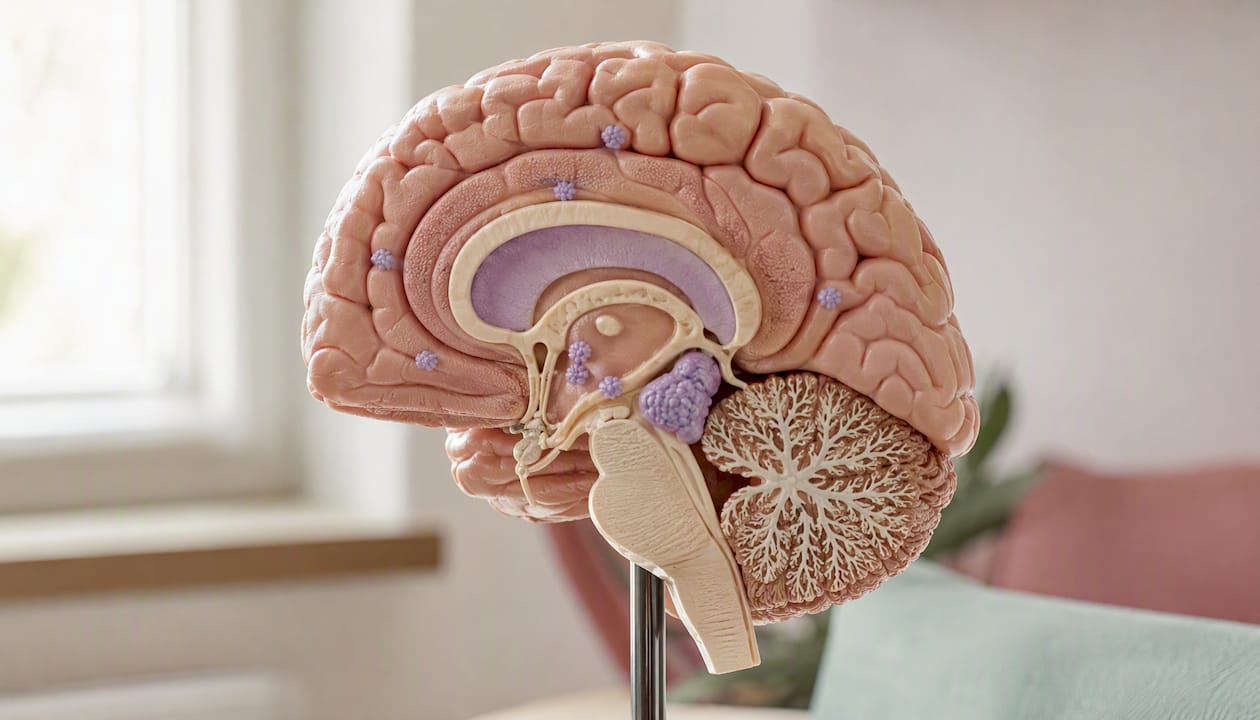
The brain responds to estrogen through three receptor types. Estrogen receptor alpha (ERα) and estrogen receptor beta (ERβ) are nuclear receptors that regulate gene expression over hours to days. The G protein-coupled estrogen receptor (GPER) sits on cell membranes and triggers faster, non-genomic signaling within minutes. All three are concentrated in the amygdala, hippocampus, and prefrontal cortex, the regions most directly involved in emotional regulation, fear processing, and executive control over mood. That anatomical overlap is why estrogen has such a direct route to emotional experience.
ERα and ERβ often have opposing effects in the same tissue, which partly explains why estrogen’s mood effects are not linear and why the same hormone can produce different outcomes depending on receptor distribution, timing, and the surrounding hormonal context.
The evidence linking estrogen changes to mood disorders
Who is affected and when
The population-level pattern is consistent: mood disorder risk in women rises at every major reproductive transition where estrogen fluctuates sharply. The premenstrual phase, the postpartum period, and perimenopause each carry elevated risk, and the mechanism in all three cases involves estrogen dynamics rather than a single absolute level.
Large fluctuations in estradiol during perimenopause are associated with several-fold increased risk for new-onset major depressive disorder compared with late premenopause. That figure comes from studies that controlled for prior depression history, meaning the hormonal transition itself carries independent risk. Women who undergo surgical menopause (bilateral oophorectomy) or experience primary ovarian insufficiency (POI) face a similar or steeper risk curve because the estrogen drop is abrupt rather than gradual.
Over half of menstruating people with a diagnosed mood disorder report premenstrual worsening of symptoms tied to cyclical estrogen and neurosteroid changes in the late luteal phase.
| Reproductive window | Mood risk signal | Evidence level |
|---|---|---|
| Premenstrual (PMDD) | More than half of menstruating people with a diagnosed mood disorder report worsening symptoms in the premenstrual phase | Large cohort; clinical series |
| Postpartum | Rapid estrogen/progesterone withdrawal linked to PPD | Clinical trials; cohort studies |
| Perimenopause | 2–5× increased MDD risk vs. late premenopause | Prospective cohort; systematic reviews |
| Surgical menopause / POI | Elevated depression prevalence; abrupt withdrawal | Clinical studies; case series |
What the evidence can and cannot tell us
The cohort-level findings are strong. The mechanistic picture is more complicated. Much of what researchers know about how estrogen affects mood at the molecular level comes from animal models, particularly studies using ovariectomized rodents. Human clinical trials of estrogen therapy for mood show heterogeneous results, partly because timing, formulation, prior mood history, and individual sensitivity all modify the outcome. A systematic review and meta-analysis of randomized controlled trials examining exogenous estrogen’s effect on depressive mood found mixed findings that depended heavily on population and timing. That heterogeneity is not a reason to dismiss the evidence; it is a reason to interpret it carefully and individually.
How estrogen affects mood biologically
Serotonin: the most studied pathway
Estradiol acts on the serotonin system at multiple points simultaneously. It increases the activity of tryptophan hydroxylase, the rate-limiting enzyme in serotonin synthesis. It reduces MAO-A activity, slowing serotonin breakdown. It also modulates serotonin transporter (SERT) expression and adjusts the sensitivity of postsynaptic serotonin receptors. The net effect is greater serotonergic availability during periods of stable, adequate estrogen. When estradiol drops sharply, that support disappears, which helps explain why SSRIs are often effective for PMDD and perimenopausal depression: they compensate for the same serotonergic deficit that estrogen withdrawal creates.
Dopamine, GABA, and glutamate
Estrogen supports dopaminergic signaling in the mesolimbic reward pathway, which governs motivation, pleasure, and emotional salience. Reduced estrogen is associated with blunted reward sensitivity, a feature of anhedonia. On the inhibitory side, estrogen interacts with GABA-A receptor subunit composition, influencing how the brain modulates anxiety and emotional reactivity. The neurosteroid allopregnanolone, a progesterone metabolite that potentiates GABA-A receptors, is tightly linked to this system and becomes clinically relevant in postpartum depression.
Neuroplasticity and BDNF
Estradiol promotes the expression of brain-derived neurotrophic factor (BDNF), a protein that supports synaptic growth, dendritic branching, and hippocampal neurogenesis. Lower BDNF is a consistent finding in major depression. Estrogen withdrawal reduces BDNF signaling in the hippocampus, which may partly explain why perimenopausal and postpartum mood episodes often involve cognitive symptoms alongside emotional ones.
HPA axis and stress buffering
Estrogen’s effect on mood is context-dependent: it acts as a biological buffer when levels are stable, but when levels fall abruptly or fluctuate substantially, stress responsivity and affective dysregulation increase in vulnerable individuals.
Estrogen interacts with stress-related brain systems and modulates the hypothalamic-pituitary-adrenal (HPA) axis, the body’s central stress-response circuit. Stable estrogen keeps cortisol reactivity in check. Withdrawal or sharp fluctuation removes that buffer, so stressors that would otherwise be manageable can trigger disproportionate emotional responses. This mechanism helps explain why some women find that small life stressors feel overwhelming during the late luteal phase or early perimenopause, even when nothing externally has changed.
Inflammation and mitochondrial effects
Estrogen has anti-inflammatory properties and supports mitochondrial function in neurons. Chronic neuroinflammation and mitochondrial dysfunction are both implicated in depression. When estrogen declines, these protective effects weaken. The HPA-axis, epigenetic, and mitochondrial pathways are well-supported in animal and molecular studies; their direct translation to human clinical outcomes is still being mapped, so caution is warranted when drawing treatment conclusions from mechanistic data alone.
Pro Tip: If you notice that your mood dips most sharply in the days before your period or during a period of major hormonal change, you may be experiencing the HPA-axis sensitization that estrogen withdrawal produces. Tracking your cycle alongside your mood for two to three months gives a clinician far more useful data than a single-visit description.
How mood risk plays out across reproductive life stages
PMDD and the premenstrual window
Premenstrual dysphoric disorder (PMDD) is not simply “bad PMS.” It is a clinically recognized condition in which the late luteal drop in estrogen and progesterone triggers severe mood symptoms, including irritability, depression, and anxiety, that resolve within days of menstruation. The underlying sensitivity appears to lie not in abnormal hormone levels but in an abnormal brain response to normal hormonal changes. SSRIs are first-line treatment and work partly because they compensate for the serotonergic deficit that estrogen withdrawal creates. For practical strategies around the menstrual cycle, holistic PMS management offers evidence-aware approaches that complement medical care.
Postpartum depression
The postpartum period involves one of the most rapid hormonal drops in human physiology. Estrogen and progesterone fall from pregnancy-peak levels to near-zero within 24–48 hours of delivery. Abrupt estrogen withdrawal after delivery is linked to depressive symptoms in both clinical populations and animal models. Postpartum depression affects roughly 10–15% of new mothers and requires clinical evaluation; it is not a character flaw or a failure to adjust. Brexanolone (the synthetic form of allopregnanolone) received FDA approval specifically for postpartum depression, targeting the GABAergic disruption that progesterone withdrawal produces. Its clinical efficacy in postpartum depression trials represents one of the clearest examples of a neurosteroid-based mechanism translating into an approved treatment.
Perimenopause: the window of vulnerability
Perimenopause, the transition period that typically spans 4–10 years before the final menstrual period, is characterized by erratic estrogen fluctuations rather than a steady decline. That irregularity is the problem. Women with no prior history of depression can develop their first major depressive episode during this window. The risk is highest in early perimenopause, when fluctuations are largest, and tends to stabilize in late postmenopause when estrogen settles at a consistently low level. Clinical practice increasingly distinguishes between this “window of vulnerability” and the later postmenopausal period, because estradiol therapy shows clearer antidepressant benefit in perimenopause than in late postmenopause.
POI and surgical menopause
Primary ovarian insufficiency (POI) and bilateral oophorectomy produce an abrupt, often unexpected estrogen withdrawal in women who may be in their 20s, 30s, or early 40s. Depression prevalence is elevated in both groups compared with age-matched controls. The abruptness of the withdrawal, combined with the psychological impact of the diagnosis, compounds the biological risk. Hormone therapy in these populations is generally considered appropriate until the average age of natural menopause, though individual assessment is always required.
The concept of affective sensitivity
Not every woman who experiences estrogen fluctuations develops a mood disorder. Affective sensitivity to ovarian steroid flux is heterogeneous: some individuals show reproducible mood sensitivity across puberty, postpartum, and perimenopause, suggesting a trait-like vulnerability rather than a situational response. Genetic differences in serotonin transporter function, estrogen receptor variants, and epigenetic priming all likely contribute. Recognizing this pattern in your own history is clinically useful: a woman who had severe PMDD is at higher risk for postpartum and perimenopausal mood episodes, and that history should inform preventive planning.
What clinical evidence shows about treatment options
When estrogen therapy may help mood
The evidence for estradiol as an antidepressant is most consistent in the perimenopausal window. Transdermal estradiol formulations appear in mechanistic and clinical studies more frequently than oral forms, partly because transdermal delivery produces more consistent central nervous system exposure by avoiding first-pass hepatic metabolism. In late postmenopause, the antidepressant signal weakens considerably, and some trials show no benefit. Timing matters more than most patients expect.
The clinical question is not simply “does estrogen help mood?” but “does estrogen help this person’s mood, at this reproductive stage, with this formulation and timing?”
A meta-analysis of RCTs on exogenous estrogen and depressive mood confirms that heterogeneity in results is real and that population selection, timing, and formulation all modify outcomes. That is not a reason to avoid the conversation with a clinician; it is a reason to have a more specific one.
SSRIs and estrogen interactions
SSRIs remain first-line for PMDD and are effective for perimenopausal depression independent of hormone therapy. Some evidence suggests that estrogen may accelerate SSRI response in perimenopausal women, possibly because estrogen primes serotonin receptor sensitivity. In clinical practice, SSRIs and estrogen therapy are sometimes used together, particularly when mood symptoms persist despite hormonal stabilization alone.
Brexanolone and neurosteroid treatments
Brexanolone (Zulresso) is the first FDA-approved treatment specifically for postpartum depression. It works by restoring allopregnanolone levels, directly addressing the GABAergic disruption caused by postpartum progesterone withdrawal. Its approval represents a shift toward mechanism-targeted treatment for hormone-related mood disorders, and it signals that the neurosteroid pathway is a legitimate therapeutic target, not just a theoretical one.
Safety, risks, and formulation differences
Hormone therapy carries real risks that vary by age, cardiovascular history, breast cancer risk, and duration of use. These are not reasons to avoid the conversation but reasons to have it with a clinician who knows your full history. Oral estrogen increases clotting risk more than transdermal formulations; progestogen type matters for breast cancer risk; and timing relative to menopause onset affects cardiovascular outcomes. General information cannot substitute for individualized assessment.
Questions to bring to your clinician:
- Am I in a hormonal window where estrogen therapy is most likely to help my mood?
- Would transdermal estradiol be more appropriate than oral for my situation?
- Should we try an SSRI first, or in combination with hormone therapy?
- What are my personal risk factors for hormone therapy, and how do they weigh against the mood benefits?
- How long would we expect to see a response, and what would we use to measure it?
- Are there nonmedical strategies I should be doing alongside any treatment?
Practical nonmedical strategies during hormonal flux
Supporting the internal environment reduces the chance that hormonal fluctuations will tip into a clinical mood episode. This is not a substitute for medical care when symptoms are severe, but it is a meaningful layer of protection for anyone with hormonal mood sensitivity.
Sleep regularity is the highest-leverage nonmedical intervention. Disrupted sleep amplifies HPA-axis reactivity and reduces serotonin precursor availability. Keeping wake times consistent, even on weekends, stabilizes circadian rhythms that estrogen fluctuation tends to destabilize.
Stress management through cognitive behavioral therapy (CBT) or mindfulness-based stress reduction (MBSR) has documented effects on HPA-axis reactivity. Both approaches have been tested adjunctively in PMDD and perimenopausal depression with positive results. They work partly by reducing the cortisol amplification that estrogen withdrawal enables.
Exercise increases BDNF, supports dopaminergic reward signaling, and has anti-inflammatory effects that parallel some of estrogen’s protective mechanisms. Moderate aerobic activity three to five times per week is the most studied dose.
Dietary patterns that support serotonin production include adequate tryptophan (found in turkey, eggs, legumes, and seeds) and omega-3 fatty acids, which reduce neuroinflammation. Avoiding large blood sugar swings, which amplify mood instability, is especially relevant in the premenstrual phase.
Gut-brain support through probiotics is an area of growing research interest. The gut produces a significant proportion of the body’s serotonin, and gut microbiome composition influences serotonergic signaling. Evidence for specific probiotic strains in mood is still developing, but the mechanistic rationale is sound. Florvahealth’s probiotic formulations are designed with this gut-hormone connection in mind, supporting the internal environment that hormonal health depends on.

For a practical framework around cyclical living and tracking, practicing cyclical living for hormonal health offers a structured approach to planning around your hormonal windows. And for broader lifestyle habits that support hormonal balance, simple hormonal health habits covers the fundamentals without overcomplicating them.
A practical self-care checklist for hormonally sensitive windows:
- Track your cycle and mood together for at least two months before a clinical appointment
- Prioritize a consistent sleep schedule, especially in the week before menstruation
- Eat regular meals to avoid blood sugar dips that amplify mood instability
- Schedule high-stress activities away from the late luteal phase when possible
- Use a stress-reduction practice (CBT, mindfulness, or structured breathing) daily during vulnerable windows
- Limit alcohol, which disrupts GABA balance and worsens hormonal mood sensitivity
When to seek medical evaluation: persistent low mood lasting more than two weeks, inability to function at work or in relationships, thoughts of self-harm, or mood symptoms that do not track with your cycle and may have another cause all warrant prompt clinical attention. Nonmedical strategies support but do not replace medical care for clinical-level symptoms.
What the evidence actually means when you are the one affected
The science of estrogen and mood has a gap that does not show up in the data tables: the distance between a population-level risk ratio and the experience of a specific person trying to understand why they feel the way they do.
Clinicians who work in this area increasingly think in terms of two distinct questions. The first is whether a patient is in a window of vulnerability, a period when hormonal flux is likely to trigger symptoms. The second is whether they are in a window of opportunity, a period when hormone therapy is most likely to produce benefit. Those windows do not always overlap, and they are not the same for everyone. A woman in early perimenopause with a history of PMDD is in a very different clinical position than a woman ten years postmenopause with new-onset depression, even though both involve estrogen.
Shared decision-making in this space means bringing your full hormonal history to the table: prior PMDD, postpartum mood episodes, how your mood tracks with your cycle, and how you responded to hormonal contraceptives. That history is often more predictive than a single hormone level drawn on a random day. Estrogen levels fluctuate enormously within a single cycle, and a snapshot measurement rarely captures the dynamic that actually drives symptoms.
The limits of current evidence are real. Many mechanistic findings come from animal models. Human trials are heterogeneous. But “the evidence is mixed” does not mean “nothing works.” It means that individualized assessment, with a clinician who takes hormonal mood sensitivity seriously, is the most reliable path to an answer that actually fits your situation.
Support your hormonal health from the inside out
Florvahealth builds its products around the same gut-hormone-mood link that the research above describes. Its women’s probiotic capsules support gut health, part of the gut-brain axis. For women navigating PMS, perimenopause or any hormonally sensitive window, the internal environment is where non-medical support starts. Explore the full Florvahealth range to find the right fit for your cycle.
Sources
The following peer-reviewed sources form the primary evidence base for this article. Each is linked directly to the original publication.
- Sex hormone fluctuation and increased female risk for depression and anxiety disorders: from clinical evidence to molecular mechanisms - PMC
- Estrogen, stress, and depression: cognitive and biological interactions | Annual Reviews
This article provides general scientific and educational information only. It is not a substitute for professional medical advice, diagnosis, or treatment. Consult a qualified healthcare provider for guidance specific to your situation, and verify current clinical guidelines with primary sources.


