

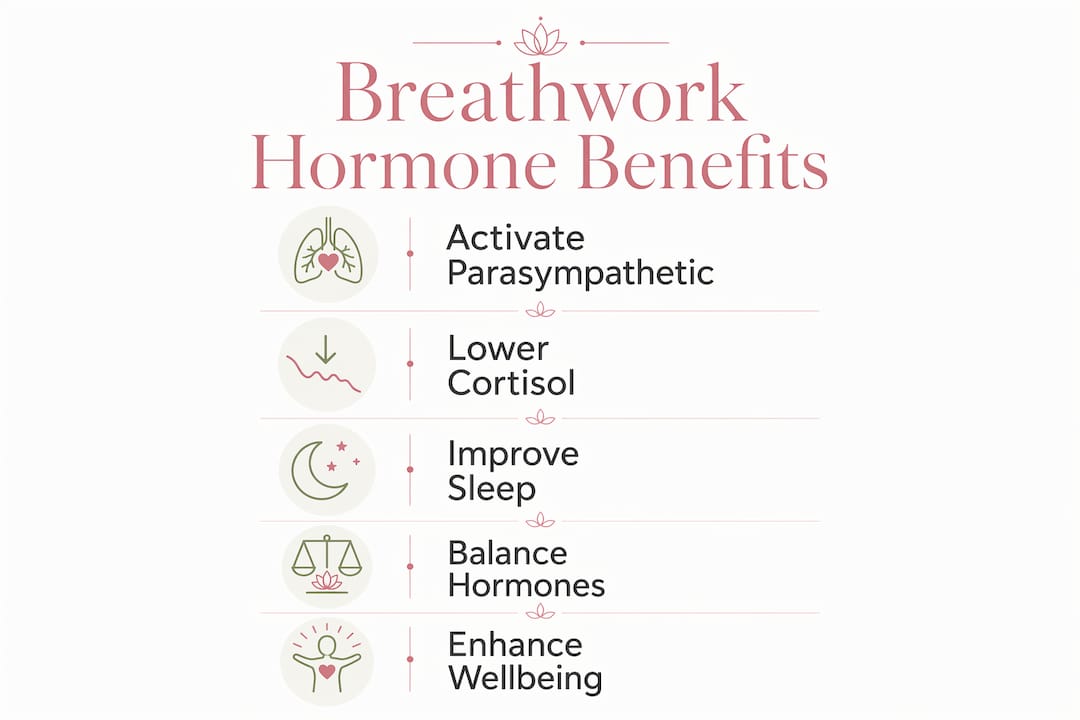
Breathwork directly supports hormone health by activating the parasympathetic nervous system, which lowers cortisol and creates the conditions your endocrine system needs to function well. This isn’t a wellness trend built on anecdote. Clinical research shows that controlled breathing techniques modulate the hypothalamic-pituitary-adrenal (HPA) axis, the body’s central stress-hormone command center, and stimulate the vagus nerve to shift you out of fight-or-flight within minutes. For women navigating PMS, perimenopause, or chronic stress, that shift has real hormonal consequences.
Here’s what breathwork does for your hormones:
- Lowers cortisol rapidly, reducing the stress-hormone load that disrupts estrogen, progesterone, and thyroid function
- Stimulates the vagus nerve, triggering parasympathetic dominance and calming the HPA axis
- Increases prolactin, a hormone with immune-supportive properties, as shown in CCB clinical research
- Supports insulin, melatonin, and metabolic hormone regulation by reducing chronic stress interference
- Eases PMS symptoms, menstrual migraines, hot flashes, and mood swings
- Recognized techniques include the Buteyko Method, Conscious Connected Breathing (CCB), and SOMA Breath
How breathwork actually changes your hormones: the science
The HPA axis is the relay system between your brain and your adrenal glands. When you’re stressed, the hypothalamus signals the pituitary, which tells the adrenals to release cortisol. That’s useful in short bursts. Chronically elevated cortisol, though, suppresses progesterone, disrupts thyroid signaling, and throws off blood sugar regulation. Breathwork interrupts that cascade at the source.
The mechanism runs through the vagus nerve. Slow, controlled breathing stimulates vagal tone, shifting autonomic balance from sympathetic to parasympathetic dominance. That shift tells the adrenals to stand down. Cortisol drops. The body stops treating digestion, reproduction, and immune function as optional.
A landmark study on Conscious Connected Breathing (CCB) in breast cancer patients found that a single session produced significant cortisol reduction (p < 0.001) alongside a significant increase in prolactin (p < 0.001). Blood gas analysis confirmed mild respiratory alkalosis, a measurable sign that the body had entered a parasympathetic state. These aren’t subtle changes. They’re detectable in the blood within 30 minutes of practice.
Yoga-based breathwork also shows broader endocrine influence, with studies reporting changes in estrogen and testosterone levels after sustained practice. The picture that emerges is consistent: breathing pattern is not just a respiratory variable. It’s a lever on your entire hormonal system.
| Marker | Direction during breathwork | Significance |
|---|---|---|
| Cortisol | Decreases | p < 0.001 (CCB study) |
| Prolactin | Increases | p < 0.001 (CCB study) |
| Blood pH | Increases (mild alkalosis) | p < 0.001 |
| pCO2 | Decreases | p < 0.001 |
| Heart rate variability | Improves | Reflects parasympathetic shift |
Clinical finding: In a controlled study of breast cancer patients, a single CCB session produced measurable decreases in cortisol and increases in prolactin, both statistically significant at p < 0.001, alongside blood gas changes confirming a shift into parasympathetic dominance.
How breathwork benefits women at every hormonal life stage
Hormonal needs change dramatically from your twenties through menopause, but the underlying problem often stays the same: too much cortisol crowding out the hormones that regulate your cycle, mood, sleep, and metabolism. Breathwork addresses that root cause regardless of where you are in your hormonal life.
- Menstrual cycle and PMS: Elevated cortisol suppresses progesterone, worsening PMS symptoms like bloating, cramps, and mood swings. Regular breathwork keeps cortisol lower across the luteal phase, giving progesterone more room to do its job. Women who practice slow breathing techniques also report fewer menstrual migraines, likely because of reduced vascular tension and improved autonomic balance.
- Perimenopause: As estrogen begins to fluctuate, the nervous system becomes more reactive. Breathwork’s autonomic modulation helps buffer those swings, reducing anxiety and emotional volatility without medication.
- Menopause: Hot flashes are partly driven by dysregulated autonomic responses. Slow breathing activates the parasympathetic system, which can reduce the frequency and intensity of hot flashes. Sleep quality also improves, which matters because melatonin and growth hormone are both released during deep sleep.
- Thyroid and metabolic health: Chronic stress suppresses thyroid-stimulating hormone and disrupts insulin sensitivity. By keeping the stress response in check, breathwork supports thyroid and metabolic hormone regulation over time.
- Across all stages: Better sleep, lower baseline cortisol, and improved heart rate variability compound over weeks of consistent practice. These aren’t dramatic overnight shifts, but they’re the kind of steady recalibration that prevents hormonal imbalances from taking hold.
Practical breathwork exercises for hormone balance
Three methods have the strongest evidence base for hormonal support, and each works through a slightly different mechanism.
The Buteyko Method
Developed by Ukrainian physician Konstantin Buteyko, this technique focuses on nasal breathing and reducing breathing volume to normalize carbon dioxide levels. Shallow overbreathing keeps the nervous system in a low-grade alert state. Buteyko corrects that by training slower, lighter nasal breaths, which steadies the autonomic system and reduces the cortisol load that worsens menstrual symptoms. Practice for 10–15 minutes daily, ideally in the morning.
Conscious Connected Breathing (CCB)
CCB uses rhythmic circular nasal breathing at a depth slightly above resting tidal volume, with no breath-holding, performed in a state of relaxed awareness. The CCB study cited above used 45-minute sessions, but shorter 15–20 minute sessions still produce measurable parasympathetic shifts. This is the technique with the most direct clinical evidence for cortisol reduction and prolactin increase. It works best in a quiet setting, lying down, with eyes closed.

SOMA Breath
SOMA Breath combines rhythmic breathing with breath retention and music to create a meditative state that targets stress resilience. The breath-hold phases are designed to stimulate nitric oxide production and deepen the parasympathetic response. Sessions typically run 20–30 minutes and are available as guided audio programs.
Exercises to start with:
- 4-7-8 breathing: Inhale for 4 counts, hold for 7, exhale for 8. Activates the parasympathetic system quickly. Use before bed or during a stressful moment.
- Box breathing: 4 counts in, 4 hold, 4 out, 4 hold. Balances the autonomic system and improves heart rate variability with consistent practice.
- Diaphragmatic breathing: Place one hand on your belly. Breathe so that hand rises first, before your chest. Five minutes of this before meals primes digestion and reduces stress hormone interference with nutrient absorption.
- Nasal-only breathing: Switch all resting and light-exercise breathing to nasal. This alone improves CO2 tolerance and lowers baseline sympathetic tone over weeks.
Pro Tip: Diaphragmatic breathing is the foundation. If your chest rises before your belly, you’re breathing in a pattern that elevates cortisol rather than lowering it. Fix the mechanics first, then layer in the techniques above.
For hormonal benefit, consistency beats intensity. Ten minutes of slow nasal breathing daily outperforms a single 60-minute session once a week. Pair breathwork with daily hormonal rituals for compounding results.

Safety, precautions, and common questions about breathwork
Breathwork is safe for most women, but a few situations call for caution or medical clearance first.
Who should check with a doctor before starting:
- Women who are pregnant (breath retention techniques are not appropriate during pregnancy)
- Anyone with cardiovascular conditions, epilepsy, or a history of fainting
- Women with severe anxiety disorders, as intense techniques can temporarily amplify symptoms
- Anyone currently managing a serious respiratory condition like asthma or COPD
Technique-specific cautions:
- Fast-paced breathwork, such as Kapalabhati or hyperventilation-style techniques, can temporarily spike cortisol rather than lower it. If your goal is hormonal balance, stick to slow, calming techniques. The research is clear on this distinction.
- Extended breath retention without proper training can cause lightheadedness or loss of consciousness. Never practice breath holds in water or while driving.
- If you feel tingling, numbness, or significant dizziness during practice, slow down and return to normal breathing. These are signs of temporary CO2 imbalance, not danger, but they’re a signal to ease off.
Common questions:
Does breathwork spike cortisol? Slow breathwork lowers cortisol. Fast, forceful techniques can cause a short-term spike. The type of breathing matters more than the act of breathing itself.
Is breathwork safe during menopause? Yes, and it’s particularly well-suited to this stage. Slow breathing techniques help regulate the autonomic responses behind hot flashes and sleep disruption.
How often should I practice? Daily practice, even 10 minutes, produces more consistent hormonal benefit than occasional longer sessions. Morning or pre-sleep timing works best for most women.
Can breathwork replace hormone therapy? No. Breathwork is a complementary tool, not a replacement for medical treatment. It works best alongside other lifestyle and, where appropriate, clinical interventions.
Breathwork as part of a broader hormonal wellness approach
Breathwork works best when it’s one piece of a larger picture. Sleep, nutrition, movement, and stress management all feed into the same hormonal systems, and breathwork connects them by regulating the nervous system that governs all of them.
Diaphragmatic breathing before meals, for example, primes the digestive system by reducing sympathetic tone, which directly supports hormone metabolism. Poor digestion impairs the clearance of used estrogen through the gut, a factor that contributes to estrogen dominance. Breathwork before eating isn’t just calming. It’s genuinely functional.
“Breathwork exerts a regulatory influence over the nervous, endocrine, and immune systems. The observed shift toward respiratory alkalosis, combined with increased prolactin and decreased cortisol, suggests that CCB may facilitate favorable neuroendocrine-immune interactions.” — Cancers, 2025
Sleep is another leverage point. Breathwork before bed, particularly 4-7-8 or slow CCB-style breathing, improves sleep onset and depth. Deep sleep is when the body releases growth hormone and consolidates melatonin production. Both are essential for hormonal repair. Women who address sleep quality as part of their hormone strategy tend to see faster results from other interventions too.
For women managing chronic stress, breathwork is one of the most accessible entry points because it requires no equipment, no appointment, and no cost. It also pairs naturally with other evidence-based approaches like adequate hydration, which affects hormone transport and cellular signaling.
Pro Tip: Build a two-minute nasal breathing reset into your existing daily anchors: right after waking, before your first meal, and before sleep. You don’t need a formal session. Consistency at those three points alone can shift your baseline cortisol pattern over four to six weeks.
Florvahealth’s approach to hormonal wellness recognizes that no single intervention works in isolation. Breathwork addresses the nervous system layer. Nutrition and gut health address the metabolic layer. Together, they create the conditions where your hormones can actually balance. The Florva PMS & Bloating Relief Kit is designed to complement exactly this kind of layered approach, targeting cycle-related symptoms from the inside while breathwork works on the stress-hormone side of the equation.

Key Takeaways
Breathwork supports hormone health by activating the parasympathetic nervous system, lowering cortisol, and creating the neuroendocrine conditions that allow reproductive, thyroid, and metabolic hormones to function properly.
| Point | Details |
|---|---|
| Cortisol drops measurably | CCB sessions produce significant cortisol reduction (p < 0.001) within 30 minutes of practice. |
| Vagus nerve is the mechanism | Slow breathing stimulates vagal tone, shifting the body from sympathetic to parasympathetic dominance. |
| Technique type matters | Slow breathwork lowers cortisol; fast-paced techniques can temporarily spike it instead. |
| Benefits span all life stages | Breathwork eases PMS, perimenopause anxiety, hot flashes, and supports sleep-dependent hormone production. |
| Daily consistency beats intensity | Ten minutes of daily practice produces more sustained hormonal benefit than occasional long sessions. |


