

The thyroid is defined as a butterfly-shaped gland in your neck that produces hormones controlling your metabolism, energy, mood, and reproductive health. Thyroid and hormone balance explained simply means understanding how two key hormones, T3 (triiodothyronine) and T4 (thyroxine), work together with your body’s feedback systems to keep everything running in sync. When this system is off, the effects reach far beyond fatigue. They touch your menstrual cycle, your skin, your weight, and your emotional wellbeing. For women aged 20–40, getting a clear picture of how thyroid function connects to overall hormone health is one of the most practical things you can do for your long-term wellness.
Thyroid and hormone balance explained: how T3 and T4 work
The thyroid produces approximately 80% T4 and 20% T3, but T3 is the biologically active hormone your cells actually use. T3 is 3–5 times more potent than T4. That difference matters because most of what your thyroid releases is T4, which acts as a storage form that your body converts into T3 in peripheral tissues like the liver and kidneys.
This conversion process depends on enzymes called deiodinases. These enzymes strip one iodine atom from T4 to produce T3. Without adequate iodine and selenium, this conversion breaks down, and your cells can end up starved of active hormone even when your T4 levels look normal on a blood test. That is a critical detail most standard thyroid panels miss.

| Hormone | Production share | Relative potency | Primary role |
|---|---|---|---|
| T4 (thyroxine) | ~80% | Baseline | Storage and transport form |
| T3 (triiodothyronine) | ~20% | 3–5x higher | Active metabolic regulation |
Pro Tip: If your thyroid labs show normal T4 but you still feel sluggish, ask your doctor to test free T3 and reverse T3 separately. Conversion issues at the tissue level will not show up on a standard TSH test alone.
The thyroid gland regulates metabolism, heart rate, body temperature, and mood. Think of it as your body’s internal thermostat. When it is calibrated correctly, your energy, digestion, and mental clarity all benefit.
How does the HPT axis regulate thyroid hormones?
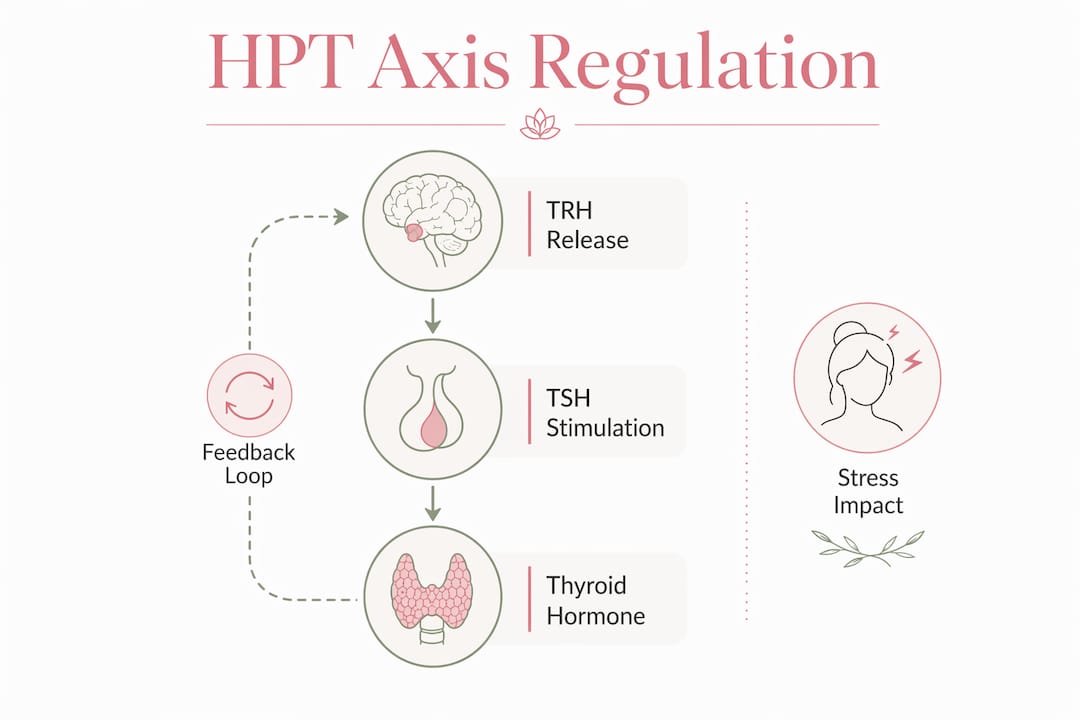
The hypothalamic-pituitary-thyroid (HPT) axis is the command-and-control system behind thyroid hormone regulation. It works through a three-step chain of signals.
The HPT axis operates like this:
- The hypothalamus detects low thyroid hormone levels and releases thyrotropin-releasing hormone (TRH).
- TRH signals the pituitary gland to release thyroid-stimulating hormone (TSH).
- TSH tells the thyroid gland to produce and release more T4 and T3.
- Rising T3 and T4 levels then signal back to the hypothalamus and pituitary to reduce TRH and TSH output. This is the negative feedback loop.
This feedback loop is what keeps your hormone levels stable under normal conditions. The system is elegant, but it is also sensitive. Chronic stress, poor sleep, and nutritional deficiencies can all interfere with the signals at any point in the chain.
Stress is a particularly disruptive factor. Elevated cortisol suppresses thyroid function, disrupts sex hormones, and impairs insulin sensitivity. That means a stressful period at work or a stretch of poor sleep can produce thyroid-like symptoms even when your gland itself is functioning normally. This is why a single TSH reading taken on one day tells an incomplete story.
How do thyroid hormones affect your menstrual cycle?
Thyroid dysfunction directly affects reproductive hormone levels. Hypothyroidism is linked to menstrual irregularities and hyperprolactinemia, a condition where elevated prolactin suppresses estrogen and progesterone production. The result can be irregular periods, heavy bleeding, or cycles that disappear altogether.
The connection runs in both directions. Estrogen affects how thyroid hormones bind to proteins in the blood, which changes how much free hormone is actually available to your cells. Women on oral contraceptives or going through hormonal shifts in their late 20s and 30s may notice thyroid-related symptoms emerge or worsen during these periods.
Common reproductive effects of thyroid imbalance include:
- Irregular or missed periods caused by disrupted LH and FSH signaling
- Heavy or prolonged bleeding associated with hypothyroidism
- Reduced fertility linked to anovulatory cycles
- PMS amplification when low thyroid function worsens progesterone deficiency
- PCOS overlap, since both conditions share insulin resistance and inflammation as underlying drivers
Pro Tip: Track your cycle length, flow, and mood symptoms in a simple app or notebook for at least three months before your next hormone panel. Patterns over time give your doctor far more useful information than a single blood draw.
Understanding why hormonal symptoms vary monthly helps you separate normal fluctuation from signs that warrant a clinical conversation.
What are the symptoms of thyroid hormone imbalance?
Thyroid hormone imbalance produces two distinct symptom profiles depending on whether the thyroid is underactive or overactive. Knowing the difference helps you describe your experience accurately to a healthcare provider.
Hypothyroidism symptoms (underactive thyroid):
- Persistent fatigue that does not improve with sleep
- Unexplained weight gain or difficulty losing weight
- Cold intolerance and low body temperature
- Brain fog, poor concentration, and depression
- Dry skin, hair thinning, and brittle nails
- Slow heart rate and constipation
Hyperthyroidism symptoms (overactive thyroid):
- Rapid or irregular heartbeat
- Unexplained weight loss despite normal or increased appetite
- Heat intolerance and excessive sweating
- Anxiety, irritability, and sleep disruption
- Frequent bowel movements
- Tremors in the hands
The critical insight here is that symptoms provide more reliable clinical clues than isolated blood tests. Two women with identical TSH values can feel completely different. One may feel fine; the other may struggle with fatigue and mood changes daily. This is not a flaw in the system. It reflects the fact that hormones fluctuate naturally throughout the menstrual cycle and across the day, so a single snapshot rarely captures the full picture.
Stress, cortisol load, and lifestyle factors amplify thyroid symptoms even when lab values appear within range. Women who sleep fewer than six hours regularly, carry high chronic stress, or eat a diet low in micronutrients often report thyroid-like symptoms that respond better to lifestyle changes than to medication.
What lifestyle changes support thyroid and hormone health?
Lifestyle is the foundation of thyroid and hormone health, not a supplement to medical treatment. The most effective approach combines nutrition, sleep, stress management, and movement into consistent daily habits.
Nutrition priorities:
- Iodine from sources like seaweed, dairy, and iodized salt supports T4 production directly.
- Selenium from Brazil nuts and fish supports the enzymatic conversion of T4 to active T3.
- Iron deficiency impairs thyroid peroxidase, the enzyme that synthesizes thyroid hormones.
- Zinc supports TSH receptor sensitivity and overall thyroid signaling.
Sleep and stress management:
Chronic sleep deprivation elevates cortisol, which suppresses the HPT axis and reduces T3 output. Prioritizing 7–9 hours of sleep per night is one of the most direct ways to protect thyroid function. Stress reduction practices like breathwork, yoga, and consistent downtime lower cortisol and allow the feedback loop to function properly.
Movement:
Moderate, consistent exercise supports thyroid hormone sensitivity in cells. High-intensity training done without adequate recovery can spike cortisol and temporarily suppress thyroid output. Balance matters more than intensity.
Tracking symptoms alongside lifestyle changes gives you a feedback loop of your own. The benefits of hormone balancing supplements become clearer when you already have a baseline of how your body responds to sleep, food, and stress. Supplements fill gaps; they do not replace the foundation.
Key Takeaways
Thyroid hormone balance requires understanding T3 and T4 production, the HPT axis feedback loop, and the direct connection between thyroid function and reproductive hormones in women.
| Point | Details |
|---|---|
| T3 is the active hormone | Your body converts T4 to T3 in peripheral tissues; normal T4 does not guarantee adequate T3. |
| HPT axis controls output | Stress and cortisol can disrupt the feedback loop even when the thyroid gland itself is healthy. |
| Thyroid affects your cycle | Hypothyroidism links directly to irregular periods, heavy bleeding, and altered estrogen and progesterone levels. |
| Symptoms outweigh single tests | Two women with identical lab values can experience completely different symptoms; track patterns over time. |
| Nutrition drives conversion | Selenium, iodine, and iron are non-negotiable for thyroid hormone production and T4-to-T3 conversion. |
What I’ve learned from watching women chase “perfect” hormone numbers
The most common mistake I see is treating a TSH result like a final verdict. Women come away from a single blood test either relieved or alarmed, when the reality is that one number taken on one morning tells you almost nothing about how your hormones are actually functioning across a full cycle.
The search for a perfect hormone level is genuinely flawed. Hormones are not static. They shift by the hour, by the day, and across your entire menstrual cycle. Chasing a single “balanced” number is like checking the weather once and deciding what to wear for the whole month.
What actually moves the needle is consistent symptom tracking combined with honest conversations with a clinician who listens. I have seen women spend years cycling through tests and supplements without improvement, then make significant progress simply by documenting their energy, mood, and cycle patterns for 90 days and bringing that record to their appointments.
The other thing worth saying plainly: lifestyle is not a soft recommendation. Sleep, food quality, and stress load are biochemical inputs. They directly change how your HPT axis functions and how efficiently your body converts T4 to T3. Treating them as optional extras while focusing only on supplements or medication is working against your own biology.
The skin and hormones connection is another area where women often notice thyroid-related changes before they show up in labs. Dry skin, hormonal acne, and dull complexion can all be early signals worth paying attention to.
— Zamanee
Florvahealth’s approach to hormone and PMS support
Thyroid health and hormone balance do not exist in isolation. They show up in your skin, your cycle, your energy, and your mood every single month.

Florvahealth builds its products around this reality. Its women’s probiotics and digestive enzymes support gut health, which ties into how the body handles hormones, and they are meant to sit alongside the lifestyle strategies covered here. They are not a thyroid treatment. If you are ready to build a consistent daily routine, the Florvahealth range is a practical place to start.
FAQ
What is the difference between T3 and T4?
T4 is the storage form of thyroid hormone, while T3 is the active form that regulates metabolism and energy. The body converts T4 into T3 in peripheral tissues using selenium-dependent enzymes.
Can thyroid problems cause irregular periods?
Yes. Hypothyroidism is directly linked to menstrual irregularities, including oligomenorrhea and heavy bleeding, by disrupting estrogen and progesterone levels through hyperprolactinemia.
Why do my thyroid symptoms persist if my labs are normal?
Normal lab values reflect a single point in time and do not capture daily or monthly hormone fluctuations. Symptoms combined with pattern tracking over time give a more complete clinical picture than one TSH result.
What nutrients does the thyroid need to function properly?
The thyroid requires iodine for hormone synthesis, selenium for T4-to-T3 conversion, and iron for the enzyme thyroid peroxidase. Deficiency in any of these can impair hormone production and conversion even when the gland itself is structurally healthy.
How does stress affect thyroid hormone balance?
Chronic stress elevates cortisol, which suppresses the HPT axis and reduces T3 output. This can produce fatigue, weight changes, and mood disruption that mirror thyroid dysfunction even when thyroid lab values appear within the normal range.
Recommended
- Benefits of Hormone Balancing Supplements for Women
- Simple Skin Care and Hormones: Your Practical Guide
- Florva Health: probiotics, intimate care and skincare
- Why Hormonal Symptoms Vary Monthly: What’s Really Going On
Sources
- Thyroid Disease: Causes, Symptoms & Treatment — Cleveland Clinic
- Thyroid Function Tests — American Thyroid Association
- Thyroid Diseases — MedlinePlus, National Library of Medicine


