

Store natural health supplements properly by keeping them in their original, labeled containers with lids tightly closed, in a cool, dry, dark location away from bathrooms and heat sources. Follow the manufacturer’s label instructions for refrigeration. Refrigerate only when required (probiotics, opened fish oil). Discard anything that smells off, shows mold, or has changed color, and dispose of it safely using FDA-approved disposal methods.
Four actions to take right now:
- Keep the original container, lid sealed tight. The packaging is designed to protect the contents from light, moisture, and oxygen.
- Pick a cool, dry, dark cabinet away from the bathroom, stove, oven, and any window.
- Refrigerate only when the label says to. Probiotics and opened fish oil almost always need it; most tablets and capsules do not.
- Check before you take. A quick smell and visual check catches spoilage before it becomes a problem.
Table of Contents
- Why does proper storage preserve potency and safety?
- General rules that apply to every supplement you own
- How should you store each supplement form?
- How to recognize spoiled supplements and dispose of them safely
- How to carry supplements when traveling
- Key Takeaways
- The storage rule most people underestimate
- Florvahealth supports your hormonal wellness routine
- Authoritative sources and further reading
Why does proper storage preserve potency and safety?
Heat, light, moisture, and oxygen each attack supplements through different chemical pathways. Heat speeds up molecular breakdown. Light triggers photodegradation, which is especially damaging to fat-soluble vitamins like A, D, E, and K. Moisture catalyzes hydrolysis and supports microbial growth inside a bottle. Oxygen drives oxidation, turning fish oil rancid and degrading probiotics.
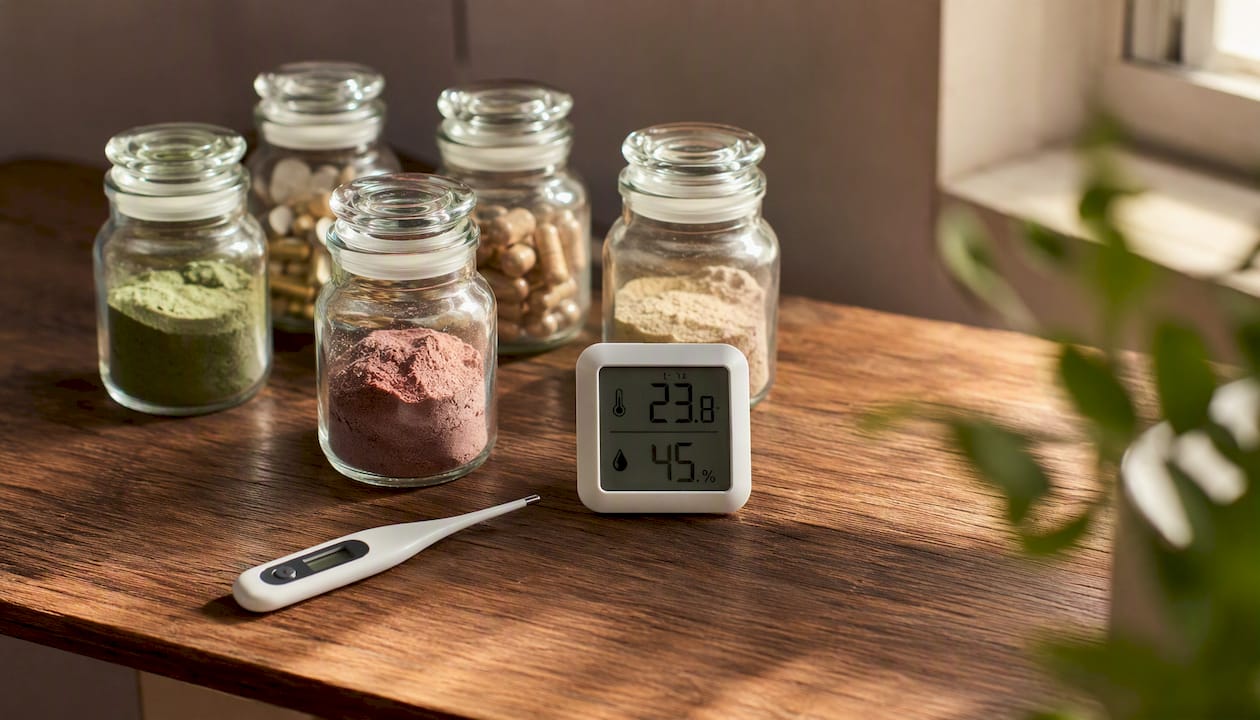
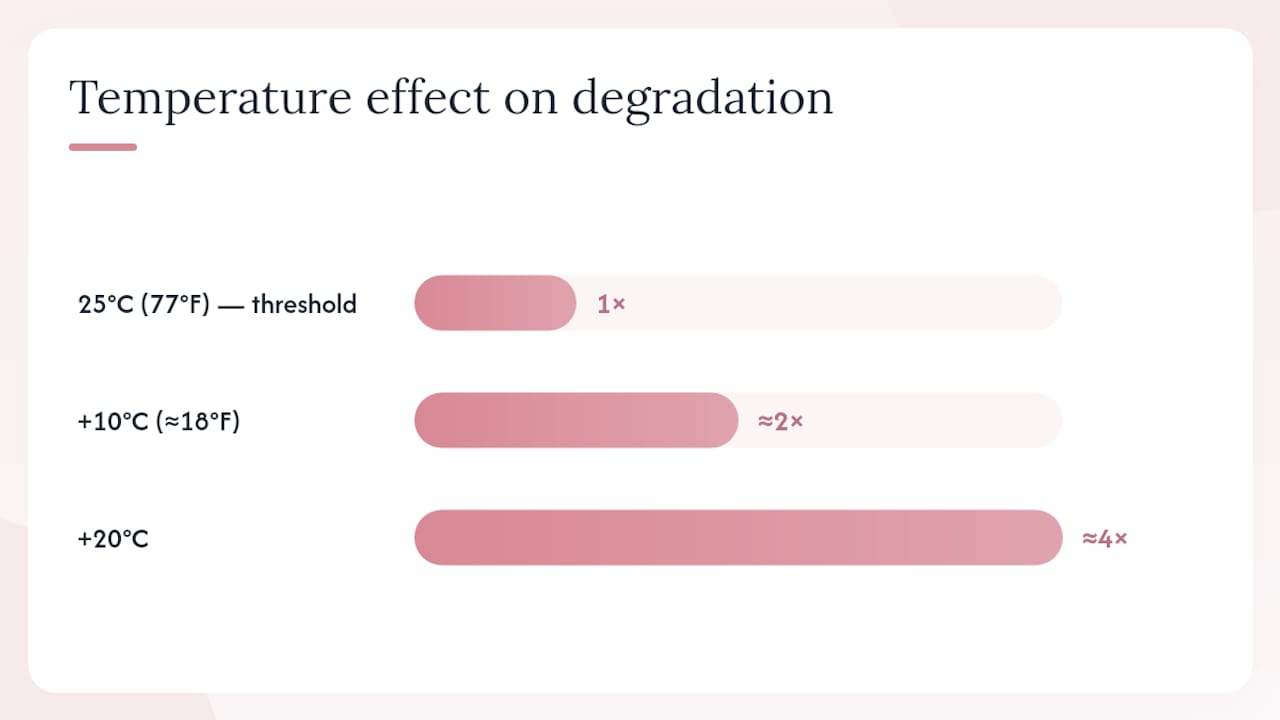
The temperature effect is the most quantifiable. According to USDA Forest Service research on chemical degradation, every 10°C (18°F) increase in temperature roughly doubles the rate of chemical breakdown for many active ingredients. That is why storing supplements above 77°F (25°C) is consistently flagged as a threshold to avoid.
Two categories carry the highest safety risk, not just potency loss. Oxidized fish oil can produce harmful lipid peroxides. Probiotics lose viable colony counts when exposed to warmth, which means you may be swallowing a capsule with a fraction of the labeled CFU count. Medical News Today notes that minerals and fat-soluble vitamins are comparatively stable past expiration, while probiotics and omega-3s degrade fastest.
General rules that apply to every supplement you own
The single most reliable rule: follow the label. Manufacturers know their formulation’s stability, and they will state refrigeration or post-opening handling when the product needs it. Healthline’s guidance on supplement storage reinforces keeping supplements in their original containers in a cool, dry, dark place as the baseline practice.
A few universal rules worth building into your routine:
- Leave desiccant packets inside. Those small silica gel packets are there to absorb moisture. Natural Factors recommends never removing them, as they actively protect powders and capsules from clumping.
Pro Tip: If you use a weekly pill organizer, fill it with only a 7-day supply from the original bottle and store the rest sealed. Pill organizers expose contents to light and ambient humidity, so refreshing them weekly limits degradation. For women managing hormonal health routines, this matters most for probiotics and B-vitamin complexes, which are among the more moisture-sensitive forms.
How should you store each supplement form?
Most tablets and capsules are fine in a cool, dark cabinet. But some forms need more specific handling, and getting it wrong can mean you are paying for a product that no longer works.
| Form | Ideal Temp | Refrigerate? | Key Risk | What to Check |
|---|---|---|---|---|
| Tablets / capsules | 65–77°F (18–25°C) | No | Heat and moisture breakdown | Crumbling, unusual odor, color change |
| Powders | 65–77°F (18–25°C) | No | Clumping, moisture absorption | Clumps, off smell, discoloration |
| Softgels / gels | 65–77°F (18–25°C) | No | Heat melting, light oxidation | Sticky texture, leaking, rancid smell |
| Oil-based (fish oil, vitamin E) | 65–77°F; fridge after opening | Yes, after opening | Oxidative rancidity | Fishy or paint-like odor |
| Probiotics | Refrigerate unless shelf-stable | Usually yes | Viability loss from heat | Check label; no visible signs |
| Liquids / shakes | Refrigerate after opening | Yes, after opening | Microbial growth | Separation, off smell, color change |
A few high-risk items deserve extra attention:
- Probiotics. Refrigerate unless the label explicitly says “shelf-stable.” Even shelf-stable strains lose viability faster at higher temperatures, per SupplementScience.ai’s potency guide. When in doubt, refrigerate.
Muscle & Fitness’s form-specific storage guide also recommends keeping powder containers sealed with their original resealable pouches or lids and using a dry scoop every time to avoid introducing moisture.
How to recognize spoiled supplements and dispose of them safely
Do not take a supplement that smells off, has visible mold, has changed color significantly, or has clumped into a solid mass. Some expired products may still be safe but are simply weaker. For probiotics and fish oil, replace at or before the expiration date because potency loss in those categories is real and fast.
Signs to look for before each use:
- Unusual or sharp odor (especially rancid or paint-like for fish oil)
- Visible moisture, mold, or discoloration
- Tablets or capsules that have crumbled, stuck together, or changed texture
- Powder that has hardened into a solid block
Safe disposal steps:
- Check for a local pharmacy or community take-back program first. The FDA recommends take-back programs as the preferred disposal route for unused medicines and supplements.
- If no take-back is available, mix the supplement with an unappealing substance such as used coffee grounds or cat litter.
- Seal the mixture in a bag or container.
- Place it in your household trash, not the recycling bin.
- Do not pour liquid supplements down the drain. Environmental contamination from supplement compounds in waterways is a real concern.
- Keep the lot number and expiration date if you are returning a product to a retailer or manufacturer.
Never donate opened or visibly degraded supplements. The recipient has no way to verify the product’s integrity.
How to carry supplements when traveling
For any trip, take only what you need and keep supplements in your carry-on, not checked luggage or the trunk of a car. A hot car trunk can reach temperatures well above 100°F in summer, which is enough to degrade most products within hours.
Short-trip rules:
- Use a short-term pill organizer for trips lasting a few days to two weeks. Return to original bottles for anything longer.
- Keep the organizer in a cool part of your bag, away from direct sunlight.
- For probiotics, use a small insulated pouch with a cold pack. Most airline security allows this.
- For fish oil capsules, keep them in the original amber bottle inside an insulated bag if the trip is longer than a day or two.
- Powders in original sealed containers are generally fine for carry-on. Liquids over 3.4 oz must go in checked luggage per TSA rules, so portion single-serve packets when possible.
Pro Tip: If you are ordering probiotics or fish oil online and shipping to a warm-weather address, choose overnight or two-day shipping and request cold-pack packaging. Some sensitive products lose significant potency during a three-to-five-day ground shipment in summer. For herbal supplements and cycle-support capsules, standard ground shipping is usually fine as long as the delivery address is not sitting in a hot mailbox for hours.
Key Takeaways
Storing supplements in their original containers in a cool, dry, dark location, following label instructions, and discarding spoiled or expired products safely are the four actions that preserve potency and prevent safety risks.
| Point | Details |
|---|---|
| Original container matters | Keep the original bottle to retain expiration dates, lot numbers, and protective packaging. |
| Temperature threshold | Avoid storing above 77°F (25°C); every 10°C (18°F) rise roughly doubles chemical degradation rate. |
| Refrigerate selectively | Probiotics and opened fish oil need refrigeration; most tablets and capsules do not. |
| Dispose safely | Mix with coffee grounds or cat litter, seal, and trash if no take-back program is available. |
| Florvahealth products | Florvahealth’s probiotics and PMS relief supplements include label-specific storage instructions; follow them to protect potency. |
The storage rule most people underestimate
The advice to store supplements in a cool, dry, dark place sounds simple enough that most people assume they are already doing it. They are not. The bathroom cabinet, the kitchen counter next to the coffee maker, the car’s center console — these are where supplements actually live in most households, and they are exactly where supplements should not be.
What the temperature rule from USDA research makes clear is that degradation is not a cliff you fall off at expiration. It is a slope, and heat steepens it dramatically. A probiotic stored at 85°F for three months may have lost more viable organisms than one stored at 65°F for two years. The expiration date assumes reasonable storage conditions. When those conditions are not met, the product expires faster than the label says.
The other thing worth saying plainly: label instructions are not boilerplate. When a manufacturer says “refrigerate after opening,” that is a stability finding from their own testing, not a generic precaution. Ignoring it is not a minor shortcut. For products like Florvahealth’s probiotic capsules, which are formulated to support gut and hormonal health, following the storage guidance on the label is part of getting the result the product was designed to deliver.
Florvahealth supports your hormonal wellness routine
If you are already investing in natural supplements for hormonal balance or gut health, storage is the step that protects that investment. Florvahealth’s range includes probiotic capsules and digestive enzyme supplements, and both benefit from good storage.
Every Florvahealth product ships with clear label instructions for storage and use. Probiotics in particular benefit from the cool, dry storage covered in this guide. Visit Florvahealth to find the right routine for your cycle.
Authoritative sources and further reading
- Disposal of Unused Medicines: What You Should Know | FDA
- How to store your supplements the right way | Muscle & Fitness
- Do vitamins expire? | Healthline
- Do vitamins expire? | Medical News Today
- Do supplements expire? Potency & Safety Guide (2026) | SupplementScience.ai
- USDA Forest Service — temperature and degradation (ag_654_vol1.pdf)
- How to Properly Store Your Supplements | Natural Factors USA
- How To Store Supplements And Vitamins Correctly | Wellness Hub
This article is general information, not medical advice. Confirm storage and safety questions with a qualified healthcare professional or the product manufacturer.


