

B vitamins are not hormones, and they don’t act like them. What they do is arguably more foundational: they function as enzymatic cofactors that enable the biochemical machinery behind hormone synthesis, estrogen clearance, neurotransmitter production, and adrenal steroidogenesis. For women specifically, that distinction matters. Deficiencies in B2, B6, B9, or B12 don’t just cause fatigue. They can disrupt methylation capacity, blunt serotonin production, and alter how estrogen is metabolized and cleared, with downstream effects on mood, cycle regularity, and reproductive markers.
The B vitamins most relevant to women’s hormonal health are:
- Riboflavin (B2): Estrogen metabolism and redox reactions; inversely correlated with serum estradiol in cohort data
- Pyridoxine (B6): Serotonin, dopamine, and GABA synthesis; altered by estrogen-containing oral contraceptives
- Folate (B9): One-carbon metabolism and methylation; critical in pregnancy and perimenopause
- Cobalamin (B12): Methylation partner to folate; absorption declines with age and metformin use
- Pantothenic acid (B5): Coenzyme A synthesis and adrenal steroid precursor support
- Niacin (B3): NAD/NADP-dependent redox reactions tied to steroidogenesis
A cohort study of US premenopausal women found that higher dietary riboflavin intake was inversely associated with serum estradiol levels, suggesting B2 plays a measurable role in estrogen regulation, not just energy metabolism.
Table of Contents
- Which B vitamins affect hormone-related pathways?
- How B vitamins biochemically influence hormone synthesis and clearance
- What human studies say about B vitamins and sex hormones
- Practical guidance on deficiency signs, testing, and recommended intakes
- Supplementation: when it helps, how to dose, and what to watch for
- What the research still can’t tell us
- Key Takeaways
- A clinician’s perspective on B vitamins and hormonal symptoms
- Florvahealth’s inside-out support for hormonal wellness
- Selected sources and further reading
Which B vitamins affect hormone-related pathways?
Each B vitamin contributes differently to the hormonal ecosystem. Here’s what the evidence actually supports for each one.
-
Riboflavin (B2) acts as a precursor to FMN and FAD, coenzymes required for the cytochrome P450 enzymes that metabolize estrogen in the liver. Cohort data from premenopausal US women shows a statistically significant inverse relationship between dietary B2 intake and serum estradiol, meaning women with higher B2 intake tended to have lower circulating estrogen. That’s not a trivial finding.
-
Niacin (B3) feeds into NAD+ and NADP+, the electron carriers that power redox reactions throughout steroidogenesis. Without adequate NAD+, the enzymatic steps converting cholesterol into cortisol, estrogen, and progesterone lose efficiency. B3 also supports mitochondrial function in adrenal and gonadal tissue.
-
Pantothenic acid (B5) is the structural backbone of coenzyme A, which is required to synthesize acetyl-CoA, the entry point for steroid hormone production. Clinically, B5 is often considered when chronic stress is a dominant driver of hormonal symptoms, because high cortisol demand increases CoA turnover.
-
Pyridoxine (B6) is the cofactor for aromatic amino acid decarboxylase and other enzymes that convert tryptophan to serotonin and tyrosine to dopamine. It also modulates prolactin secretion by influencing dopaminergic tone. Women on estrogen-containing oral contraceptives can show tryptophan metabolic patterns that resemble B6 deficiency, even when plasma B6 levels appear normal.
-
Folate (B9) and cobalamin (B12) work as a pair in one-carbon metabolism. Together they drive the methylation cycle that produces S-adenosylmethionine (SAM), the universal methyl donor. SAM-dependent methylation is how the body tags and clears estrogen metabolites, regulates gene expression, and synthesizes neurotransmitters. Deficiency in either vitamin raises homocysteine, a marker of impaired methylation with cardiovascular and neurological implications.
-
Biotin (B7) and thiamine (B1) play supporting roles in cellular energy production. Their hormonal relevance is indirect, operating through mitochondrial efficiency in steroid-producing tissues rather than any direct enzymatic step in hormone synthesis.
Pro Tip: When a patient presents with mood instability, fatigue, or irregular cycles, prioritize assessing B6, B9, and B12 first. These three have the most direct connections to neurotransmitter synthesis and methylation capacity, and they’re the most commonly depleted by medications like oral contraceptives and metformin.
How B vitamins biochemically influence hormone synthesis and clearance
The biochemical mechanisms connecting B vitamins to hormones fall into four main categories: methylation, neurotransmitter synthesis, steroid metabolism, and adrenal support.
One-carbon metabolism and methylation is where folate, B12, and B2 converge. The methylation cycle converts homocysteine back to methionine, which then becomes SAM. SAM donates methyl groups to catechol estrogens, tagging them for Phase II conjugation and urinary excretion. When this pathway is sluggish, due to low folate, B12, or B2, estrogen metabolites can accumulate or shift toward more reactive forms. B2 is specifically required as a cofactor for MTHFR, the enzyme that activates folate for this cycle. Women with the common MTHFR C677T polymorphism have reduced MTHFR activity and may need riboflavin to maintain adequate methylation capacity.
Neurotransmitter synthesis depends heavily on B6. Pyridoxal 5’-phosphate (PLP), the active form of B6, is the cofactor for the rate-limiting step in serotonin synthesis from tryptophan. It also drives dopamine production from L-DOPA and GABA synthesis from glutamate. Serotonin and dopamine both feed back into hypothalamic regulation of GnRH and prolactin. Disrupted dopaminergic tone, for instance, can elevate prolactin and suppress LH pulsatility, affecting ovulation.
Estrogen itself can induce B6-dependent enzymes in the tryptophan pathway, which increases the demand for B6 and diverts tryptophan away from serotonin toward kynurenine metabolites. This is the mechanism behind the mood symptoms some women experience on hormonal contraceptives.
Steroid hormone metabolism and clearance involves B2 and B3 in the cytochrome P450 system. Phase I estrogen hydroxylation requires FAD (from B2) and NADPH (from B3). Phase II conjugation then depends on methylation (SAM, requiring folate and B12) and sulfation or glucuronidation. A bottleneck at any of these steps can shift the estrogen metabolite profile.
Adrenal support runs through B5. Coenzyme A is required at multiple points in the cortisol synthesis pathway, from cholesterol mobilization to the final enzymatic conversions. During periods of chronic stress, adrenal demand for CoA increases, and B5 requirements rise accordingly.
| Mechanism | B Vitamins Involved | Hormonal Effect |
|---|---|---|
| One-carbon methylation | B2, B9, B12 | Estrogen clearance, homocysteine regulation |
| Neurotransmitter synthesis | B6 | Serotonin, dopamine, GABA; prolactin modulation |
| Steroidogenesis (redox) | B2, B3 | Cholesterol-to-steroid conversion efficiency |
| Estrogen Phase I/II metabolism | B2, B3, B9, B12 | Estrogen metabolite profile and clearance |
| Adrenal CoA synthesis | B5 | Cortisol precursor availability |
| Tryptophan pathway modulation | B6 | Mood, OCP-related metabolic shifts |
Estrogen exposure can induce B6-dependent enzymes in the tryptophan pathway, producing urinary metabolite patterns that resemble B6 deficiency, even when plasma B6 levels remain within normal reference ranges.
What human studies say about B vitamins and sex hormones
The human evidence base is real but uneven. A handful of cohort studies provide specific hormonal associations; most of the rest is mechanistic or observational.
The strongest single dataset comes from a US cohort of premenopausal women where dietary B2, B6, and B12 intakes were measured against serum sex hormone levels across the menstrual cycle. Higher riboflavin intake correlated inversely with estradiol, a finding that held after adjusting for energy intake and other dietary variables. The same cohort also found a modest positive association between higher B12 intake and testosterone levels in regularly menstruating women, though this association was smaller and should be interpreted cautiously given the observational design.
A separate clinical study found that women diagnosed with premature ovarian failure had markedly lower serum B6 and B12 compared to age-matched controls. This is an association, not a proven cause, and the study’s design limits causal inference. Still, it raises a reasonable clinical question about whether B-vitamin status is a modifiable factor in ovarian function, or whether it reflects a downstream consequence of altered endocrine physiology.
| Study / Source | Design | Population | Main Hormonal Finding | Key Limitations |
|---|---|---|---|---|
| US premenopausal cohort (PMC7186155) | Prospective cohort | Premenopausal US women | Higher B2 inversely associated with estradiol; B12 modestly associated with testosterone | Dietary recall; supplement use; single population |
| Premature ovarian failure study | Case-control | Women with POF vs. controls | Lower serum B6 and B12 in POF group | Small sample; cross-sectional; confounding likely |
| B6-estrogen interaction studies | Mechanistic/observational | Women on OCPs | OCP use alters tryptophan metabolism, resembling B6 deficiency | No randomized intervention; plasma B6 often normal |
The honest interpretation: the riboflavin-estradiol finding is the most replicated signal in this literature. The B12-testosterone and B6/B12-ovarian failure associations are single-study observations that warrant follow-up but don’t yet support clinical action on their own. None of these studies establish causation.
Practical guidance on deficiency signs, testing, and recommended intakes
Testing strategy
Serum B12 is the standard first-line test, but it has a known limitation: it can appear normal while functional deficiency exists. Methylmalonic acid (MMA) is a more sensitive marker of cellular B12 adequacy. For folate, RBC folate reflects longer-term status better than serum folate. For B6, plasma pyridoxal 5’-phosphate (PLP) is the preferred functional marker.
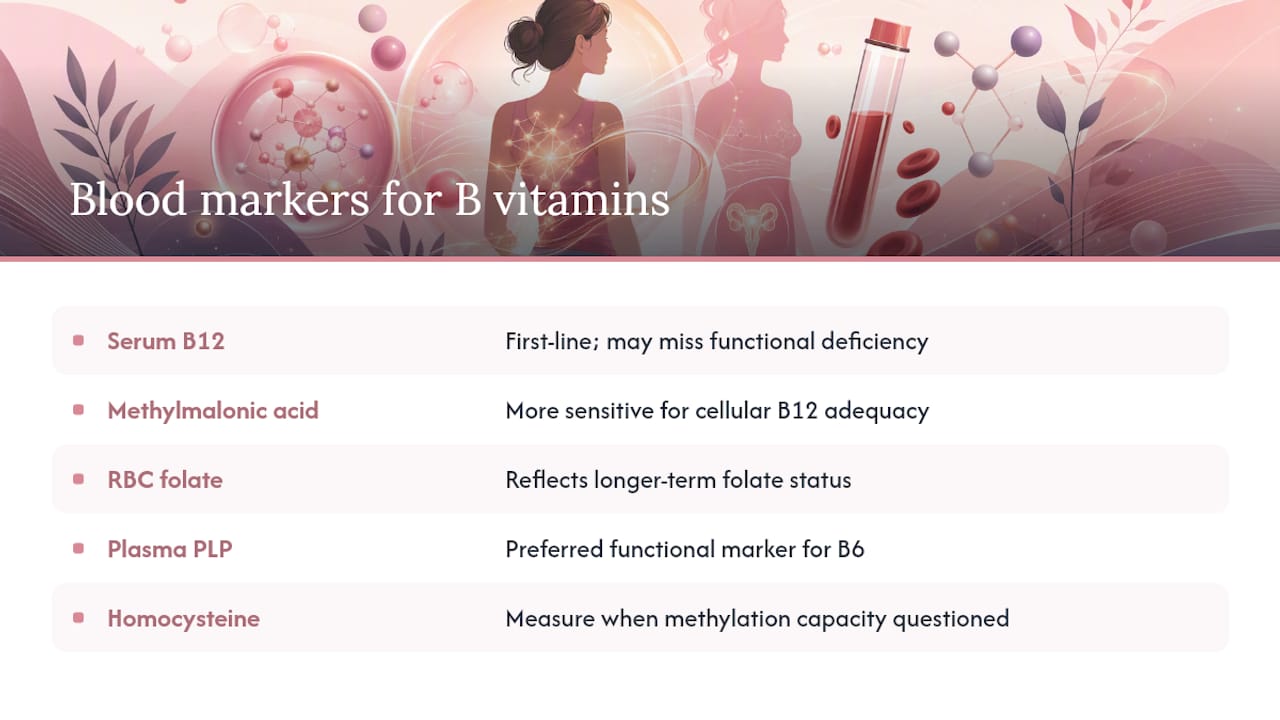
Homocysteine is worth measuring when methylation capacity is in question, particularly in women planning pregnancy, those with mood disorders, or those on metformin or OCPs long-term.
RDAs and upper intake levels
The US Dietary Reference Intakes set the following life-stage-specific recommendations:
| B Vitamin | RDA (adult women) | RDA (pregnancy) | RDA (lactation) | Tolerable Upper Intake Level |
|---|---|---|---|---|
| B2 (riboflavin) | — | — | — | Not established |
| B3 (niacin) | 14 mg NE/day | — | — | — |
| B6 (pyridoxine) | 1.3 mg/day | — | — | 100 mg/day |
| B9 (folate) | — | — | — | 1,000 mcg/day (folic acid) |
| B12 (cobalamin) | — | — | — | Not established |
| B5 (pantothenic acid) | 5 mg/day (AI) | 6 mg/day (AI) | 7 mg/day (AI) | Not established |
Life-stage differences
Pregnancy dramatically increases folate and B12 demand. Folate supplementation before conception and through the first trimester is one of the most evidence-supported nutritional interventions in women’s health, specifically for neural tube defect prevention. B12 demand also rises, and vegan or vegetarian women are at particular risk.
Perimenopause and menopause bring a different set of concerns. Declining estrogen affects serotonin synthesis, and B6 becomes more relevant for mood support. Methylation capacity matters more as cardiovascular risk rises with the loss of estrogen’s protective effects. B12 absorption tends to decline with age due to reduced gastric acid production, making testing more important in women over 50.
Pro Tip: Don’t rely on serum B12 alone in older women or those on proton pump inhibitors. Methylmalonic acid gives you a clearer picture of whether B12 is actually working at the cellular level. A normal serum B12 with elevated MMA is functional deficiency.
Supplementation: when it helps, how to dose, and what to watch for
Formulation choices
Methylfolate (5-MTHF) is the active, pre-converted form of folate and bypasses the MTHFR enzyme. For women with MTHFR variants or those who have not responded to standard folic acid, methylfolate is the preferred form. Similarly, methylcobalamin or adenosylcobalamin are the active forms of B12 and may be better absorbed than cyanocobalamin in some individuals, particularly those with absorption issues.
For B6, the active form is pyridoxal 5’-phosphate (PLP). Standard pyridoxine supplements are converted to PLP in the liver, which works fine for most people, but PLP-form supplements may be preferable when liver function is compromised.
Safety risks
Chronic high-dose B6 is the most clinically significant safety concern in this group. Doses above 200 mg/day taken long-term have been associated with sensory neuropathy, and cases have been reported at doses as low as 50 mg/day with prolonged use. The tolerable upper intake level of 100 mg/day is a ceiling, not a target. Most women do not need more than 1.3–2 mg/day from diet and a standard supplement.
High-dose folic acid supplementation can mask B12 deficiency by correcting the megaloblastic anemia while leaving neurological damage to progress. This is why the upper limit for folic acid (1,000 mcg/day) exists, and why B12 status should always be confirmed before starting high-dose folate.
Pro Tip: If mood or menstrual symptoms improve after starting B-vitamin correction, don’t assume you’ve found the cause. Confirm through testing and reassess after 8–12 weeks. Symptom response to a nutrient doesn’t prove deficiency was the driver, especially when multiple variables change simultaneously.
What the research still can’t tell us
The current evidence base has real strengths and real limits. Understanding both helps you use it correctly.
Study design limitations
- Most hormonal B-vitamin studies rely on dietary recall questionnaires, which have well-documented accuracy problems. Recall bias systematically underestimates or misclassifies intake.
- Supplement use is often poorly adjudicated. A woman who takes a B-complex daily but doesn’t report it can shift her apparent dietary intake substantially.
- The majority of studies are cross-sectional or prospective observational, meaning they can identify associations but cannot establish causation. Confounding by overall diet quality, body weight, physical activity, and socioeconomic status is difficult to fully control.
- Most cohort data comes from specific populations, often premenopausal US women, limiting generalizability to other life stages and ethnicities.
Biological complexity
B vitamins don’t act in isolation. Their downstream hormonal effects depend on the status of other nutrients (zinc, magnesium, iron), the health of the gut microbiome, liver function, genetic polymorphisms like MTHFR, and the hormonal milieu itself. Estrogen, as noted, can alter B6 metabolism. That bidirectionality makes it genuinely hard to disentangle cause from effect in observational data.
Research gaps
- Randomized controlled trials testing targeted B-vitamin interventions against specific hormonal endpoints (estradiol, progesterone, LH, FSH) are largely absent.
- Life-stage-specific dosing trials in perimenopausal and postmenopausal women are sparse.
- Mechanistic human studies directly linking methylation changes (measured via SAM/SAH ratios) to hormone metabolite profiles would substantially strengthen the field.
Key Takeaways
B vitamins support hormone balance as metabolic cofactors, not direct precursors, and the strongest clinical evidence centers on B2, B6, B9, and B12 in women of reproductive age through menopause.
| Point | Details |
|---|---|
| B vitamins are cofactors, not hormones | They enable the enzymatic pathways that synthesize and clear hormones; correcting deficiency supports the system, not replaces it. |
| B2 and estradiol are linked | Cohort data shows higher dietary riboflavin inversely associated with serum estradiol in premenopausal women. |
| B6, B9, B12 are the priority trio | These three most directly affect neurotransmitter synthesis and methylation; they’re also most depleted by OCPs, metformin, and alcohol. |
| Test before you supplement | Use PLP for B6, RBC folate for long-term folate status, and methylmalonic acid for functional B12 adequacy rather than serum B12 alone. |
| Florvahealth’s inside-out approach | Florvahealth’s hormone-support products complement nutritional strategies for women managing PMS, cycle irregularity, and mood-related hormonal symptoms. |
A clinician’s perspective on B vitamins and hormonal symptoms
The conversation around B vitamins and hormones tends to go one of two ways: either they’re dismissed as irrelevant to endocrine function, or they’re oversold as a natural hormone fix. Neither framing is useful.
What the evidence actually supports is more nuanced. B vitamins are infrastructure. When that infrastructure is intact, the systems that synthesize, regulate, and clear hormones work as intended. When it’s compromised, whether by medication, diet, absorption issues, or genetic variation, the downstream effects on mood, cycle regularity, and estrogen metabolism are real and measurable. That’s worth taking seriously.
In practice, the most productive approach is to test first and correct what’s actually deficient. Empirical megadosing of B-complex is rarely the right move, and the B6 neuropathy risk is underappreciated by patients who assume water-soluble means safe at any dose. The women who benefit most from targeted B-vitamin correction are those on long-term OCPs or metformin, those planning pregnancy, those with MTHFR variants, and those in perimenopause where methylation and neurotransmitter support become increasingly relevant.
A few practical heuristics worth keeping in mind:
- Test B12 and MMA in any woman who has been on metformin for more than a year
- Consider methylfolate over folic acid in women with a history of poor response to standard prenatal vitamins or known MTHFR variants
- In perimenopause, B6 and B9 support for mood is a reasonable adjunct to hormonal health habits, not a replacement for clinical evaluation
- Don’t interpret a normal serum B12 as ruling out functional deficiency; always pair it with MMA when the clinical picture suggests depletion
The gap between association and causation in this literature is real, but it doesn’t mean the findings are clinically irrelevant. It means they should inform your index of suspicion and your testing decisions, not your prescription pad.
Florvahealth’s inside-out support for hormonal wellness
For women managing the day-to-day reality of hormonal symptoms, PMS, bloating, mood shifts, and cycle irregularity, nutritional correction is one piece of a larger picture. Florvahealth builds on that foundation with an inside-out system designed specifically for women’s hormonal health.

Florvahealth’s range combines probiotic capsules, digestive enzyme capsules and gentle topical care, covering the gut side of the gut-hormone link alongside the nutritional gaps this article covers. Every product is made for women who want natural, non-medicated support that works alongside, not instead of, clinical care.
If you’re considering adding a B-vitamin supplement or a hormone-support routine, check ingredient labels carefully and confirm with your clinician, especially if you’re pregnant, breastfeeding, or taking medications like OCPs or metformin.
Selected sources and further reading
- Dietary intakes of vitamins B2, B6, and B12 and ovarian cycle function among premenopausal women
- B Vitamins: Functions and Uses in Medicine - PMC
- Dietary Vitamin B Complex: Orchestration in Human Nutrition throughout Life with Sex Differences
- The interactions between vitamin B6 and hormones
- The Interactions between Vitamin B 6 and Hormones
- NONE


