

Preventive women’s wellness is a non-medicated, product-led approach to supporting hormonal balance, skin clarity, and intimate health before symptoms escalate into bigger problems. Instead of waiting for a flare of hormonal acne or another month of relentless bloating, this approach layers targeted probiotics, pH-balanced intimate care, topical cycle support, and a handful of lifestyle habits into a daily rhythm. Clinical reviews back the core pieces of this idea: an 8-week randomized trial found measurable hormonal shifts from targeted probiotic strains, and international guidance bodies like the Royal College of Obstetricians and Gynaecologists have long recommended gentle, pH-friendly external cleansing over harsh soaps. Florvahealth’s range is built around this same framework.
Here’s what typically makes up a preventive wellness routine:
- A strain-specific probiotic supplement to support the gut-hormone connection
- A pH-balanced, hypoallergenic external intimate wash (not a douche)
- Topical patches or spot treatments timed to cycle phases
- Cycle-aware skincare that shifts with hormonal changes
- Foundational habits: sleep, stress management, and consistent movement
None of this replaces medical care when something’s actually wrong. It’s the groundwork you lay so fewer things go wrong in the first place.
Key Takeaways
Preventive women’s wellness works because it pairs strain-specific internal support with gentle external care and gives both 8 to 12 weeks of consistent use before judging results.
| Point | Details |
|---|---|
| Definition | Preventive wellness means product-led, non-medicated routines for hormonal balance, skin, and intimate health. |
| Check the strain | Choose probiotics with named Lactobacillus or Bifidobacterium strains, not vague blends. |
| Match the pH | Intimate washes should sit between pH 4.2 and 5.6 and skip soap entirely. |
| Give it time | Meaningful biomarker or symptom shifts typically take 8 to 12 weeks of consistent use. |
| Know the red flags | Fever, unusual discharge, or sharp pelvic pain mean it’s time to see a clinician, not adjust the routine. |
| Florvahealth’s system | Florvahealth pairs a strain-specific probiotic, pH-balanced wash, and symptom-targeted kits to match this exact checklist. |
Table of Contents
- What Are the Core Components of Women’s Preventive Care?
- What Does the Research Say About Probiotics and Intimate Care?
- How Do You Build a Daily Preventive Wellness Routine?
- What Should You Avoid in Intimate and Hormonal Care?
- How Do You Choose the Right Preventive Wellness Products?
- What Does a 30-Day Starter Plan Look Like?
- Where Can You Read More About the Research Behind This?
- Why We Built Florvahealth Around the Gut-Skin-Hormone Connection
- Which Florvahealth Products Fit Your Symptoms Best?
- Frequently Asked Questions
- Sources
What Are the Core Components of Women’s Preventive Care?
A preventive system works because it addresses the body from more than one angle at once. Gut health, skin health, and intimate health aren’t separate systems: they talk to each other constantly, which is why a routine built around only one of them tends to underperform.
Targeted probiotics sit at the center. Not all probiotic capsules do the same job. Formulas built around specific Lactobacillus strains have the most consistent research behind them for supporting a balanced vaginal microbiome, while other strains are studied more for gut and hormonal signaling. Reading the label matters more than most people realize.
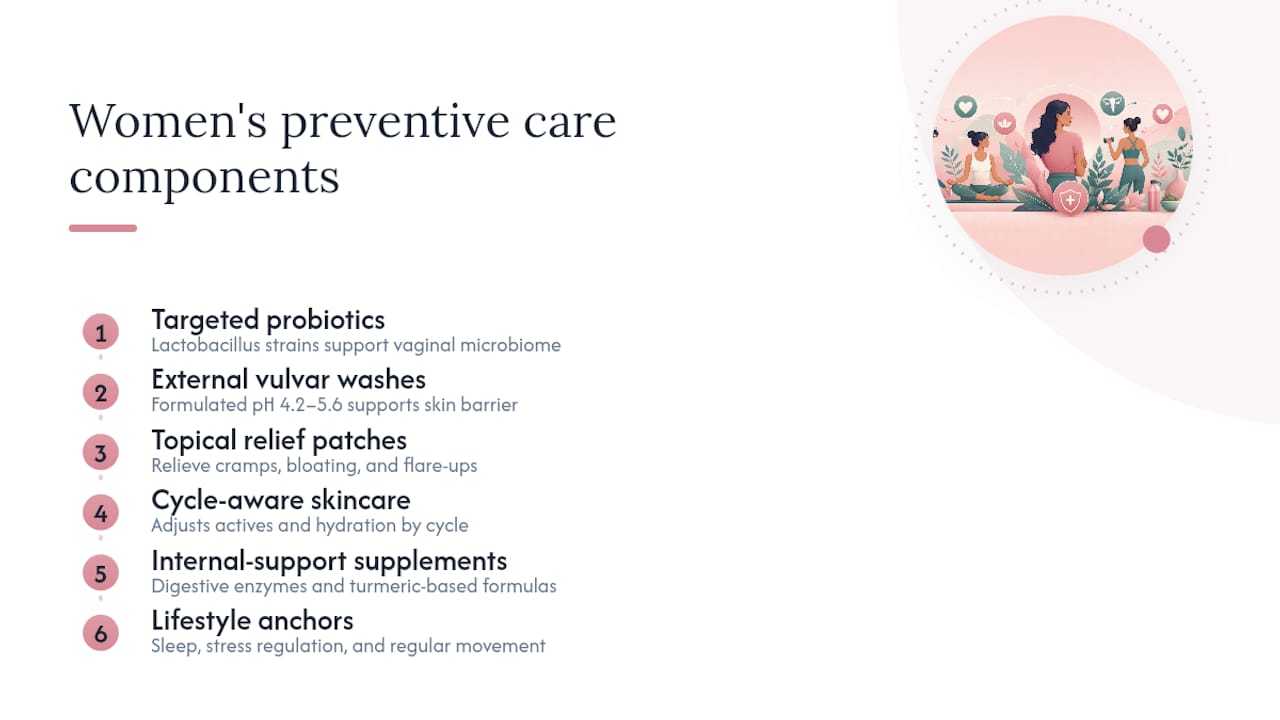
External vulvar washes come next, and pH is the detail that separates a good one from a bad one. A wash formulated closer to the vagina’s natural acidity (roughly pH 4.2 to 5.6) supports the skin barrier instead of stripping it.
Topical relief patches address the visible, immediate discomfort: cramping, bloating pressure, and skin flare-ups tied to the luteal phase. Cycle-aware skincare adjusts actives and hydration based on where you are in your cycle rather than treating every week the same. Internal-support supplements, like digestive enzymes or turmeric-based formulas, round out the gut-skin-hormone triangle. And lifestyle anchors, sleep, stress regulation, and regular movement, are what make the products actually work instead of just sitting on a shelf.

Product priorities shift with age, too. Women in their 20s are often managing acne and unpredictable cycles tied to stress or birth control transitions. Women in their 30s more often deal with bloating, slower skin recovery, and PMS that feels more intense than it used to. The core categories stay the same; the emphasis moves.
Pro Tip: Check probiotic labels for the actual strain name, not just “probiotic blend.” “Contains Lactobacillus” tells you almost nothing; “Lactobacillus rhamnosus, 10 billion CFU” tells you what you’re actually getting and at what dose.
What Does the Research Say About Probiotics and Intimate Care?
The evidence is real, but it’s also more modest than most marketing implies. A 12-week, placebo-controlled trial of a multispecies probiotic in women with PCOS found increases in sex hormone-binding globulin (SHBG) and decreases in LH and androstenedione, with some participants also seeing reductions in BMI. That’s a meaningful hormonal shift, and it came from consistent daily use over three full months, not three weeks.
An earlier 8-week trial using Lactobacillus helveticus and Bifidobacterium longum found improvements in SHBG along with several inflammatory and oxidative-stress markers. But the same trial noted something worth sitting with: short-term biomarker improvement didn’t translate into immediate, visible changes in acne or hirsutism. Blood markers moved before skin did.
That gap matters for expectations. Strain specificity is a big part of why results vary so much between products. A review of probiotic mechanisms on ovarian sex hormones points to several possible communication pathways between gut bacteria and the ovaries, though the exact mechanisms are still being mapped. Translation: probiotics can influence hormonal signaling, but not every strain does it the same way, and the honest research timeline runs 8 to 12 weeks minimum before you’d expect to see any biomarker movement at all.
On the intimate-care side, the evidence is more straightforward. Lactic acid-based washes near pH 4 have been associated with reduced recurrence of bacterial vaginosis when used as a supportive measure, according to the same vulvovaginal health review. Look for products that are dermatologically tested, hypoallergenic, and formulated within that an acidic pH range commonly between roughly 4 and 6. That’s the range clinical guidance keeps coming back to.
How Do You Build a Daily Preventive Wellness Routine?
Consistency beats intensity here. A routine you actually stick with for 12 weeks will outperform a “perfect” one you abandon after ten days.
Daily habits:
- Wash externally with a pH-balanced, fragrance-free intimate wash once a day, never more
- Take your probiotic at the same time daily, ideally with food, unless the label says otherwise
- Adjust skincare actives based on where you are in your cycle rather than using the same products every day
Weekly and cycle-based actions:
- Use topical relief patches during the luteal phase (roughly the 7 to 10 days before your period) when bloating and cramping tend to peak
- Schedule gentler exfoliation during the follicular phase, when skin typically tolerates actives better
- Prioritize hydration and 7 to 9 hours of sleep, especially in the days leading up to your period
- Space probiotic doses away from antibiotics by at least two hours if you’re taking both
What should you expect, and when? At 4 weeks, most people notice small shifts: less bloating discomfort, slightly calmer skin. At 8 to 12 weeks, the window most clinical trials use, you’re more likely to see measurable changes in cycle regularity or skin clarity if the routine is working. At 3 months, you’ll have enough data from your own body to know whether to keep the routine, adjust the probiotic strain, or bring specific symptoms to a clinician. Practices like cyclical living and cycle-adjusted skincare can help you structure that timeline instead of guessing.
What Should You Avoid in Intimate and Hormonal Care?
Some very common habits actively work against everything a preventive routine is trying to accomplish.
- Skip vaginal douching entirely. It’s linked to a higher risk of pelvic inflammatory disease, endometriosis, and sexually transmitted infections in the research literature.
- Avoid harsh, fragranced soaps on the vulvar area. They strip the natural pH balance and can trigger irritation or infection.
- Steer clear of talc-based powders near intimate areas.
- Don’t layer multiple new active skincare or supplement products at once. If something reacts, you won’t know which one caused it.
If a new product causes severe redness, swelling, burning, or an allergic reaction, stop using it immediately and contact a clinician rather than waiting to see if it resolves.
Certain symptoms are signals to skip the self-care routine and call a doctor instead: a fever, unusual or strong-smelling discharge, sharp pelvic pain, or bleeding that stays irregular for more than a couple of cycles. None of those are things a wash or a supplement should be asked to fix. For more on why internal cleansing specifically causes harm, this breakdown of douching risks walks through the mechanism.
How Do You Choose the Right Preventive Wellness Products?
A useful shopping checklist cuts through a lot of noise. Before buying a probiotic, intimate wash, or topical product, check for these:
- Named strains, not vague “probiotic blend” labels, with a CFU count and a suggested minimum-use duration (8 to 12 weeks, based on the trial data above)
- pH between 4.2 and 5.6 on any external intimate wash
- Hypoallergenic and dermatologically tested claims, ideally with details on the kind of testing performed
- Soap-free formulation for anything used near the vulva
- Clear guidance on how internal and external products are meant to be paired
Florvahealth’s range was built around this checklist. The Florva probiotic capsules use targeted strains rather than a generic blend. The pH-balanced intimate wash sits inside the 4.2 to 5.6 range and skips soap entirely in favor of a gentler, hypoallergenic formula.
The products that actually move the needle are the ones you can explain in one sentence: what strain, what pH, what it’s tested for. If a label can’t answer those questions, it’s not giving you enough to make a real decision.
What Does a 30-Day Starter Plan Look Like?
Week 1 is about baseline, not overhaul. Swap your current intimate wash for a pH-balanced, soap-free version and start tracking your symptoms daily: mood, bloating, skin, sleep. Don’t change anything else yet.
Weeks 2 and 3 add the internal layer. Introduce a strain-specific probiotic at a consistent time each day, and start using topical patches as your luteal phase approaches. This is also when small food swaps, stabilizing snacks instead of blood-sugar spikes, tend to pay off fastest.
Week 4 is for review. Look back at your tracking notes. Is bloating less intense? Has skin texture shifted at all? Are you sleeping better? Adjust from there rather than starting over.
Daily habits worth tracking through the month:
- Mood and energy shifts across the cycle
- Bloating severity, not just presence
- New or resolving skin changes
- Cycle timing and flow consistency
Pro Tip: Track in weekly averages, not daily snapshots. One rough day means nothing on its own; a rough week compared to last week’s average tells you something real.
Where Can You Read More About the Research Behind This?
- The 8-week PCOS probiotic trial shows what realistic short-term biomarker change actually looks like.
- The 12-week hormonal profile study is the strongest evidence for giving a routine a full three months before judging it.
- The ovarian sex hormone mechanism review explains the gut-ovarian communication pathways probiotics may work through.
Why We Built Florvahealth Around the Gut-Skin-Hormone Connection
We designed Florvahealth’s system around one idea: gut health, skin health, and intimate health aren’t three separate problems, they’re one connected system that most wellness brands treat in isolation. Instead of selling a single supplement and calling it done, the approach layers internal probiotic support, external pH-balanced cleansing, and topical cycle-targeted relief into one routine that mirrors how the body actually works.
That’s not a shortcut. It’s why the product lineup includes a strain-specific probiotic alongside a soap-free intimate wash and patches built for the luteal phase specifically, rather than one generic “hormone support” product trying to do everything. The positioning stays non-medicated and science-rooted on purpose: readers researching this topic aren’t looking for a prescription, they’re looking for a consistent, evidence-informed routine they can actually stick with.
Which Florvahealth Products Fit Your Symptoms Best?
If bloating after meals is your main complaint, digestive enzyme capsules support digestion. If cycle irregularity is the main frustration, the strain-specific Florva probiotic is the place to start, since it’s the component with the most direct hormonal research behind it. If hormonal acne and dull skin are your priority, the turmeric and kojic acid foaming cleanser targets skin clarity specifically.
A shopper tip worth knowing before checkout: pairing an internal product (the probiotic) with an external one (the wash or patches) tends to produce more noticeable results than using either alone, since you’re supporting the gut-hormone-skin connection from two directions at once instead of one. Start by visiting Florvahealth to see the full system and match a bundle to your specific symptom profile.
Frequently Asked Questions
What is preventive women’s wellness, exactly? It’s a non-medicated, product-led approach that combines internal probiotics, pH-balanced intimate care, topical cycle support, and lifestyle habits to support hormonal balance and skin health before symptoms worsen.
How long before I see results from a preventive routine? Most clinical trials use an 8 to 12 week window to detect measurable change, so plan on at least three months of consistent use before judging whether a routine is working.
Can probiotics really affect hormonal acne?
Is it safe to use an intimate wash every day? Yes, as long as it’s pH-balanced (roughly 4.2 to 5.6), soap-free, and hypoallergenic. Daily use of harsh soaps or douching is not recommended as it can increase infection risk.
When should I stop a preventive routine and see a doctor? Stop and seek medical care if you notice fever, unusual or strong-smelling discharge, sharp pelvic pain, or bleeding that stays irregular for more than a cycle or two.
This article is general information, not a substitute for advice from a qualified doctor. Consult a qualified healthcare professional about your own circumstances before acting on anything here.
Sources
- Role of female intimate hygiene in vulvovaginal health: Global hygiene practices and product usage
- The role of probiotics in women’s health: An update narrative review
- Effects of supplementation with two probiotic strains (Lactobacillus helveticus and Bifidobacterium longum) on hormonal status, oxidative stress, and clinical symptoms in women with polycystic ovary syndrome: a randomized clinical trial
- Changes in Hormonal Profile and Body Mass Index in Women with Polycystic Ovary Syndrome After Probiotic Intake: A 12-Week Placebo-Controlled and Randomized Clinical Study


