

The answer from every major U.S. medical authority is the same: don’t douche. The Office on Women’s Health, the National Cancer Institute, and the American College of Obstetricians and Gynecologists all advise against internal vaginal rinsing. Right now, the simplest thing you can do is stop any internal washing routine and switch to rinsing the external vulva with warm water only.
Table of Contents
- What is a douche, and why do so many women still use one?
- What the medical evidence says about douching risks
- What safe, gentle daily intimate care actually looks like
- When symptoms mean it’s time to see a clinician
- How Florvahealth’s approach aligns with this guidance
- Key Takeaways
- The case for trusting your body’s design
- A non-medicated starting point from Florvahealth
- Primary sources and further reading
What is a douche, and why do so many women still use one?
The NCI defines a douche as washing the vagina with water or other mixtures, and notes that regular douching washes away the protective bacteria your body depends on. The equipment ranges from squeeze bottles to bag-and-nozzle kits sold at drugstores, and the solutions inside vary from plain water to vinegar blends to antiseptic formulas.
Women reach for these products for understandable reasons. Perceived odor, post-sex cleanup, menstrual freshness, and decades of marketing that framed the vagina as something that needed fixing. Cultural practices passed down through generations add another layer. The problem is that the premise is wrong.
Common myths vs. facts:
- Myth: Douching cleans the vagina and prevents infection. Fact: The vagina is self-cleaning; internal rinsing disrupts the very bacteria that keep it healthy.
- Myth: Douching after sex prevents pregnancy or STIs. Fact: It does neither, and can actually push pathogens further inward.
- Myth: Odor means the vagina is dirty. Fact: Most odor originates from the external vulva, perineum, or inner thighs, not the vaginal canal itself.
That last point matters more than most people realize. Because most hygiene issues stem from external areas, an internal rinse is solving the wrong problem entirely.
What the medical evidence says about douching risks
Nearly one in five women ages 15–44 in the U.S. report douching, despite consistent medical guidance against it. The gap between what women are doing and what clinicians recommend is wide, and the consequences are well-documented.
Douching not only disturbs the vaginal microbiota but can mechanically push pathogens upward into the uterus and fallopian tubes, raising the risk for pelvic inflammatory disease and ectopic pregnancy.
The mechanism is straightforward. A healthy vagina maintains an acidic pH below 4.5, dominated by Lactobacillus bacteria that crowd out harmful microbes. Introduce a rinse, and you raise the pH, kill off protective flora, and create an environment where anaerobic bacteria thrive. Douching is linked to bacterial vaginosis and PID, and the research connecting it to pregnancy complications is consistent across multiple studies.
Nearly one in five U.S. women ages 15–44 still douche regularly, despite official guidance from the Office on Women’s Health and NCI advising against it.
| Risk Category | Associated Harm | Evidence Level |
|---|---|---|
| Vaginal infections | Higher odds of bacterial vaginosis | Peer-reviewed studies, PMC |
| Pelvic inflammatory disease | Upward pathogen movement via douching | Office on Women’s Health |
| Pregnancy complications | Ectopic pregnancy, preterm birth, low birth weight | Multiple studies, Wikipedia/University of Rochester review |
| STI susceptibility | Increased risk including HPV | — |
| Symptom masking | Delays diagnosis of BV, STIs, other infections | Office on Women’s Health |
Douching can also mask infection signs by temporarily neutralizing odor, which is one of the more insidious harms. You feel cleaner while an untreated infection progresses.
What safe, gentle daily intimate care actually looks like
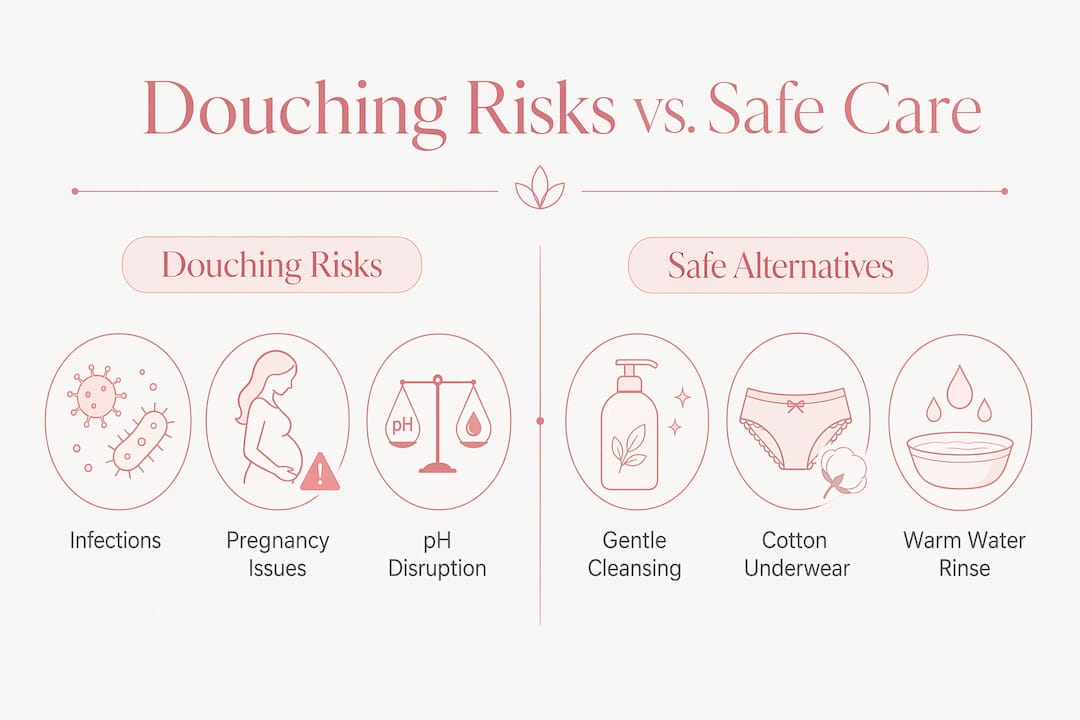
The good news: effective intimate care is simpler and cheaper than any product on the feminine hygiene shelf. Mayo Clinic Health System’s guidance puts it plainly — less is more, and warm water does the job.
Daily vulvar care, step by step:
- Rinse the external vulva with warm water once daily, or at most twice daily.
- If you use a cleanser, choose one that is pH-balanced, soap-free, and fragrance-free. Clinical reviews recommend hypoallergenic, mild formulas applied externally only.
- Wash front to back, always, to prevent perineal bacteria from reaching the vulva.
- Pat dry gently with a clean towel. Moisture left behind encourages yeast growth.
- Skip internal rinsing entirely. The vagina handles its own cleaning through natural discharge.
What to avoid:
- Scented soaps, body washes, or deodorant sprays near the vulva
- Talcum powder or cornstarch-based products in the groin area
- Overuse of feminine wipes, especially scented ones
- Tight synthetic underwear that traps heat and moisture
- Laundry detergents with heavy fragrance on underwear
Underwear choice matters more than most people expect. Cotton breathes; synthetic fabrics don’t. During your period, unscented pads or a menstrual cup tend to cause less irritation than heavily fragranced options. After a course of antibiotics, breathable cotton underwear and probiotic support can help the vaginal microbiome recover faster. Hydration also plays a role in mucosal health, which is worth keeping in mind as part of a broader hormone and hydration routine.
Pro Tip: After heavy exercise or swimming, rinse the vulva with warm water and change out of damp clothing promptly. Prolonged moisture is a more common trigger for irritation than any lack of internal washing.
When symptoms mean it’s time to see a clinician
Persistent odor, unusual discharge, itching, or pelvic discomfort are not hygiene failures. They are symptoms, and they deserve a clinical evaluation, not a douche. The problem is that douching can mask these signs by temporarily reducing odor, which delays the diagnosis and allows the underlying condition to worsen.
Persistent changes in odor or discharge are clinical symptoms, not hygiene problems. Using scented products or douching to address them can delay diagnosis of bacterial vaginosis, STIs, or other infections.
See a clinician if you notice:
- A strong or fishy odor that persists after bathing
- Discharge that is gray, green, or yellow, or has an unusual texture
- Itching, burning, or swelling of the vulva or vagina
- Pelvic pain or pressure, especially with urination or sex
- Fever alongside any of the above
- Bleeding unrelated to your menstrual cycle
Questions to bring to your appointment:
- “Could this be bacterial vaginosis, a yeast infection, or an STI?”
- “Should I be tested for anything specific given my symptoms?”
- “Are any of my current hygiene products contributing to this?”
- “Do I need treatment, or will this resolve on its own?”
Your clinician will likely consider testing for BV, yeast, and common STIs. Getting that answer quickly is far better than masking symptoms for weeks with products that don’t treat the cause.
How Florvahealth’s approach aligns with this guidance
Florvahealth builds its intimate and hormonal wellness products around the same principle the medical evidence supports: external care only, no internal rinsing, and microbiome-friendly support from the inside out.
| Florvahealth Offering | How It Aligns With Medical Guidance |
|---|---|
| pH-balanced external cleansing | Supports external-only vulvar care; no internal application |
| Probiotic capsules | Supports overall microbiome health, including vaginal flora recovery |
| Deep Clean & Glow Bundle | External skin and cleansing support without internal rinses |
| Holistic PMS and hormonal support | Addresses root hormonal factors that can affect discharge and odor |
What this means in practice:
- All Florvahealth cleansing products are designed for external use, consistent with clinical recommendations against internal washing.
- Probiotic support complements, rather than replaces, the vagina’s natural Lactobacillus environment.
- The brand’s educational content encourages women to distinguish between normal physiological variation and symptoms that need clinical attention.
Florvahealth’s products are non-medicated and supportive. They are not a substitute for clinical diagnosis or treatment. If you have persistent symptoms, see a clinician first.
Key Takeaways
Douching disrupts vaginal pH and protective bacteria, raising the risk of infections, PID, and pregnancy complications — and every major U.S. authority advises against it.
| Point | Details |
|---|---|
| Don’t douche | Office on Women’s Health, NCI, and ACOG all advise against internal vaginal rinsing. |
| Nearly 1 in 5 women still do | Despite consistent medical guidance, nearly one in five U.S. women ages 15–44 report douching. |
| External care is enough | Warm water and a pH-balanced, fragrance-free cleanser on the vulva is all that’s needed daily. |
| Symptoms need a clinician | Persistent odor, unusual discharge, or pelvic pain are medical issues, not hygiene failures. |
| Florvahealth’s approach | External-only, pH-friendly products and probiotic support that align with clinical guidance. |
The case for trusting your body’s design
Marketing has spent decades convincing women that the vagina is a problem to be solved. It isn’t. The vagina is a self-regulating system with its own pH, its own bacterial defense, and its own cleaning mechanism. Every internal rinse you introduce works against that system, not with it.
What I find worth saying plainly: the women most likely to douche are often the ones who care most about their health. They’re responding to real concerns about odor or cleanliness, concerns that are completely understandable. The failure isn’t theirs. It’s a product category that exploited those concerns without evidence, and a cultural narrative that framed normal physiology as something shameful.
The shift worth making isn’t just stopping internal rinsing. It’s recognizing that persistent symptoms deserve a clinician’s attention, not a drugstore fix. And that gentle, external care with the right products is genuinely sufficient for most women, most of the time. If you’re perimenopausal and noticing changes in odor or flora, that’s a distinct physiological shift worth understanding on its own terms, and resources like this guide on perimenopause and body odor address it directly.
A non-medicated starting point from Florvahealth
If you’re ready to replace internal rinsing with a routine that actually supports your body, Florvahealth offers a concrete place to start. The Deep Clean & Glow Bundle is built around external cleansing and skin support, with no internal application and no harsh chemicals. For women managing hormonal symptoms alongside intimate health concerns, the full Florvahealth wellness system combines pH-friendly external care with probiotic and hormonal support in one integrated approach.

These are non-medicated, supportive products. They are not a diagnosis, and they don’t replace a clinician’s evaluation for persistent symptoms. But if you want a clean, evidence-aligned daily routine, this is a practical next step. Visit florvahealth.com to see the full range and find what fits your routine.
This article is general health information, not medical advice. For persistent symptoms or concerns, consult a qualified healthcare provider.
Primary sources and further reading
- Office on Women’s Health — Douching: Official U.S. government guidance on douching risks, prevalence, and recommendations against the practice.
- National Cancer Institute — Definition of Douche: Clinical definition and risk summary from the NCI Dictionary of Cancer Terms.
- PMC — Role of Female Intimate Hygiene in Vulvovaginal Health: Peer-reviewed review of global hygiene practices, BV risk, and product safety evidence.
- SAGE Journals — Maintaining Vulvar, Vaginal and Perineal Health: Clinical review of washing frequency, pH-balanced cleansers, and anatomical distinctions for intimate care.
- Mayo Clinic Health System — Practicing Good Feminine Hygiene: Consumer-facing guidance reinforcing warm water and minimal-product approaches.


