

Holistic skin wellness is the practice of treating your skin as a reflection of your whole body, combining topical care with nutrition, sleep, stress management, gut health, and hormonal balance to achieve lasting skin clarity rather than temporary fixes.
Before anything else, here are four things you can start today:
- Apply a broad-spectrum SPF 30 or higher every morning, rain or shine. The American Academy of Dermatology lists this as the single most impactful daily skin habit.
- Prioritize earlier bedtimes to improve sleep timing, which influences cortisol levels, a key factor in skin barrier breakdown and breakouts.
- Simplify your cleanser. Twice-daily gentle cleansing, no scrubbing, protects the skin barrier more reliably than most actives.
- Look at your plate and your stress load before adding another serum. Diet and chronic stress are two of the most under-addressed drivers of persistent skin concerns.
Table of Contents
- What does “holistic skin wellness” actually mean?
- What are the core pillars of a holistic skin routine?
- How do you combine topical skincare with internal strategies?
- Which ingredients actually work, and for which skin types?
- How do you build a simple holistic skin routine?
- When should you see a holistic esthetician, integrative clinician, or dermatologist?
- How do hormones and gut health actually affect your skin?
- What are the biggest myths about holistic skin wellness?
- How do pollution and blue light affect your skin, and what can you do?
- Key Takeaways
- Skin health is a practice, not a product
- Hormone-linked skin concerns? Florvahealth takes an inside-out approach
- Useful sources and further reading
What does “holistic skin wellness” actually mean?
The short answer: holistic skin wellness treats skin from the inside out and the outside in, while also accounting for the nervous system’s role in inflammation and barrier function. It is not the same as clinical dermatology, which focuses on diagnosing and treating disease, and it is not the same as a product-first approach, which layers actives without asking why the skin is struggling in the first place.
The difference matters because skin is an organ, not a surface. It responds to what you eat, how you sleep, how stressed you are, and what your hormones are doing. Research consistently frames the gut-skin axis and stress pathways as core mechanisms linking internal health to visible skin outcomes. Two people can use the same serum and get completely different results because their internal environments are different.
A product-first mindset asks: “Which ingredient fixes this?” A holistic mindset asks: “Why is this happening, and what does my skin need from the inside and outside to stop it?” That reframe is where the approach starts.
This guide uses the mindful beauty framework throughout: skin as a biomarker of internal health, care as a daily practice rather than a rescue mission, and routines built around consistency over complexity.
What are the core pillars of a holistic skin routine?
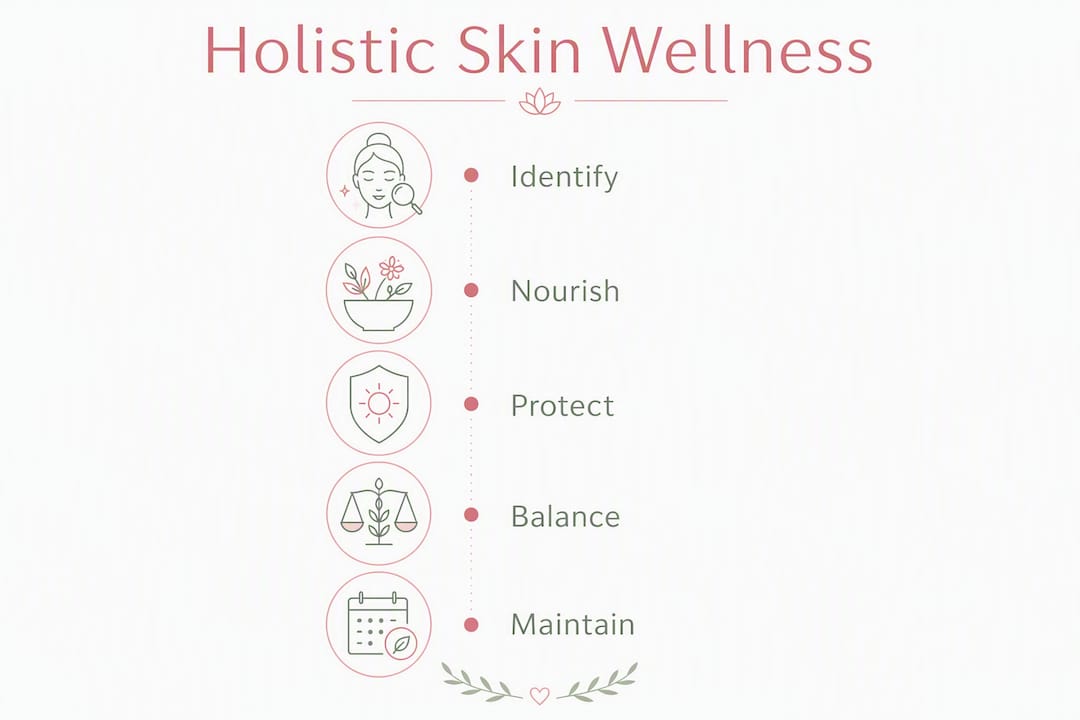
Mayo Clinic and the AAD both identify the same foundational habits: sun protection, not smoking, gentle skin care, a balanced diet, stress management, and adequate sleep. These are not soft lifestyle suggestions. They are the highest-impact, lowest-risk interventions available, and every other holistic strategy builds on them.
Here is how each pillar translates into a micro-action you can take this week:
- Sun protection: Apply SPF 30+ broad-spectrum sunscreen every morning before going outside. Reapply every two hours during outdoor exposure. This one habit slows photoaging more than any topical anti-aging product.
- Barrier care: Use a fragrance-free, pH-balanced cleanser twice daily. Follow immediately with a moisturizer containing ceramides or hyaluronic acid to lock in hydration before the skin surface dries.
- Nutrition and hydration: Prioritize omega-3 fatty acids (fatty fish, walnuts, flaxseed), antioxidant-rich vegetables, and at least eight cups of water daily. Skin lipid content and collagen synthesis both depend on dietary inputs.
- Sleep and circadian timing: Aim for sufficient sleep and prioritize consistent sleep and wake times over total hours alone. Melatonin, produced during quality sleep, acts as an antioxidant in skin tissue and helps reduce chronic low-grade inflammation.
- Stress management: Psychological stress raises cortisol activity in the outer skin layers, weakens barrier integrity, and increases transepidermal water loss. Even ten minutes of daily breathwork or a short walk can blunt that response.
- Movement and circulation: Regular moderate exercise improves blood flow to skin cells and supports lymphatic drainage. You do not need a gym; a 20-minute brisk walk counts.
- Gut health and microbiome: Gut microbiome metabolites modulate systemic inflammation, which shows up on skin as acne, eczema, or redness. Fermented foods (yogurt, kefir, kimchi) and prebiotic fiber support a healthier microbial balance.
- Environmental exposures: Pollution particles and UV radiation generate free radicals that degrade collagen and trigger inflammation. Antioxidant serums and physical barriers (hats, SPF) are the practical response.
A simple, consistent routine built around these pillars outperforms a complicated one built around single-purpose actives every time.
How do you combine topical skincare with internal strategies?
Both matter, and the evidence is clearest when they work together. A 2026 integrative dermatology review in Dermatology and Therapy frames skin as a target for longevity strategies and recommends combining topical agents (retinoids, peptides, antioxidants) with internal nutraceuticals (collagen peptides, polyphenols, microbiome modulators) for better outcomes than either approach alone.
Topical interventions: pros and cons
- Pro: Direct delivery to the target tissue; faster visible results for surface concerns like dryness, hyperpigmentation, and texture.
- Pro: Well-studied safety profiles for most standard actives (retinoids, niacinamide, SPF).
- Con: Cannot address root causes driven by hormones, gut health, or chronic stress.
- Con: Overloading actives can compromise the barrier and worsen sensitivity.
Oral supplements: pros and cons
- Pro: Targets systemic drivers (inflammation, collagen synthesis, microbiome balance) that topicals cannot reach.
- Con: Evidence quality varies widely; many supplements have promising but preliminary data.
- Con: Interactions with medications, pregnancy, and underlying conditions are real risks. Always check with a clinician before starting a new supplement.
The table below summarizes common oral interventions, their primary role, and a realistic evidence note.
| Supplement | Primary role | Evidence level | Practical note |
|---|---|---|---|
| Collagen peptides | Supports skin elasticity and hydration | Moderate (several RCTs) | 10 g daily; benefits typically appear after 8–12 weeks |
| Omega-3 fatty acids | Reduces inflammatory skin conditions | Good (multiple trials) | Fish oil or algae-based; supports barrier lipids |
| Probiotics | Modulates gut-skin axis; may reduce acne and eczema | Emerging (strain-dependent) | Strain matters; Lactobacillus and Bifidobacterium most studied |
| Vitamin C (oral) | Antioxidant; cofactor for collagen synthesis | Good | Pairs well with topical vitamin C for broader coverage |
| NAD+ precursors (NMN, NR) | Cellular energy and DNA repair; anti-aging focus | Preliminary | Longevity-focused use; consult a clinician for dosing |
| Adaptogens (ashwagandha, rhodiola) | Stress-cortisol modulation; skin resilience | Emerging | Use standardized extracts; not appropriate for all individuals |
For collagen-boosting strategies that combine topical and dietary approaches, the evidence points to consistency over dose: small daily amounts over months outperform high-dose short courses.
Which ingredients actually work, and for which skin types?
The ingredient market is noisy. Here is a stripped-down reference for the actives that have real evidence behind them, who they suit, and what to watch for.
Topical actives
- Vitamin C (L-ascorbic acid): Brightens hyperpigmentation, boosts collagen synthesis, neutralizes free radicals. Best for oily and normal skin; can oxidize quickly in unstable formulas. Use in the morning under SPF.
- Retinoids/retinol: The most evidence-backed anti-aging topical available. Increases cell turnover, reduces fine lines, and clears acne. Start low (0.025–0.05%) and increase slowly. Not safe during pregnancy.
- Niacinamide: Reduces redness, minimizes pores, strengthens barrier, and fades dark spots. Suits almost every skin type, including sensitive. One of the most versatile actives in the category.
- Hyaluronic acid: A humectant that draws water into the skin. Works best when applied to damp skin and sealed with a moisturizer. Suits all skin types.
- Ceramides: Barrier-repair lipids that mimic the skin’s natural structure. Ideal for dry, sensitive, or compromised skin. Non-irritating and compatible with most actives.
- Botanicals and adaptogens (topical): Centella asiatica calms inflammation; bakuchiol is a plant-based retinol alternative suitable for sensitive skin and pregnancy. Chaga and reishi extracts appear in formulations targeting cellular stress resilience.
Oral supports
- Collagen peptides: Hydrolyzed form absorbs readily; supports skin hydration and elasticity. Timeline: 8–12 weeks minimum.
- Omega-3s: Reduce inflammatory skin conditions and support barrier lipid content. Algae-based options work for those avoiding fish.
- Probiotics: Gut-skin axis support. Most studied for acne and eczema; strain selection matters more than dose.
- Adaptogens (ashwagandha, rhodiola, chaga): Bioactive effects on cellular stress responses; increasingly used in oral skin-resilience formulations. Choose standardized extracts and consult a clinician for dosing.
The table below maps ingredients to their primary benefit, suitable skin types, and key cautions.
| Ingredient | Primary benefit | Best for | Sensitivity / warning |
|---|---|---|---|
| Vitamin C (topical) | Brightening, antioxidant | Normal, oily | Can irritate sensitive skin; avoid layering with retinol at the same time |
| Retinol | Anti-aging, acne | Most types | Avoid in pregnancy; start low; causes initial purging |
| Niacinamide | Barrier, redness, pores | All types | Rarely irritating; flush possible at very high doses |
| Hyaluronic acid | Hydration | All types | Apply to damp skin; can dehydrate in dry climates if not sealed |
| Ceramides | Barrier repair | Dry, sensitive | None; compatible with all actives |
| Bakuchiol | Retinol alternative | Sensitive, pregnant | Gentler; slower results than retinol |
| Collagen peptides (oral) | Elasticity, hydration | All | Check for fish/bovine allergens |
| Omega-3s (oral) | Inflammation, barrier | All | Blood-thinning at high doses; consult clinician |
| Probiotics (oral) | Gut-skin axis | All | Strain-specific; start low to avoid GI adjustment |
Pro Tip: Never layer vitamin C and retinol in the same application. Use vitamin C in the morning and retinol at night to get the benefit of both without the irritation risk.
Copper peptides are worth a mention here too. They support wound healing, collagen and elastin synthesis, and have a gentler profile than retinoids, making them a strong option for sensitive skin or anyone who cannot tolerate retinol.
How do you build a simple holistic skin routine?
The core daily steps are cleanse, treat, moisturize, and protect. Everything else is optional. The lifestyle anchors (sleep, stress, diet, movement) run in parallel and amplify what the topicals can do.
Morning routine (5–10 minutes)
- Gentle cleanser (or water rinse if skin is not oily)
- Antioxidant serum (vitamin C or niacinamide)
- Moisturizer with ceramides or hyaluronic acid
- SPF 30+ broad-spectrum sunscreen
- One lifestyle anchor: drink a full glass of water before coffee
Evening routine (5–10 minutes)
- Gentle cleanser to remove SPF and environmental residue
- Treatment step: retinol (2–3 nights per week to start), or a calming botanical serum on off nights
- Moisturizer, slightly richer than the morning formula
- One lifestyle anchor: dim lights 30 minutes before bed to support melatonin production
Weekly additions
- Exfoliate once or twice with a gentle chemical exfoliant (lactic acid or mandelic acid for sensitive skin; glycolic for oily or normal skin).
- A brief facial massage (2–3 minutes) using a facial oil or balm. Lymphatic drainage movements reduce puffiness and shift the nervous system toward a calmer state, which itself lowers inflammatory burden over time.
Cycle-aware adjustments
Hormonal fluctuations across the menstrual cycle change skin behavior in predictable ways. Adjusting your routine across your cycle is one of the most practical, underused strategies for women dealing with hormonal skin concerns.
- Follicular phase (days 1–13): Estrogen rises; skin tends to be clearer and more tolerant. A good window to introduce or increase retinol frequency.
- Ovulation (around day 14): Skin often looks its best. Maintain your standard routine.
- Luteal phase (days 15–28): Progesterone rises; sebum production increases and sensitivity spikes. Scale back actives, switch to a lighter moisturizer, and add a salicylic acid spot treatment if needed.
- Menstruation: Estrogen and progesterone drop; skin can be more reactive. Prioritize barrier repair (ceramides, gentle cleansing) and skip aggressive exfoliation.
Three example routines
Minimal (5 minutes AM/PM): Gentle cleanser, SPF 30+ in the morning, ceramide moisturizer at night. No actives. Ideal for beginners or anyone with a compromised barrier.
Balanced (8–10 minutes AM/PM): Cleanser, vitamin C serum, moisturizer, SPF in the morning. Cleanser, retinol (3x/week) or niacinamide, richer moisturizer at night. Weekly gentle exfoliation. A soft facial cleansing brush on its gentlest setting is one way to handle the weekly step.
Performance (10–15 minutes AM/PM): Full antioxidant stack in the morning (vitamin C + niacinamide), SPF, targeted eye cream. Retinol or a prescription retinoid at night, barrier repair, weekly exfoliation, monthly facial massage ritual.
Pro Tip: Before bed, try two minutes of slow nasal breathing (four counts in, six counts out) while applying your evening moisturizer. This brief nervous-system ritual reduces cortisol signaling and makes the routine itself a stress-reduction practice, not just a skin-care one.
When should you see a holistic esthetician, integrative clinician, or dermatologist?
Each provider serves a different function, and knowing who to call first saves time and money.
Holistic esthetician:
- Facial treatments, extractions, lymphatic massage, and skin analysis
- Guidance on routine building and product selection
- Best for: maintenance, education, and non-medical skin concerns
Integrative clinician (naturopath, functional medicine doctor):
- Hormone and gut health testing, supplement protocols, dietary interventions
- Addresses root causes of skin issues through lab work and lifestyle
- Best for: chronic hormonal acne, eczema with suspected gut involvement, PMS-related skin changes
Dermatologist:
- Diagnosis and treatment of skin disease; prescription actives (tretinoin, antibiotics, biologics)
- Best for: persistent or worsening conditions, suspicious lesions, severe acne or rosacea
See a doctor promptly if you notice:
- A rash that spreads rapidly or is accompanied by fever
- Sudden changes in a mole (asymmetry, color change, bleeding)
- Severe, painful skin flares that do not respond to standard care
- Systemic symptoms alongside skin changes (joint pain, fatigue, swollen lymph nodes)
Questions to bring to any appointment:
- What medications or supplements am I currently taking?
- Where am I in my menstrual cycle, and does my skin change predictably across it?
- Have I had any relevant lab work (thyroid, hormones, inflammatory markers)?
- What have I already tried, and for how long?
For hormone-linked skin concerns like eczema or acne that flare predictably with your cycle, an integrative clinician and a dermatologist working in parallel is often the most effective combination.
How do hormones and gut health actually affect your skin?
Hormones and gut health are two of the most direct internal drivers of skin behavior, and they interact with each other in ways that make skin concerns feel unpredictable without that context.

Estrogen supports collagen synthesis and skin hydration. When estrogen drops (late luteal phase, perimenopause), skin becomes drier and less elastic. Androgens (testosterone and its derivatives) stimulate sebaceous glands, which is why androgen-dominant hormonal profiles drive cystic acne along the jawline and chin. Cortisol, the stress hormone, degrades collagen, increases sebum, and weakens the skin barrier simultaneously.
The gut-skin axis works through a different mechanism. Gut microbiome metabolites circulate systemically and modulate inflammatory pathways throughout the body, including in skin tissue. An imbalanced gut microbiome can amplify inflammatory skin conditions like acne and eczema even when topical care is consistent. This is why two people with identical routines can have completely different skin outcomes.
The practical implication: if your skin concerns flare predictably with your cycle, worsen after antibiotic use, or correlate with digestive symptoms, the root cause is likely internal. Topical care manages the surface; internal support addresses the driver.
Practical, cycle-specific steps:
- Days 1–5 (menstruation): Prioritize anti-inflammatory foods (fatty fish, leafy greens, turmeric). Reduce alcohol and processed sugar, which spike inflammation when the body is already under hormonal stress.
- Days 6–14 (follicular): Estrogen is rising. This is a good window to increase collagen-supporting nutrients (vitamin C, glycine-rich foods, bone broth).
- Days 15–28 (luteal): Progesterone dominates. Add magnesium-rich foods (pumpkin seeds, dark chocolate, legumes) to support progesterone metabolism and reduce PMS-related skin reactivity. A cycle-aware approach to hormonal acne can make breakout timing predictable and manageable.
When to consider lab work or specialist referral:
- Persistent hormonal acne unresponsive to topicals: ask for androgens, DHEA-S, and free testosterone panels
- Widespread inflammation or eczema: consider a GI consult and food sensitivity testing
- Irregular cycles alongside skin changes: thyroid panel (TSH, free T3, free T4) and a gynecologist or endocrinologist referral
A practical guide to skin care and hormones can help you map your own cycle-skin patterns before a clinical appointment.
What are the biggest myths about holistic skin wellness?
The category attracts both genuine science and a lot of marketing noise. Here is where the two diverge.
Myth vs. fact:
- “Natural always means safe.” False. Poison ivy is natural. Essential oils cause contact dermatitis in a significant portion of users. “Natural” is a marketing descriptor, not a safety certification. Patch test every new product, regardless of how clean the label looks.
- “Topical care alone can fix hormonal acne.” Topicals manage symptoms at the surface. If the driver is androgen excess or a disrupted gut microbiome, no serum resolves it permanently.
- “Detox skincare removes toxins from your skin.” The skin does not accumulate toxins in a way that topical products can remove. The liver and kidneys handle detoxification. Products marketed as “detoxifying” are usually just cleansing.
- “More actives = better results.” Stacking too many actives, especially without barrier support, is one of the fastest routes to sensitized, reactive skin. A minimal, consistent routine outperforms an aggressive one for most people.
- “Holistic care is slow and you won’t see results for months.” Some changes (better hydration, reduced redness from barrier repair) are visible within days. Structural changes (collagen, pigmentation) take 8–12 weeks. Setting realistic timelines prevents abandonment.
Patch testing: the non-negotiable step
Apply a small amount of any new product to the inner forearm or behind the ear. Wait 24–48 hours. If no reaction occurs, apply to a small area of the face for another 24 hours before full use. Stop immediately if you notice burning, swelling, or a spreading rash.
Red-flag product claims to avoid:
- “Clinically proven” with no published study cited
- “Replaces prescription treatment” for acne, eczema, or rosacea
- Unrealistic timelines (“visible results in 24 hours” for structural concerns)
- “Detox” or “purge” claims without a clear mechanism
Pregnant or breastfeeding? Avoid retinoids (including retinol), high-dose vitamin A supplements, salicylic acid above 2%, and any supplement not cleared by your OB or midwife. When in doubt, ask your clinician before starting anything new.
How do pollution and blue light affect your skin, and what can you do?
Environmental stressors are an underappreciated driver of skin aging and inflammation, particularly for people living in urban areas or spending long hours in front of screens.
Pollution generates particulate matter and polycyclic aromatic hydrocarbons that penetrate the outer skin layers, trigger oxidative stress, and degrade collagen. Research links air pollution exposure to accelerated skin aging, increased hyperpigmentation, and worsening of inflammatory conditions like eczema and acne. The mechanism is free-radical damage, the same pathway UV radiation uses.
Blue light from screens and LED lighting penetrates deeper into the skin than UVA and can generate reactive oxygen species that contribute to pigmentation and collagen breakdown. The evidence is still developing, but the mechanism is real enough that antioxidant protection is a reasonable precaution.
What you can do:
- Antioxidant serum in the morning: Vitamin C (L-ascorbic acid) or a niacinamide-based formula neutralizes free radicals before they cause structural damage. This is the most evidence-supported response to both pollution and blue light.
- Double cleanse in the evening: An oil-based cleanser first removes pollution particles and SPF; a water-based cleanser follows to clear residue. This matters most for people in cities or who wear makeup.
- Physical barriers: Hats, sunglasses, and SPF are the first line of defense against UV and, to a lesser extent, pollution particles settling on skin.
- Indoor air quality: A HEPA air purifier in your bedroom reduces particulate exposure during the hours your skin is in repair mode. This is a low-effort, high-impact environmental intervention most people overlook.
- Screen distance and brightness: Keeping screens at arm’s length and reducing brightness reduces blue light intensity reaching the skin. Iron oxide-containing sunscreens offer some protection against visible light, including blue light.
The combination of a morning antioxidant and consistent SPF addresses the majority of environmental skin stressors most people face daily.
Key Takeaways
Consistent sun protection, barrier care, and internal lifestyle habits form the foundation of lasting skin health, and no topical product replaces them.
| Point | Details |
|---|---|
| SPF is non-negotiable | Apply broad-spectrum SPF 30+ every morning; it is the highest-impact single skin habit available. |
| Internal drivers matter | Hormones, gut health, and chronic stress shape skin outcomes that topicals alone cannot fix. |
| Cycle-aware routines work | Adjusting your routine across menstrual phases reduces hormonal breakouts and sensitivity predictably. |
| Simplicity outperforms complexity | A minimal, consistent routine with barrier support beats an aggressive multi-active stack for most skin types. |
| Florvahealth for hormone-linked skin | Florvahealth’s inside-out bundles address PMS, hormonal acne, and cycle-related skin concerns with probiotics, cleansing tools, and targeted topical support. |
Your 30-day starter plan:
- Week 1: Lock in the three non-negotiables: SPF every morning, gentle cleanser twice daily, and 7+ hours of sleep with a consistent bedtime.
- Week 2: Add one internal habit: a daily probiotic or fermented food, and reduce processed sugar and alcohol.
- Week 3: Introduce one active (niacinamide or vitamin C serum) and track skin response. Note where you are in your cycle.
- Week 4: Add a weekly exfoliation step and a 2-minute facial massage. Review what changed and what needs adjusting.
Three non-negotiable daily habits:
- SPF 30+ every morning, no exceptions
- Consistent sleep and wake time (circadian rhythm is a skin-health lever most people ignore)
- One anti-inflammatory dietary choice per day (omega-3s, leafy greens, fermented foods)
Skin health is a practice, not a product
The part of holistic skin wellness that most guides skip is this: the ritual itself has value beyond the ingredients. Spending five minutes each morning and evening in deliberate, gentle self-care signals to the nervous system that you are safe, and that signal reduces inflammatory load over time. It is not mystical. It is physiology.
What I find most worth saying, after reading through the evidence on this, is that the people who see the most consistent improvement are not the ones with the most sophisticated routines. They are the ones who stopped chasing fixes and started building habits. Sunscreen every day. Sleep at a consistent time. A cleanser that does not strip the barrier. Those three things, done reliably, outperform most premium skincare stacks.
The inside-out model is not a rejection of topical care. It is a reframe: topicals work better when the internal environment supports them. A retinol applied to a stressed, sleep-deprived, cortisol-flooded skin barrier will underperform the same retinol applied to a well-rested, nourished one. That is not a wellness platitude. It is how skin biology works.
Start with the basics. Build from there. Give it 30 days before you judge the results.
Hormone-linked skin concerns? Florvahealth takes an inside-out approach
When skin concerns track your cycle — jawline breakouts before your period, unexpected dryness mid-luteal phase, or inflammation that no topical seems to touch — the driver is usually hormonal, not topical. That is exactly the gap Florvahealth is built to address.

Florvahealth combines probiotic support, cleansing tools and gentle topical care for women navigating hormonal skin changes. The turmeric and kojic acid foaming cleanser pairs with the ultrasonic facial cleansing brush for a barrier-respecting daily routine, while women’s probiotic capsules cover the gut side. All are available at florvahealth.com.
This is not medical advice. Consult a qualified clinician before starting any new supplement, especially if you are pregnant, breastfeeding, or taking medications.
Useful sources and further reading
The claims in this guide draw from the following sources. Each is linked directly for readers who want to go deeper.
- Mayo Clinic: Skin care — 5 tips for healthy skin — Foundational lifestyle habits for skin health; supports the core pillars and routine sections.
- AAD: 10 skin care secrets for healthier-looking skin — Evidence-backed sunscreen and barrier guidance; cited in the BLUF and core principles sections.
- Dermatology and Therapy: Integrative Dermatology for Longevity — Peer-reviewed review of the “In & Out” topical-plus-internal model; primary citation for the supplements and integrative strategy sections.
- PMC: Air pollution and skin aging — Research linking pollution exposure to accelerated skin aging and hyperpigmentation; supports the environmental factors section.
- Florvahealth: Adjust Skincare Across Your Menstrual Cycle — Practical cycle-aware routine guidance; supports the routine and hormones sections.
- Florvahealth: Simple Skin Care and Hormones — Maps hormonal factors to topical routine choices; useful companion to the EEAT hormones section.
This article provides general wellness information, not medical advice. Confirm any supplement, prescription, or treatment decision with a qualified healthcare provider.


