

Stress usually worsens acne as an aggravating factor, not a standalone cause. It rarely creates acne from nothing, but in someone already prone to breakouts, stress reliably turns up the volume on inflammation and oil production. The main pathways researchers point to:
- HPA axis activation, which raises cortisol and shifts immune signaling toward inflammation
- Local CRH production in the skin itself, which drives oil glands to work overtime
- Substance P release, a nerve signaling molecule that triggers inflammatory flares
- Delayed wound healing, which keeps existing lesions visible longer
- Behavioral shifts like poor sleep, skipped treatments, and picking at skin
The practical takeaway: acne treatment that ignores stress is treating half the problem. Dermatologic care paired with stress management tends to outperform either approach alone.
Key Takeaways
Stress worsens acne mainly by raising cortisol and local CRH activity, triggering neurogenic inflammation, and disrupting the sleep, diet, and adherence habits that normally keep skin in check.
| Point | Details |
|---|---|
| Stress is an aggravator, not a cause | It amplifies existing acne tendencies through hormonal and inflammatory pathways rather than creating breakouts on its own. |
| Skin makes its own stress hormones | Local CRH and cortisol production at lesion sites can drive oil output independent of brain-based cortisol. |
| Nerve signals inflame lesions directly | Substance P and related neuropeptides trigger mast cell activity and push comedones toward inflammatory breakouts. |
| Behavior compounds biology | Poor sleep, high-glycemic eating, and skipped treatments during stressful periods often do as much damage as hormones alone. |
| Combine medical and psychological care | Dermatologic treatment paired with CBT, MBSR, or inside-out products like Florvahealth’s system supports skin from both directions. |
Table of Contents
- Why Stress Worsens Acne Through Hormonal and Cutaneous Pathways
- Neurogenic Inflammation: How Nerve Signals Fuel Breakouts
- How Stress-Related Habits Make Acne Worse
- What the Research Actually Shows About Stress and Acne
- A Practical Plan for Managing Stress-Related Breakouts
- When Breakouts Need a Dermatologist, Not Just a New Routine
- Florvahealth’s View on Supporting Stress-Sensitive Skin
- Building a Daily Routine That Supports Hormonal Skin
- Frequently Asked Questions
- Sources
Why Stress Worsens Acne Through Hormonal and Cutaneous Pathways
The connection starts in the brain but finishes in the pores. When you’re under sustained pressure, whether it’s exam week, a work deadline, or a rough stretch personally, your hypothalamic-pituitary-adrenal (HPA) axis kicks into gear. The hypothalamus releases corticotropin-releasing hormone (CRH), which tells the pituitary gland to release ACTH, which then tells the adrenal glands to pump out cortisol. That’s the textbook systemic stress response, and it doesn’t stay contained to your bloodstream. Cortisol receptors sit on sebaceous glands throughout your skin, and elevated cortisol pushes those glands toward higher oil output while nudging your immune system toward a more inflammatory state.
Here’s the part most people never learn: your skin runs its own miniature version of this same system, independent of what’s happening in your brain. Sebocytes and keratinocytes, the cells that make up oil glands and the outer skin layer, can synthesize their own CRH and cortisol locally. Research on acne lesions has found notably higher CRH expression at breakout sites compared to unaffected skin, suggesting the skin is generating its own stress signal on top of whatever cortisol is already circulating from the brain.
This local production matters because it creates a feed-forward loop. CRH and cortisol both directly stimulate sebocytes to ramp up lipogenesis (fat production) and steroidogenesis (hormone synthesis), which means more sebum sitting in the pore, more food for Cutibacterium acnes, and a more favorable environment for inflammatory lesions to form. The American Academy of Dermatology notes that skin functions as both a target and a source of stress hormones, which is why dermatologists increasingly treat the skin as an active participant in the stress response rather than a passive bystander.
The chain, simplified:
- Psychological stress triggers systemic HPA activation and cortisol release.
- Cortisol reaches sebaceous glands and increases oil production while promoting inflammation.
- Skin cells independently produce CRH and cortisol at the lesion site, amplifying the local effect.
- Combined signals push sebocytes toward higher lipid output, feeding acne-causing bacteria and clogged pores.
A statistic worth sitting with: a study of medical students in Jeddah found a statistically significant positive correlation between perceived stress and acne severity. That’s a modest correlation, not a dramatic one, but it’s consistent with what clinicians see anecdotally and it holds up in a population under predictable, recurring academic stress.
Neurogenic Inflammation: How Nerve Signals Fuel Breakouts
Cortisol isn’t the only messenger connecting your nervous system to your pores. Stress also triggers the release of neuropeptides directly from nerve endings in the skin, and these compounds can inflame a lesion almost as fast as a hormone shift can.
- Substance P, released from cutaneous nerve fibers under stress, binds to receptors on sebaceous glands and mast cells, triggering oil production and inflammatory signaling in the same motion.
- CGRP (calcitonin gene-related peptide) works alongside substance P to widen blood vessels and recruit immune cells to the area, which is part of why stressed skin looks flushed and irritated even before a pimple fully forms.
- Mast cell activation releases histamine and other inflammatory compounds, adding another layer of redness and swelling to existing lesions.
- Cytokines like IL-6 and IL-11 rise during psychological stress and amplify the inflammatory cascade already underway in a clogged pore.
The practical effect: these mediators don’t just make an existing lesion angrier. They actively increase sebaceous gland activity, which means more raw material for future breakouts, and they push comedones (clogged pores) toward becoming inflammatory papules and pustules faster than they might otherwise. The Harvard Health discussion of the brain-skin axis describes this as a genuinely bidirectional relationship: stress worsens skin inflammation, and inflamed, uncomfortable skin feeds back into the stress response.
This is also why topical anti-inflammatories, and systemic ones in more severe cases, matter as much as oil-control products. If neurogenic and cytokine-driven inflammation is doing real work in a breakout, treating oil alone leaves half the mechanism untouched.
How Stress-Related Habits Make Acne Worse
Biology is only part of the story. What you do differently when you’re stressed often matters as much as what your hormones are doing.
- Sleep disruption is one of the most underrated pathways here. Poor sleep independently raises cortisol levels and slows the skin’s overnight repair processes, so a stressful week that costs you sleep compounds the hormonal effect rather than running separately from it.
- Dietary shifts toward high-glycemic comfort foods during stressful periods raise insulin and IGF-1, both of which are mechanistically tied to increased sebocyte lipogenesis and comedone formation, according to a narrative review on stress-sensitive dermatoses.
- Medication nonadherence creeps in quietly. When life gets hectic, the nightly retinoid or the twice-daily wash gets skipped, and inconsistent treatment is one of the most common reasons a previously controlled case of acne suddenly flares.
- Touching and picking at skin increases under stress as an almost unconscious coping behavior, and it introduces bacteria while physically damaging lesions that were otherwise healing.
Pro Tip: Keep your skincare routine somewhere you’ll see it during stressful stretches, on the bathroom mirror, next to your toothbrush, wherever. The goal isn’t perfection during a hard week; it’s just not letting the routine disappear entirely when you need it most.
What the Research Actually Shows About Stress and Acne
The evidence here is real but modest, and it’s worth being precise about what it does and doesn’t prove. The Jeddah medical student study is the most frequently cited data point, and its r=0.23 correlation between perceived stress and acne severity is statistically significant without being enormous. That’s the honest read: stress is a contributing factor, measurable and real, but it explains only a slice of overall acne severity, not the majority of it.
Interventional evidence adds a useful second angle. The same research and related work on relaxation and biofeedback techniques suggest that reducing stress can improve acne outcomes, not just correlate with milder cases. A narrative review synthesizing mechanistic and clinical data found support for cognitive behavioral therapy (CBT) and mindfulness-based stress reduction (MBSR) as adjuncts that improved quality of life and, in some cohorts, objective lesion counts.
The skin functions as both a source and a target of stress signaling, meaning treatment for stress-sensitive acne needs to address cutaneous and psychological factors together rather than treating them as separate problems.
The limitations matter too: most of this research relies on self-reported stress measures, cross-sectional designs that can’t fully separate cause from effect, and populations where hormonal fluctuation is a confounding variable that’s hard to fully isolate from stress itself.
A Practical Plan for Managing Stress-Related Breakouts
You don’t need to overhaul your life to interrupt this cycle. A few adjustments, layered together, do more than any single fix.
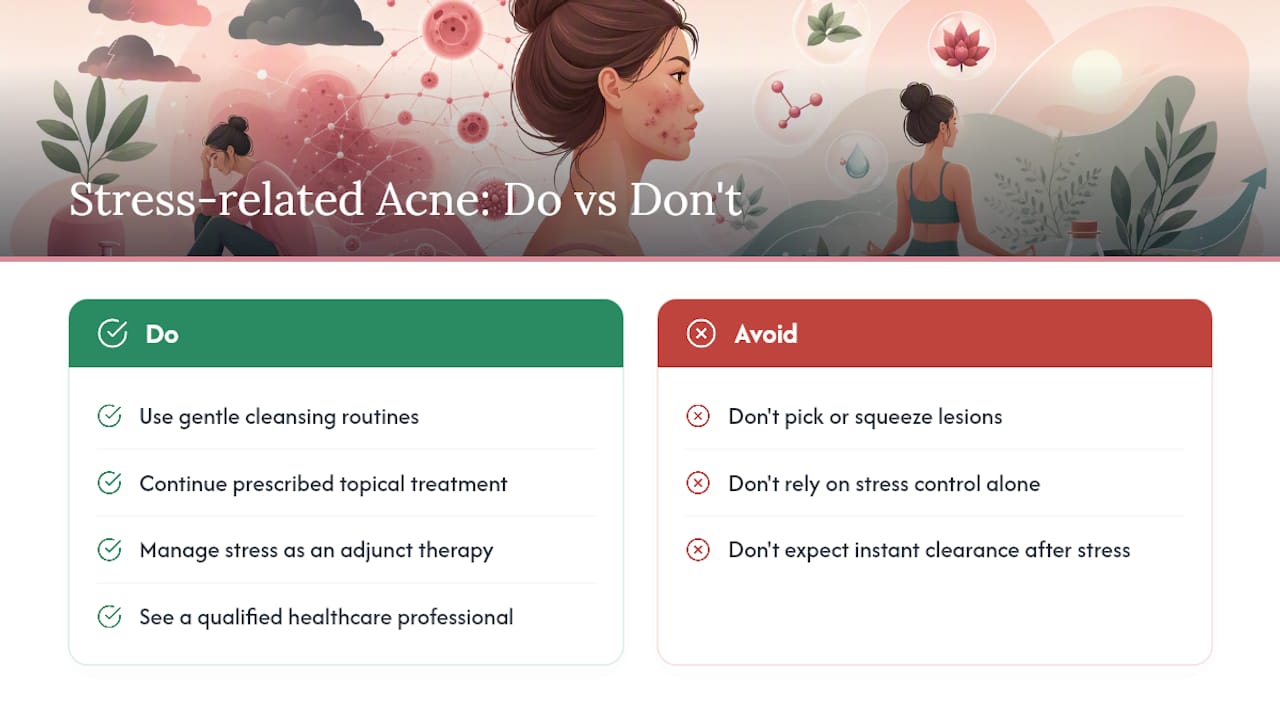
- During an active flare, stick to gentle cleansing, skip the aggressive scrubs and drying spot treatments, and resist the urge to squeeze anything. Keep your prescribed topicals on their normal schedule even when the routine feels pointless in the moment.
- If breakouts are frequent or scarring, talk to a dermatologist about escalating care: topical retinoid and antibiotic combinations, hormonal therapy for cycle-linked flares, or oral options including isotretinoin for more severe, persistent cases.
- Add a psychological intervention with real evidence behind it. CBT and MBSR both show measurable benefit for stress-sensitive skin conditions. A structured program like the one outlined in this step-by-step mindfulness guide is a reasonable, low-barrier place to start if therapy access is limited.
- Support the basics that stress erodes first: consistent sleep, meals that don’t spike blood sugar repeatedly through the day, and regular movement. None of these clear acne on their own, but they remove some of the behavioral fuel feeding it.
- Build adherence into a ritual, not a chore. Pairing your skincare routine with something you already do daily, morning coffee, evening phone scroll, makes it far more likely to survive a stressful month.
Pro Tip: Try tying your stress-reduction practice directly to your skincare routine, five minutes of breathing exercises while your cleanser sits on your face, for example. Two habits reinforcing each other survive stress better than either one alone.
When Breakouts Need a Dermatologist, Not Just a New Routine
Some warning signs mean it’s time to stop self-managing. Deep, painful nodules, breakouts that leave dark marks or pitted scars, or acne that hasn’t responded to consistent over-the-counter treatment after eight to twelve weeks all warrant a professional visit.
A dermatologist evaluating stress-linked acne typically checks for:
- Hormonal patterns, including cycle-related timing and signs of conditions like PCOS
- Current medications and supplements that might be contributing
- Acne severity grading to guide treatment intensity
- Coexisting conditions like anxiety or sleep disorders that may need separate attention
Ask directly about combined care. Some practices now coordinate with psychodermatology specialists or recommend CBT alongside topical and oral treatment, and that integrated approach tends to produce better long-term results than skin-only care.
Florvahealth’s View on Supporting Stress-Sensitive Skin
Stress reduction should sit alongside dermatologic treatment, never replace it. Florvahealth’s inside-out approach, probiotics, gut support, and pH-balanced topical care, is built to support hormonal balance and skin resilience as a daily habit. For moderate to severe acne, a dermatologist’s input still matters most.
Building a Daily Routine That Supports Hormonal Skin
If stress and hormones are both working against your skin, the products you use daily should be doing more than sitting on the surface. Florvahealth’s inside-out system pairs probiotic support with pH-balanced topical care designed specifically around hormonal fluctuation, the same biological terrain that stress disrupts.

These products are adjuncts, not replacements for prescription treatment when acne is moderate to severe. Where they fit best is in the gap between dermatologic care and daily life: supporting gut balance, and pairing that with a gentle, pH-balanced cleanser that won’t strip skin already dealing with inflammation. For spots that track your cycle, hydrocolloid pimple patches protect a breakout while it heals. Explore the full range on the Florva homepage.
Frequently Asked Questions
Does stress actually cause acne, or just make it worse? Stress typically acts as an aggravating factor rather than a root cause. It amplifies oil production and inflammation in skin already prone to breakouts, but it rarely triggers acne in skin with no underlying tendency toward it.
Can anxiety worsen acne even without major life stressors? Yes. Chronic, low-grade anxiety keeps cortisol and local CRH activity elevated over time, which can maintain a mild but persistent inflammatory state in the skin, even without one obvious stressful event.
How long after a stressful period does acne typically flare? Many people notice breakouts emerging days to about a week after a stressful stretch, partly because sebum production changes take time to show up and partly because sleep and habit disruptions lag behind the initial stress trigger.
Can managing stress alone clear acne without other treatment? Rarely on its own for moderate to severe cases. Stress management works best as an adjunct alongside topical or prescription dermatologic treatment, not as a standalone cure.
What’s the fastest way to calm a stress-triggered breakout? Gentle cleansing, consistent use of existing topical treatment, and avoiding picking give skin the best chance to recover without added trauma while the inflammatory signals from stress settle down.
This article is general information, not a substitute for advice from a qualified doctor. Consult a qualified healthcare professional about your own circumstances before acting on anything here.
Sources
- The association between stress and acne among female medical students in Jeddah, Saudi Arabia
- Feeling stressed? It can show in your skin, hair, and nails
- Stress may be getting to your skin, but it’s not a one-way street - Harvard Health
- The Skin–Brain–Exposome Axis in Stress-Sensitive Dermatoses: A Narrative Review


