

Hormonal acne cycle phases are defined as the four distinct stages of the menstrual cycle where shifting estrogen, progesterone, and androgen levels directly change how your skin behaves and how prone it is to breakouts. These phases are the follicular phase, ovulation, the luteal phase, and the menstrual phase. Each one creates a different hormonal environment that either protects your skin or sets the stage for clogged pores and inflammation. Research shows 58.5% of women with acne experience their worst breakouts just before their period. That single statistic tells you this is not random. Your skin is responding to a predictable hormonal script, and once you understand it, you can work with it.
What are the hormonal acne cycle phases explained?
The menstrual cycle runs on a four-phase rhythm, and each phase produces a different hormonal fingerprint. Understanding acne cycles means mapping those hormonal fingerprints to what you actually see in the mirror.
Follicular phase (days 1–13)
The follicular phase begins on the first day of your period and runs until ovulation. Estrogen rises steadily during this window, and rising estrogen promotes collagen and skin hydration, producing clearer, more radiant skin with lower inflammation. This is typically the best week for your complexion. Sebum production is relatively low, pores are less congested, and your skin barrier is at its strongest. Women who track their cycles often notice this phase as the one where their skin feels most cooperative.

Ovulation (around day 14)
Estrogen peaks at ovulation, and that peak supports a healthy skin glow with a temporary reduction in acne severity. However, a brief surge in testosterone also occurs around this point. For women whose skin is sensitive to androgens, this can trigger a minor breakout, particularly along the jawline or chin. The effect is usually short-lived and mild compared to what happens in the phase that follows.
Luteal phase (days 15–28)
The luteal phase is where most hormonal acne originates. Progesterone surges after ovulation, and acne flares correspond closely to this late luteal window when progesterone peaks and skin is most sensitive to acne triggers. Sebum production increases, pores are more likely to clog, and the skin becomes thicker and less able to shed dead cells efficiently. The breakouts you see just before your period were actually set in motion here, roughly 7–10 days earlier.
Menstrual phase (days 1–5)
When your period arrives, both estrogen and progesterone drop sharply. Skin hydration dips during the menstrual phase because of this hormonal withdrawal, making barrier repair and hydration critical to reduce inflammation. The acne that formed during the luteal phase becomes fully visible now. Skin feels more sensitive, sometimes dry, and more reactive to products. This phase demands gentleness, not aggression.
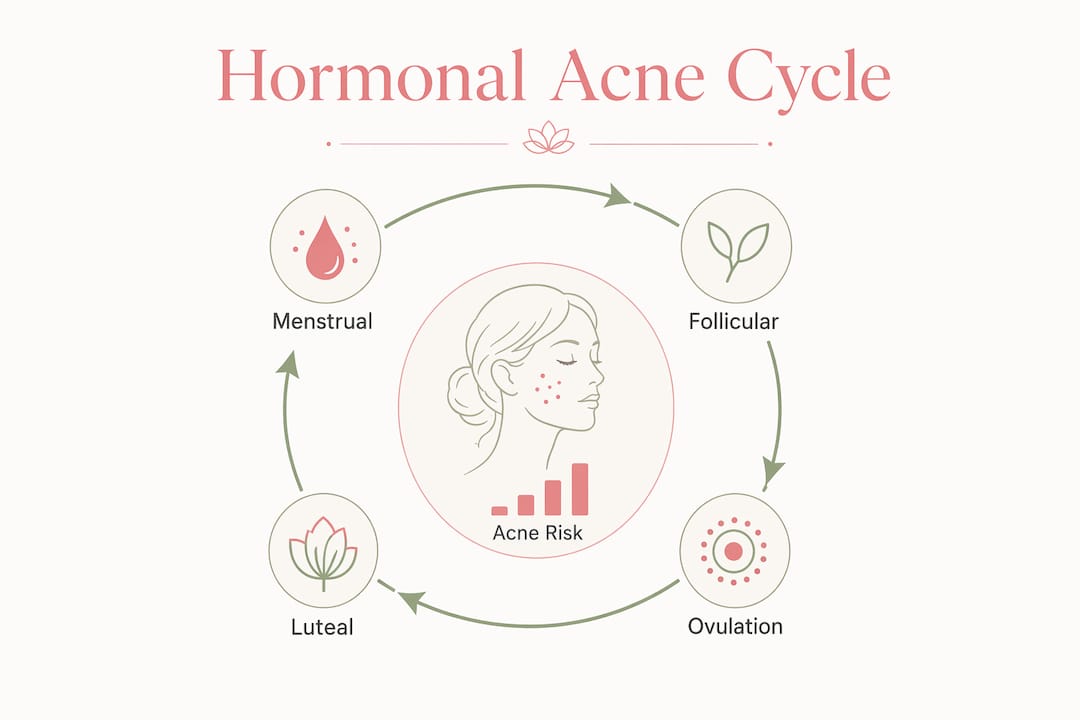
| Cycle phase | Dominant hormone | Skin effect | Acne risk |
|---|---|---|---|
| Follicular | Rising estrogen | Hydrated, clear, radiant | Low |
| Ovulation | Peak estrogen, brief testosterone | Glowing, minor sensitivity | Low to moderate |
| Luteal | Progesterone surge | Oily, congested, thickened | High |
| Menstrual | Estrogen and progesterone drop | Dry, sensitive, inflamed | Moderate (existing acne visible) |
Pro Tip: Track your breakouts on a calendar for two full cycles. You will almost certainly find a pattern that maps directly onto the luteal and menstrual phases, which makes targeted treatment far more effective.
Why do hormonal fluctuations trigger acne?
The biological mechanism behind hormonal acne is more specific than most people realize. Progesterone increases skin sensitivity to androgens rather than directly raising sebum output. This receptor-level sensitivity explains why many women break out despite having completely normal androgen levels on a blood test. Your skin’s androgen receptors become hyperresponsive during the luteal phase, amplifying the acne signal even when circulating hormone levels look fine on paper.
This mechanism also explains the location pattern of hormonal acne. Androgen receptors are densest along the jawline, chin, and lower cheeks. That is why hormonal breakouts cluster in those areas rather than spreading across the forehead or nose the way teenage acne typically does. Recognizing this pattern is one of the clearest signs that your acne is hormonally driven.
Skin cell turnover also slows during the luteal phase. Dead skin cells accumulate faster than they shed, which traps sebum inside follicles and creates the ideal environment for acne-causing bacteria to multiply. The result is not just surface oiliness. It is a structural blockage that forms days before you see any visible blemish.
Hormonal changes also weaken the skin barrier and increase inflammatory sensitivity. When progesterone is high and estrogen is falling, the skin produces fewer ceramides, the lipids that hold the barrier together. A compromised barrier lets irritants in more easily and makes existing inflammation harder to resolve. This is why cycle-synced skincare outperforms uniform treatment by respecting these hormonal sensitivities rather than ignoring them.
Key biological drivers of hormonal acne include:
- Androgen receptor hypersensitivity triggered by progesterone in the luteal phase
- Slowed skin cell turnover leading to follicle blockage and clogged pores
- Reduced ceramide production weakening the skin barrier during hormone withdrawal
- Increased sebum viscosity making oil thicker and more likely to trap bacteria
- Elevated inflammatory response due to falling estrogen and a compromised barrier
How to adapt your skincare to each cycle phase
Adapting your skincare to your cycle is the single most effective strategy for managing hormonal acne phases without constantly irritating your skin. A phased lifestyle and treatment approach yields 90% total acne improvement in 8–12 weeks when lifestyle changes, dietary refinements, and topical treatments are layered progressively. That is a meaningful result, and it comes from working with your cycle rather than fighting it.
Here is how to structure your routine across each phase:
-
Follicular phase. Use this window to introduce or maintain active ingredients. Salicylic acid, niacinamide, and light exfoliants work well when estrogen is high and your barrier is strong. Your skin can handle more without reacting. Focus on maintaining hydration and keeping pores clear as a preventive measure before the luteal phase begins.
-
Ovulation. Keep your routine steady. If you are prone to jawline breakouts around mid-cycle, a targeted salicylic acid spot treatment applied at the first sign of congestion can prevent a full blemish from forming. Avoid introducing new products during this window since your skin is in transition.
-
Luteal phase. Shift your focus to oil control and anti-inflammatory support. Ingredients like salicylic acid, benzoyl peroxide (used carefully), and zinc-based products address the sebum surge. Add a gentle clay mask once or twice a week to absorb excess oil without stripping. Avoid heavy, occlusive moisturizers that can worsen congestion.
-
Menstrual phase. Pull back on actives entirely. Using aggressive treatments like salicylic acid all month weakens the skin barrier, causing dryness and irritation especially when estrogen is low. Switch to a gentle, fragrance-free cleanser, a barrier-repair moisturizer with ceramides, and a soothing serum. Let your skin recover rather than pushing it harder.
Pro Tip: Florvahealth’s cycle-synced skincare guide maps specific product swaps to each phase so you are never guessing what your skin needs that week.
Lifestyle changes amplify every topical effort. Reducing refined sugar and dairy during the luteal phase lowers the insulin response that can spike androgen activity. Prioritizing 7–9 hours of sleep keeps cortisol in check, since cortisol directly worsens androgen-driven sebum production. Stress management through consistent exercise or breathwork also reduces the cortisol-androgen feedback loop that makes luteal-phase breakouts worse.
Common myths about managing hormonal acne
The most damaging myth about hormonal acne is that it is purely a surface problem. Washing your face more often, using stronger cleansers, or applying more product does not address the hormonal receptor activity happening beneath the skin. Treating it as a hygiene issue leads to over-cleansing, which strips the barrier and worsens inflammation.
Several other misconceptions consistently undermine good outcomes:
- “More product means faster results.” Layering multiple actives during the menstrual phase damages the barrier and triggers irritant dermatitis, which looks and feels like a breakout but is actually a reaction to over-treatment.
- “The same routine works all month.” Uniform treatment ignores the fact that your skin’s tolerance, oil production, and barrier strength change significantly across the four phases.
- “Hormonal acne only affects teenagers.” Hormonal acne in women aged 20–40 is driven by adult hormonal patterns, often worsening with stress, birth control changes, or perimenopause.
- “Hydration makes oily skin worse.” Skin hydration during the menstrual phase is commonly underestimated, yet it is a key factor in minimizing inflammatory acne. Dehydrated skin overproduces oil to compensate.
If you have followed a phased approach consistently for 8–12 weeks and seen no meaningful improvement, that is a clear signal to consult a dermatologist. Prescription options like topical retinoids, spironolactone, or hormonal contraceptives address the underlying hormonal driver at a level that topical care alone cannot reach. Phased skincare is powerful, but it has limits. Knowing when to escalate is part of managing your skin well. You can also explore why hormonal symptoms vary monthly to better understand when your pattern signals something worth investigating further.
Key Takeaways
Understanding your hormonal acne cycle phases and adapting your skincare to each phase is the most evidence-backed path to lasting skin clarity.
| Point | Details |
|---|---|
| Luteal phase drives most breakouts | Progesterone peaks here, raising androgen receptor sensitivity and sebum production. |
| Phased treatment yields real results | A layered lifestyle and topical approach produces up to 90% improvement in 8–12 weeks. |
| Menstrual phase needs hydration, not actives | Estrogen withdrawal weakens the barrier; barrier repair reduces inflammation more than exfoliation. |
| Uniform treatment backfires | Applying harsh actives all month damages the skin barrier and worsens acne over time. |
| Cycle tracking predicts flares | Logging breakouts over two cycles reveals a pattern that makes targeted prevention possible. |
Why I think most hormonal acne advice misses the point
Most articles on hormonal acne focus on what to put on your face. Very few talk about timing. In my experience, timing is everything. A woman who uses the right ingredients at the wrong phase of her cycle will see worse results than someone using gentler products at exactly the right time.
The shift I see make the biggest difference is not a product change. It is a mindset change. When you stop treating your skin as a problem to be fixed and start treating your cycle as a rhythm to be read, your whole approach changes. You stop panicking when a breakout appears before your period because you know exactly why it is there and what phase comes next.
Patience is genuinely hard to practice when your skin is inflamed and visible. But the 8–12 week timeline for phased improvement is not a marketing claim. It reflects how long it takes for the skin cell turnover cycle to reset and for hormonal receptor sensitivity to stabilize with consistent support. Quick fixes that promise overnight results almost always involve aggressive ingredients that borrow against your skin’s future health.
One thing I would add that rarely gets mentioned: your cycle length matters. A 24-day cycle compresses the luteal phase significantly, which changes when your peak risk window falls. A 35-day cycle extends it. Generic advice built around a 28-day cycle will be off by days for most women. Tracking your own cycle length and adjusting your phase windows accordingly is the detail that separates real results from frustrating inconsistency.
— Zamanee
Florvahealth’s approach to hormonal skin and cycle balance
Hormonal acne does not exist in isolation. It is one signal in a larger pattern of cycle-driven changes that includes PMS, bloating and energy shifts. Florvahealth’s range is built around that inside-out link, pairing probiotic capsules with gentle skin care.
The turmeric and kojic acid foaming cleanser and tea tree hydrocolloid pimple patches pair with the phase-specific routines covered here, giving your skin gentle cleansing and spot care at each stage of your cycle. Florvahealth’s approach treats the cycle as the system, not the symptom.
FAQ
What phase of the menstrual cycle causes the most acne?
The luteal phase, roughly days 15–28, causes the most acne. Progesterone peaks here, raising androgen receptor sensitivity and increasing sebum production, which leads to clogged pores and breakouts that become visible just before or during menstruation.
Why does hormonal acne appear on the jawline and chin?
Androgen receptors are most concentrated along the jawline, chin, and lower cheeks. When progesterone amplifies sensitivity to androgens during the luteal phase, these areas respond with increased oil production and follicle blockage, producing the characteristic lower-face pattern of hormonal acne.
Can I use salicylic acid during my period?
Using salicylic acid during the menstrual phase is not recommended as a daily treatment. Estrogen is at its lowest during this window, which weakens the skin barrier, and aggressive actives during low estrogen phases can cause irritant dermatitis and worsen inflammation. Switch to barrier-repair ingredients instead.
How long does it take for cycle-synced skincare to work?
A phased approach combining lifestyle changes, dietary adjustments, and targeted topical treatments produces meaningful improvement in 8–12 weeks. The timeline reflects the skin cell turnover cycle and the time needed for hormonal receptor sensitivity to stabilize with consistent support.
Does hormonal acne only happen before your period?
No. While 58.5% of women with acne report their worst flares before their period, 35% worsen during menstruation and 6.5% after. The full hormonal acne pattern spans the luteal and menstrual phases, and some women also experience minor breakouts around ovulation due to the brief testosterone surge.
Recommended
- Hormonal Cycle Phases Explained for Better Health
- Adjust Skincare Across Your Menstrual Cycle
- Simple Skin Care and Hormones: Your Practical Guide
- Why Hormonal Symptoms Vary Monthly: What’s Really Going On
Sources
- Hormonal Acne: Causes, Treatment & Prevention — Cleveland Clinic
- Menstrual Cycle: Overview & Phases — Cleveland Clinic
- Is it really acne? — American Academy of Dermatology


