

A monthly wellness reset is a menstrual cycle-aligned routine built on three product pillars: an oral probiotic, a pH-balanced external wash, and targeted topical care for skin flare-ups. Instead of guessing your way through cramps, bloating, and breakouts every month, you time specific products to specific cycle phases. The payoff, when it works, tends to show up as less cramping, a flatter stomach in the days before your period, and fewer of those stubborn premenstrual breakouts along the jawline.
None of this happens overnight. Randomized trials on probiotic supplementation show measurable pain reduction after three months of consistent use, not three days.
What a reset actually delivers, month over month:
- Lower period pain scores with consistent probiotic use
- Reduced bloating and gut discomfort tied to hormonal shifts
- Calmer, less reactive skin during the luteal phase
- A repeatable routine instead of reactive symptom chasing
Key Takeaways
A monthly wellness reset works because it matches specific, evidence-backed products to specific cycle phases rather than treating every day the same.
| Point | Details |
|---|---|
| Three pillars, not one | Combine an oral probiotic, a pH-balanced external wash, and phase-timed topicals for full coverage. |
| Give it three cycles | Probiotic pain-score improvements typically emerge around month three, not week one. |
| Never douche internally | Use external washes only; internal cleansing disrupts protective vaginal bacteria. |
| Track daily, briefly | Log pain, bloating, and breakouts nightly to know if the routine is actually working. |
| Florva maps to the checklist | Florvahealth’s probiotic, digestive enzyme and skincare collections cover all three reset pillars. |
This article is general information, not a substitute for advice from a qualified doctor. Consult a qualified healthcare professional about your own circumstances before acting on anything here.
Table of Contents
- What Goes Into the Reset, and When
- Why This Actually Works: The Gut-Hormone-Skin Connection
- Your Phase-by-Phase Monthly Checklist
- How to Personalize and Adjust the Reset
- Safety Notes and When to See a Doctor
- What the Research Actually Supports, and Where It Doesn’t
- Building Your Reset With Florva
- Sources
What Goes Into the Reset, and When
Four product types do the heavy lifting. Oral probiotics, ideally multispecies strains with Lactobacillus, support gut and vaginal microbiome balance. Digestive enzymes ease the bloating that often spikes right before your period. A pH-balanced external wash (look for a lactic-acid base) keeps the vulvar area calm without disrupting your natural flora. Topical patches or spot treatments target breakouts exactly when and where they show up.
Timing matters more than most women realize:
- Follicular phase (right after your period): Focus on your probiotic baseline and gentle daily cleansing.
- Ovulation: Skin usually looks its best here. Maintain the routine, nothing new to add.
- Luteal phase: Sebum production climbs, so this is when spot treatments and enzyme support earn their keep.
- Perimenstrual days: Lean on relief patches for cramping and keep the external wash in rotation to manage discharge and odor sensitivity.
Probiotics work best as a continuous habit, not a one-time fix. Stopping tends to erode the benefit within a cycle or two.
Pro Tip: Set a recurring phone reminder for day one of your cycle to restock or reorder your probiotic. Missed days are the number one reason women think a supplement “isn’t working” when they simply weren’t consistent.
Why This Actually Works: The Gut-Hormone-Skin Connection
The mechanism here isn’t mysterious once you see the chain reaction. Estrogen and progesterone don’t just control your cycle. They directly change how much oil your skin produces and how well it holds onto moisture. A review of hormonal fluctuations and skin physiology confirms that sebum output rises while hydration often drops in certain phases, which explains why breakouts cluster in such a predictable window before your period rather than randomly throughout the month.
Gut health enters the picture through what researchers call the gut-skin axis. A 2023 study correlating gut microbiome composition with acne found specific bacterial shifts tracked with inflammatory lesion counts. Your gut isn’t separate from your skin. It’s upstream of it.
The clinical evidence for probiotics themselves is more than anecdotal:
- A randomized trial found daily multispecies probiotic use dropped menstrual pain scores on a standard pain scale after three months, compared to placebo, according to that trial’s published results.
- A separate double-blind RCT confirmed reduced dysmenorrhea severity during active supplementation, though benefits generally require ongoing use.
- Strain-specific research on Lactobacillus paragasseri OLL2809 showed measurable drops in premenstrual irritability after three consecutive cycles.
On the external care side, the vaginal microenvironment is naturally acidic, and it wants to stay that way. A clinical study on lactic-acid vaginal gel found twice-weekly use over eight weeks lowered vaginal pH and improved Nugent scores, a lab measure of healthy bacterial balance, without disrupting the protective lactobacilli that live there. That’s the argument for gentle, pH-matched external washes and against douching, which strips out the bacteria doing the protective work in the first place.
Your Phase-by-Phase Monthly Checklist
This is the part you actually act on. No guesswork, no vague “listen to your body” advice. Just what to use, when, and for how long.
Days 1 to 5 (menstruation):
- Continue your daily probiotic without interruption, even on heavy flow days.
- Use your pH-balanced wash externally once a day. Skip anything with fragrance or harsh surfactants.
- Apply a relief patch at the first sign of cramping rather than waiting for pain to peak.
Days 6 to 13 (follicular phase):
- Keep the probiotic going. This is maintenance mode, not a break.
- This is a good window to sync your broader wellness habits to your cycle, since energy and mood are typically more stable here.
- Skin tends to calm down. Simplify your topical routine rather than adding new products.
Day 14 (ovulation):
- Maintain your baseline. Don’t introduce anything new right before the luteal shift.
Days 15 to 28 (luteal phase):
- Add a digestive enzyme if bloating is a recurring complaint. Take it with your largest meal.
- Start spot-treating any emerging breakouts along the jaw or chin rather than waiting for a full flare.
- Increase water intake. Progesterone-driven water retention responds better to more fluids, not less.
A realistic trial period matters here. Give the probiotic a minimum of three full cycles before judging whether it’s working, since that’s the window most of the dysmenorrhea research used to detect real change. Track your symptoms daily, even briefly.
Pro Tip: Log three numbers each night: a pain score from 1 to 10, a bloating rating, and a yes/no for new breakouts. Thirty seconds a day gives you three months of real data instead of a vague impression.

How to Personalize and Adjust the Reset
Your cycle isn’t identical to your friend’s, so the reset needs a feedback loop built in. Keep a simple daily log tracking pain (rate it 1 to 10), bloating (mild, moderate, severe), acne breakouts (count new ones weekly), and mood shifts.
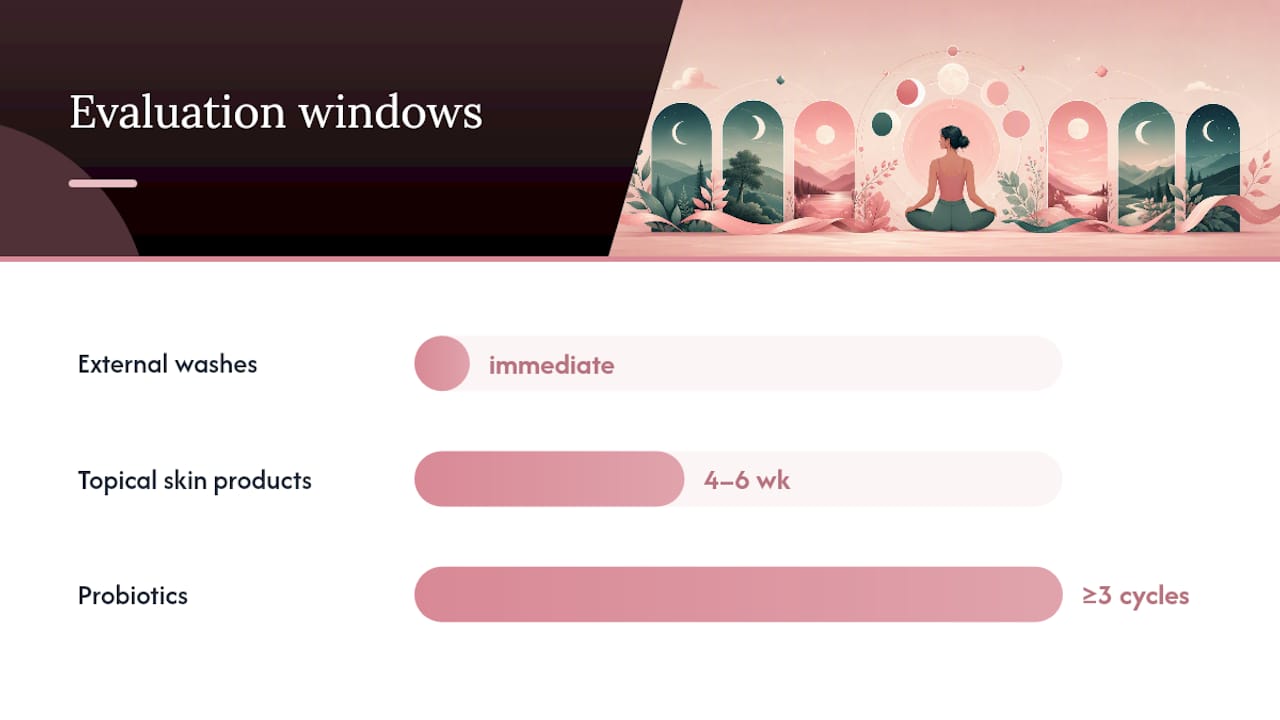
Give each product category its own evaluation window, since they work on different timelines:
- Probiotics: minimum 3 cycles before deciding effectiveness. Subjective relief sometimes shows up in cycle one or two, but the objective pain-score improvements researchers measure tend to land around month three.
- Topical skin products: 4 to 6 weeks, since skin cell turnover takes time.
- External washes: immediate comfort is the marker. If irritation happens, it happens fast.
Watch for these adjustment signals:
- Mild GI upset in the first week of a new probiotic is common and usually settles. Persistent upset past two weeks means switch strains.
- Any burning or redness from a topical patch or wash means stop immediately, not “push through it.”
- No improvement at all by cycle four is a sign to adjust your skincare approach or reconsider the specific probiotic strain.
Safety Notes and When to See a Doctor
This routine is a non-medicated adjunct, not a replacement for medical care, and it isn’t the right first move for severe symptoms. See a clinician promptly for heavy bleeding that soaks a pad hourly, pain that doesn’t respond to anything you try, or signs of infection like unusual odor, fever, or discharge changes.
A few safety basics worth knowing:
- Probiotics are generally well tolerated, but if you’re immunocompromised or on immunosuppressive medication, check with your provider before starting one.
- Never douche or use internal washes. Clinical guidance on vulvovaginal hygiene is consistent on this: internal cleansing disrupts the microbiome and raises infection risk. External washes only.
- Choose washes and topicals that have actual clinical testing behind their pH claims, not just marketing language.
- If you’re pregnant, trying to conceive, or on hormonal medication, run any new supplement by your doctor first.
What the Research Actually Supports, and Where It Doesn’t
Most wellness content treats “balance your hormones” as a vague aspiration you chase with tea and journaling. The research doesn’t support that framing. What it supports is much narrower and, honestly, more useful: specific probiotic strains taken consistently for three months measurably reduce pain scores, and external pH management protects a microbiome that’s already doing protective work on its own.
Where conventional advice falls short is the timeline. Women try a probiotic for two weeks, see no dramatic shift, and assume it failed. The trial data says otherwise. Change shows up gradually, and stopping early is the single biggest reason people conclude “nothing works for me.”
If you prioritize one thing, make it consistency over novelty. Rotating through five different products in search of a miracle fix undermines the entire mechanism, since gut and skin microbiomes need sustained, unchanging input to stabilize. Pick a probiotic, pick a wash, and give both real time before you touch anything else.
— Zamanee
Building Your Reset With Florva
You now know the framework: probiotics, pH-balanced external care and phase-timed topicals. Florvahealth’s range covers each of those, so you’re not sourcing three products from three separate brands.
For the internal piece, the women’s probiotics and digestive enzymes collection covers the probiotic and gut-support steps discussed above. For the skin side of the checklist, the skincare for hormonal skin line and hydrocolloid pimple patches handle the luteal-phase spot treatment step. Every product ships with the same science-forward reasoning laid out here, not vague wellness language.
If your symptoms are severe or don’t respond within a few cycles, talk to your doctor. Otherwise, start by browsing the full wellness collection and picking one product to begin your first three-cycle trial this month.
Sources
- Randomized trial: multispecies probiotics reduce menstrual pain (2026)
- Efficacy of probiotic supplementation in reducing primary dysmenorrhea: double-blind RCT (2026)
- Hormonal fluctuations modulate skin physiology and sebaceous activity (review)
- Lactic acid-containing vaginal gel and pH/microbiota outcomes (2025)


