

Minimal routines support wellness by reducing the mental load that complex health protocols create, freeing up energy for the habits that actually move the needle. The standard wellness industry pushes 12-step morning routines, biometric tracking, and stacked supplement schedules. That volume of effort triggers what clinical psychologist Sophie Mort calls message fatigue, a state where the nervous system becomes exhausted rather than supported. The fix is not more discipline. It is fewer, better habits. Research confirms that simplified routines lower mental fatigue and show measurable health benefits within weeks. Florvahealth is built on exactly this principle: inside-out wellness that works because it is simple enough to stick with.
Why minimal routines support wellness better than complex ones
Decision fatigue is the core reason why minimal routines outperform complex ones. Every choice you make in a day draws from a finite pool of cognitive energy. When your wellness routine demands 10 decisions before 8:00 AM, you arrive at the rest of your day already depleted. Routine creates predictability, and predictability buffers against background anxiety and chronic stress.
The psychological mechanism here is straightforward. The brain does not distinguish between a stressful work deadline and a stressful wellness checklist. Both activate the same stress response. When your morning routine is automatic, your prefrontal cortex stays available for real decisions. That is the core advantage of minimalist wellness practices.
Research links minimalism directly to mental health outcomes. About 1 in 5 Americans practices some form of minimalist lifestyle, and that group reports lower financial stress and reduced clutter-induced anxiety. Clutter, whether physical or in your daily schedule, competes for attention and raises baseline cortisol. Removing it is not a lifestyle preference. It is a health intervention.

The benefits extend to mood and motivation. Daily physical activity as short as 10–15 minutes can lower depression risk by up to 18%. That statistic matters because it reframes the goal. You do not need an hour at the gym. You need consistency, and consistency comes from simplicity.
Pro Tip: Pick one anchor habit for your morning, such as a 10-minute walk right after coffee. Attach it to something you already do automatically. That pairing removes the decision entirely.
Key signs that your routine is creating cognitive overload:
- You feel tired before your day starts
- You skip wellness habits when life gets busy
- You feel guilty rather than energized after your routine
- You rotate between new protocols without finishing any
- You track more metrics than you can interpret
What does a minimal wellness routine actually include?
A minimal wellness routine has three non-negotiable pillars: sleep, movement, and hydration. Wellness expert Jordan Lee Dooley frames this clearly: wellness is not earned through constant improvement but through stewardship and simplification. Advanced tools and supplements work best when they sit on top of a strong foundational routine, not in place of one.
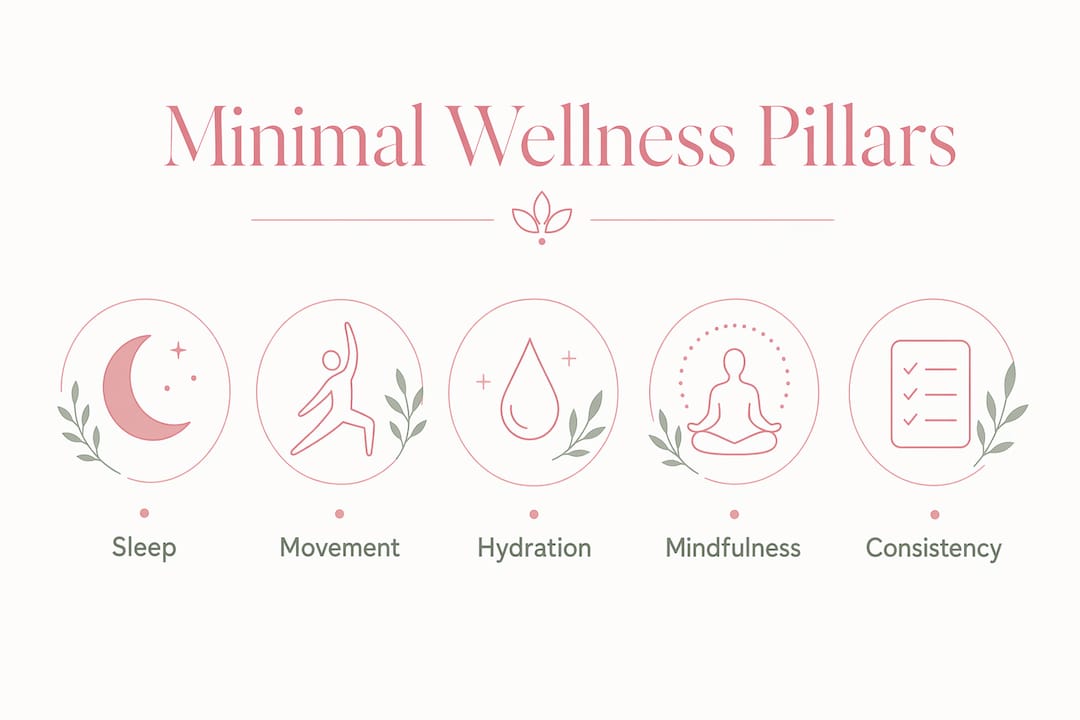
Sleep: the highest-leverage habit
Sleep consistency reduces mental disorder risk more than sleep duration alone. Regular wake times and morning light exposure anchor your circadian rhythm, which governs hormone production, mood regulation, and immune function. The target is 7–9 hours, but the more important variable is waking at the same time every day. That single habit stabilizes more downstream health markers than most supplements combined.
Movement: effective at a low dose
The bare minimum template for physical activity is 150 minutes of moderate exercise per week. That breaks down to about 22 minutes per day, which is a brisk walk. You do not need a gym membership, a fitness tracker, or a structured program to hit this target. You need a pair of shoes and a consistent time slot.
Hydration: the most underrated pillar
Hydration directly affects energy, skin clarity, and hormone balance. Women who track hydration and hormone balance often notice improvements in PMS symptoms, skin texture, and mood stability before they change anything else. The mechanism is simple: dehydration raises cortisol, and elevated cortisol disrupts estrogen and progesterone signaling.
| Pillar | Minimum effective dose | Why it works |
|---|---|---|
| Sleep | 7–9 hours, consistent wake time | Anchors circadian rhythm and hormone production |
| Movement | 150 minutes moderate activity per week | Lowers depression risk and reduces cortisol |
| Hydration | Consistent daily intake | Reduces cortisol, supports hormone signaling |
| Mindfulness | 5–10 minutes daily | Lowers cortisol and supports mental wellness |
Five to ten minutes of consistent daily mindfulness can significantly lower cortisol and stress. That is a shorter commitment than most people spend scrolling before bed.
Why do complex wellness routines fail?
Complex routines fail because they treat wellness as a performance rather than a practice. When you track 15 health metrics, follow a 7-supplement stack, and attempt three new protocols simultaneously, you create a system that only works under ideal conditions. Life is not ideal. The routine collapses the moment your schedule shifts, and the collapse triggers guilt, which makes restarting harder.
Overtracking health metrics produces stress that outweighs the benefits of the data. Monitoring every variable keeps your nervous system in a low-grade alert state. That is the opposite of what wellness is supposed to deliver.
Perfectionism compounds the problem. When a routine is complex, any deviation feels like failure. When a routine is simple, missing one day is irrelevant because the next day’s habit is easy to resume. Simplicity creates resilience. Complexity creates fragility.
The 10-to-3 audit is a practical fix. List every wellness habit you currently practice or intend to practice. Then cut the list to three. The 10-to-3 audit forces you to identify which habits actually move your health forward and which ones you do out of obligation or trend-following. Sleep, movement, and hydration survive almost every audit. Most other habits do not.
- Write down every wellness habit you currently do or plan to do
- Rate each habit by actual health impact, not effort or cost
- Identify the three with the highest impact-to-effort ratio
- Drop everything else for 30 days
- Add one habit back only after the three are fully automatic
Pro Tip: When you feel the urge to add a new wellness habit, wait two weeks. If the urge is still there and your current three habits are solid, add it. If not, the urge was trend-driven, not need-driven.
How do you build a minimal wellness routine that sticks?
Building a routine that sticks requires anchoring new habits to existing ones. Habit anchoring removes ambiguity about when to act. Instead of deciding each morning whether to exercise, you attach the habit to a fixed cue, such as putting on workout clothes immediately after brushing your teeth. The decision disappears. The behavior becomes automatic.
Start by selecting three habits that address your most pressing health goals. For most people in their 20s and 30s, those goals center on energy, mood, and hormonal balance. A minimal routine targeting those outcomes might look like this:
- Wake at the same time daily and get 5 minutes of morning light
- Walk for 20–25 minutes at lunch or after dinner
- Drink water before coffee and before each meal
Environmental design supports the routine without requiring willpower. Place your water bottle on the counter where you make coffee. Set your walking shoes by the door. Keep your daily rituals visible and the friction to start them as low as possible.
Tracking should be minimal by design. One checkbox per habit per day is enough. The goal is not data collection. The goal is building the identity of someone who does these three things. Consistency in minimal routines produces measurable health improvements within weeks, which means you will feel the results before you have accumulated months of data.
Scale gradually. After 30 days of consistent three-habit adherence, you can add one more practice if your goals require it. Florvahealth’s approach to women’s wellness follows this same logic: start with foundational support, such as gut health and hormonal balance, then layer in targeted care as the foundation solidifies. Simple skin care and hormones work the same way. A clean, consistent routine outperforms an elaborate one every time.
Key Takeaways
Minimal routines support wellness because they eliminate the decision fatigue and perfectionism that cause complex protocols to collapse, leaving only the high-impact habits that produce real, lasting results.
| Point | Details |
|---|---|
| Decision fatigue is the enemy | Every extra wellness choice depletes cognitive energy; fewer habits preserve it. |
| Three pillars cover the foundation | Sleep (7–9 hours), movement (150 min/week), and hydration address most health goals. |
| The 10-to-3 audit works | Cutting your habit list to three high-impact actions prevents burnout and improves adherence. |
| Habit anchoring removes willpower | Tying new habits to existing cues makes them automatic and far more durable. |
| Simplicity produces faster results | Consistent minimal routines show measurable health improvements within weeks. |
What I’ve learned from watching people overcomplicate wellness
Most people do not fail at wellness because they lack discipline. They fail because they build systems that only work when everything goes perfectly. I have watched this pattern repeat across every wellness conversation I have had: someone starts strong with a 10-habit morning routine, hits one hard week at work, and abandons the whole thing because missing one piece feels like failing the entire system.
The uncomfortable truth is that complexity in wellness often signals anxiety, not commitment. When you are uncertain whether your habits are working, the instinct is to add more. More supplements, more tracking, more protocols. That instinct makes the problem worse. Removing non-essential habits and focusing on what matters is structurally protective for mental health.
Wellness is stewardship, not optimization. Your body does not need you to perform health. It needs you to show up consistently with the basics. The people I have seen thrive long-term are not the ones with the most sophisticated routines. They are the ones who sleep well, move daily, drink water, and do not stress about the rest. That is not a lowered standard. That is the actual standard.
— Zamanee
Florvahealth products built for minimal wellness routines
Florvahealth designs products for women who want real results without adding complexity to their day. Every product in the Florvahealth system is built to slot into a minimal routine, not replace it.

Digestive enzyme capsules support digestion with one simple daily step that fits the three-pillar framework. The green tomato clay facial cleanser supports skin health through a low-effort cleansing routine that pairs with a minimal morning habit. Both reflect the idea this article is built on: fewer, better inputs produce better outcomes. Visit Florvahealth to see the full range.
FAQ
What are minimal routines in wellness?
Minimal wellness routines are a small set of consistently practiced, high-impact habits, typically sleep, movement, and hydration, that support health without creating cognitive overload or burnout.
How does simplicity improve mental health?
Routine creates predictability that buffers against anxiety and decision fatigue. Fewer daily choices preserve cognitive energy and lower baseline stress levels.
How many habits should a minimal wellness routine include?
Three high-impact habits is the recommended starting point. The 10-to-3 audit method identifies which three habits deliver the most health benefit with the least effort.
Can a minimal routine actually improve physical health?
Yes. Just 10–15 minutes of daily physical activity lowers depression risk by up to 18%, and consistent sleep timing stabilizes hormone production and immune function without any additional intervention.
How long before a minimal routine shows results?
Measurable health improvements from consistent minimal routines typically appear within weeks, making simplicity one of the fastest paths to observable change.
Recommended
- Why Daily Rituals Support Hormones: a Women’s Guide
- Florva Health: probiotics, intimate care and skincare
- About Us
- Simple Skin Care and Hormones: Your Practical Guide
Sources
- Stress — MedlinePlus, National Library of Medicine
- Healthy Sleep — MedlinePlus, National Library of Medicine
- Exercise and Physical Fitness — MedlinePlus, National Library of Medicine


