

For PCOS-related irregular cycles, inositol is the most evidence-backed starting point. For PMS, bloating and luteal symptoms, a phase-aware routine combining magnesium, B6 and probiotic support will get you further than any single pill. If you want the probiotic part covered, Florvahealth’s women’s probiotic capsules are a simple option.
Match your goal to the right approach before you buy anything:
- Irregular cycles or PCOS: Myo-Inositol + D-Chiro-Inositol at a 40:1 ratio (4 grams of Myo-Inositol and 100 mg of D-Chiro-Inositol in powder form daily) is the clinical benchmark.
- PMS, bloating, and luteal symptoms: Magnesium glycinate + B6 + chasteberry blends, ideally in a phase-synced kit that pairs internal supplements with topical or lifestyle support.
- Hormonal acne alongside cycle symptoms: Pair a daily probiotic with gentle topical care, like Florvahealth’s turmeric and kojic acid foaming cleanser.
Start with the approach that matches your primary symptom. Reassess after two full cycles before adding or switching anything.
Table of Contents
- How do different cycle regulation supplements compare?
- What does the evidence say about each key ingredient?
- Which supplement type fits your condition and timeline?
- What are the safety risks and interactions you need to know?
- How do you choose the right supplement for your cycle?
- How does Florvahealth’s system address cycle regulation?
- What does a 90-day supplement plan actually look like?
- Key Takeaways
- The case for slowing down and tracking
- Florvahealth offers a ready-to-use kit for women managing multiple cycle symptoms
- Useful sources for further reading
How do different cycle regulation supplements compare?
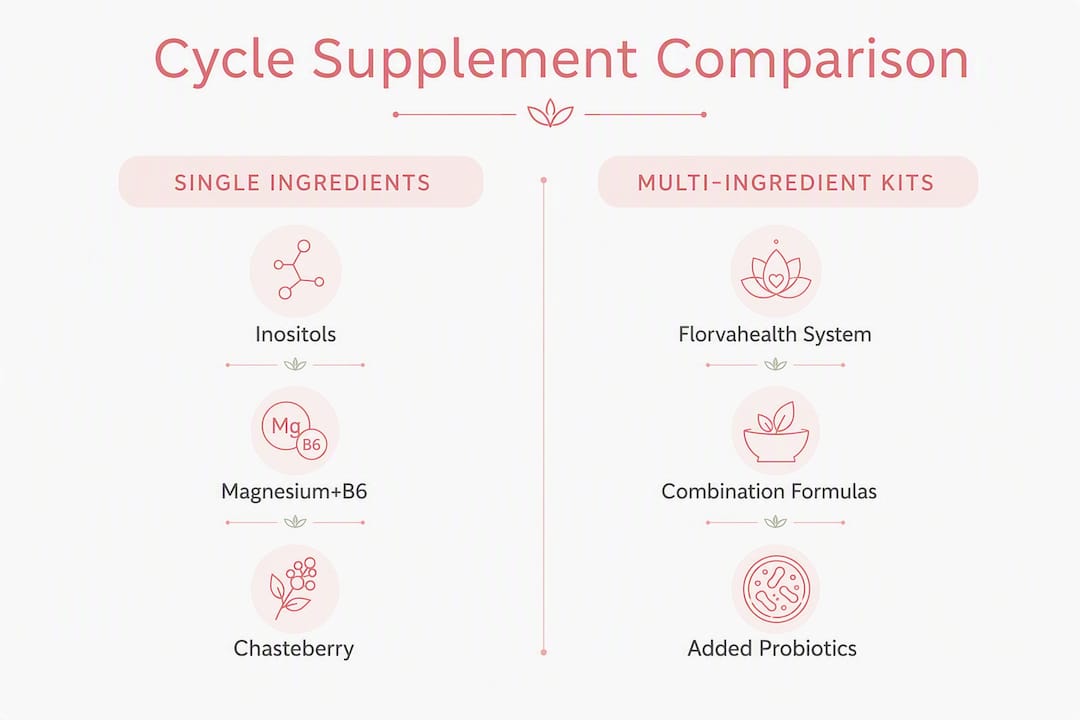
The table below organizes the main supplement types alongside Florvahealth’s product entries. Florvahealth options appear first, followed by the major supplement categories you’ll encounter when researching hormonal support.
| Option | Best for | Primary ingredient(s) | Evidence level | Typical dose & form | Time to effect | Safety notes | Price / format | Ease of use |
|---|---|---|---|---|---|---|---|---|
| Myo/D-Chiro Inositol protocol | PCOS, anovulatory cycles, ovulation support | Myo-Inositol + D-Chiro-Inositol (40:1) | Strong: multiple RCTs in PCOS populations | 4 grams of Myo-Inositol and 100 mg of D-Chiro-Inositol in powder form daily | several weeks of consistent use to assess cycle regularity | GI upset at high doses; caution with diabetes meds | Single-ingredient powder | Requires measuring or pre-dosed packets |
| Magnesium + B6 + chasteberry blend | PMS, mood swings, luteal cramps | Magnesium glycinate, pyridoxine (B6), agnus castus | Moderate: consistent clinical signal for PMS | clinically supported doses of magnesium, vitamin B6, and chasteberry | a few weeks for luteal phase symptom relief | Chasteberry interacts with hormonal contraceptives | Single bottle or blend | Easy; 1–2 capsules daily |
| Probiotic-only supplement | Gut-hormone axis support, general cycle health | Lactobacillus strains, Bifidobacterium | Emerging: strong mechanistic rationale, growing trial base | probiotic doses commonly used in research | a few weeks of consistent use | Generally well tolerated | Single bottle | Very easy; one capsule daily |
| Omega-3 fatty acids | Dysmenorrhea, inflammation, mood | EPA + DHA | Moderate: RCT evidence for period pain reduction | a dose of omega-3 fatty acids typically studied, softgel | a few weeks of consistent use | Anticoagulant interaction at high doses | Single bottle | Easy; 1–2 softgels daily |
| Vitamin D + magnesium | Irregular cycles, mood, bone support | Cholecalciferol, magnesium | Moderate: deficiency correction improves cycle regularity | typical maintenance doses of vitamin D3 and magnesium | a few weeks of consistent use | Test levels before high-dose D3 | Single bottle or combo | Easy |
| DIM (diindolylmethane) | Estrogen dominance, hormonal acne | DIM from cruciferous extract | Limited direct RCT data; mechanistic support | a usual dose of DIM taken daily | a few weeks of consistent use | Avoid in pregnancy; may affect thyroid meds | Single bottle | Easy |
A few practical trade-offs worth noting:
Powder formats make clinical inositol dosing straightforward. Reaching 4 g of Myo-Inositol in capsule form typically means swallowing three to four capsules per dose, which many women find hard to sustain. Pre-dosed powder packets solve that problem and are the format most clinical protocols use.
Multi-ingredient kits like the Florvahealth system trade single-ingredient clarity for broader symptom coverage and built-in adherence structure. If your goal is isolating one variable (say, confirming inositol works for your cycles), a clean single-ingredient product gives you a cleaner read. If your goal is managing PMS across multiple symptom domains at once, a kit is the more practical choice.
What does the evidence say about each key ingredient?
The ingredients below have the strongest research backing for cycle regulation and hormonal support. Evidence quality varies considerably, so the summary for each is honest about where the data is solid and where it is still emerging.
Myo-Inositol and D-Chiro-Inositol
Myo-Inositol improves insulin signaling in the ovaries, which is why it consistently shows up in PCOS research as a tool for restoring ovulation and cycle regularity. The clinical protocol most supported by trials is 4 g Myo-Inositol combined with 100 mg D-Chiro-Inositol daily, a 40:1 ratio that mirrors the body’s natural tissue distribution. Evidence level: strong, with multiple randomized controlled trials in PCOS populations.

Magnesium and vitamin B6
Magnesium glycinate reduces PMS-related cramping, mood changes, and bloating by supporting smooth muscle relaxation and neurotransmitter synthesis. B6 amplifies that effect by supporting progesterone production and reducing premenstrual anxiety. Cycle-syncing frameworks specifically recommend both during the luteal phase, when progesterone demand peaks. Evidence level: moderate, with consistent clinical signals across multiple PMS trials.

Chasteberry (agnus castus)
Chasteberry acts on dopamine receptors in the pituitary gland, which suppresses excess prolactin and helps normalize the luteal phase. It is one of the better-studied herbal options for PMS, with several European trials showing meaningful reductions in breast tenderness, mood symptoms, and cycle irregularity. The typical studied dose is 20–40 mg of a standardized extract daily. Evidence level: moderate.
Omega-3 fatty acids (EPA and DHA)
Omega-3s reduce prostaglandin-driven inflammation, which directly lowers the severity of dysmenorrhea (painful periods). Several randomized trials have compared omega-3 supplementation to ibuprofen for period pain, with omega-3s performing comparably in some studies. The effective dose in most trials is 1–2 g of combined EPA and DHA daily. Evidence level: moderate for dysmenorrhea; emerging for mood and cycle regularity.
Probiotics
The gut-hormone connection is real: certain gut bacteria metabolize and recirculate estrogen through a process involving beta-glucuronidase activity. Disrupting that process with the wrong bacterial balance can contribute to estrogen dominance and irregular cycles. Lactobacillus and Bifidobacterium strains are the most studied for hormonal support. Evidence level: mechanistically strong, clinical trial base still growing.
Pro Tip: If you’re already taking a multi-ingredient kit, check whether it includes a probiotic strain. Many women add a standalone probiotic on top of a PMS blend without realizing their kit already covers it, which doubles the dose unnecessarily.
Vitamin D
Low vitamin D is disproportionately common in women with PCOS and irregular cycles. Correcting a deficiency often improves cycle regularity on its own, which is why testing your level before supplementing is worth doing. The typical supplementation range is 1,000–2,000 IU of D3 daily for maintenance, though deficiency correction may require higher short-term doses under clinical supervision. Evidence level: moderate, strongest when deficiency is confirmed.
DIM (diindolylmethane)
DIM supports the liver’s conversion of estrogen into less potent metabolites, making it a popular choice for estrogen-dominance symptoms like hormonal acne and heavy periods. Direct RCT evidence in menstrual populations is limited, but the mechanistic rationale is solid. Evidence level: limited direct trial data; mechanistic support is well established.
Licorice root
Licorice has anti-androgenic properties that may help with PCOS-related symptoms like excess androgens, but it also raises blood pressure with prolonged use. It is one of the more interaction-prone herbal ingredients in cycle support products. Evidence level: limited; use with caution and not long-term without clinical oversight.
Which supplement type fits your condition and timeline?
| Condition | Recommended supplement type | Typical clinical dose/form | Expected timeline |
|---|---|---|---|
| PCOS / anovulatory cycles | Myo + D-Chiro Inositol (40:1) | 4 grams of Myo-Inositol and 100 mg of D-Chiro-Inositol in powder form daily | several weeks of consistent use to assess cycle regularity |
| PMS (mood, cramps, bloating) | Magnesium + B6 + chasteberry blend or phase-synced kit | clinically supported doses of magnesium, vitamin B6, and chasteberry | several weeks of consistent supplementation for symptom reduction |
| Hormonal acne | DIM + probiotic + topical support | 100–200 mg DIM + 10–50 billion CFU probiotic | a few weeks of consistent use for skin changes |
| Irregular cycles (non-PCOS) | Probiotic + vitamin D + magnesium multi-nutrient kit | Per label; D3 1,000–2,000 IU + Mg 200–400 mg | a few weeks of consistent use |
| Dysmenorrhea (painful periods) | Omega-3s + magnesium | supplement doses of omega-3 fatty acids and magnesium typically studied for period pain | a few menstrual cycles for period pain relief |
| Luteal-phase bloating | Phase-specific kit (luteal nutrients + topical support) | Per kit instructions | a few weeks for luteal phase symptom relief |
On format and adherence: Phase-synced kits that pair internal supplements with lifestyle and tracking guidance consistently outperform single-pill approaches in real-world use, not because the ingredients are different, but because the structure keeps women on protocol. Powder inositol is clinically ideal for PCOS but requires a daily mixing habit. Capsule-based kits are easier to sustain for most women managing multiple symptoms.
When to escalate to a clinician:
- No improvement in cycle regularity after 12–16 weeks of consistent use
- Cycles shorter than 21 days or longer than 45 days
- Suspected thyroid dysfunction (see thyroid and hormone balance for overlap symptoms)
- Pregnancy, breastfeeding, or active fertility treatment
- Symptoms worsening rather than improving after 8 weeks
What are the safety risks and interactions you need to know?
Most cycle-regulation supplements are low-risk at standard doses, but “natural” does not mean interaction-free. A few combinations deserve real attention.
Chasteberry and hormonal contraceptives are the most commonly missed interaction. Chasteberry modulates dopamine and prolactin pathways, which can theoretically interfere with the hormonal signaling that oral contraceptives rely on. If you’re on the pill, discuss chasteberry use with your prescriber before starting.
Omega-3s at high doses (above 3 g daily) have anticoagulant effects. Combined with blood thinners like warfarin or aspirin therapy, that becomes clinically relevant. At the 1–2 g range used for cycle support, the risk is low for most women, but worth flagging if you’re on anticoagulant therapy.
Licorice root raises blood pressure with prolonged use and can interact with antihypertensives, corticosteroids, and diuretics. Products containing licorice should not be used long-term without monitoring.
DIM and thyroid medications may interact because DIM affects estrogen metabolism pathways that overlap with thyroid hormone processing. Women on levothyroxine or other thyroid medications should confirm compatibility with their prescriber.
Inositol is one of the gentler options on this list. The main side effect at clinical doses is gastrointestinal discomfort, particularly nausea or loose stools, which typically resolves after the first week or two. Starting at half the clinical dose for the first week reduces that risk.
Pregnancy and breastfeeding: Chasteberry, DIM, licorice, and high-dose omega-3s are not recommended during pregnancy without direct clinician oversight. Probiotics and magnesium at standard doses are generally considered safe, but confirm with your OB or midwife before continuing any supplement regimen once pregnant.
This article is general information, not medical advice. Confirm supplement choices with a qualified healthcare provider, particularly if you have an underlying condition, take prescription medications, or are pregnant or breastfeeding.
How do you choose the right supplement for your cycle?
Start with your primary goal, not the longest ingredient list. A supplement with twelve ingredients sounds thorough but makes it nearly impossible to know what’s working or causing a side effect.
The decision framework:
- Identify your primary symptom. Irregular cycles point toward inositol or vitamin D correction. PMS and luteal symptoms point toward magnesium, B6, and chasteberry. Hormonal acne points toward DIM and probiotic support. Bloating specifically points toward a phase-aware kit.
- Confirm the clinical dose on the label. A magnesium supplement with 50 mg per capsule is not going to move the needle; the research-supported range is 200–400 mg daily. Check the dose per serving, not just the ingredient list.
- Check for proprietary blends. A “hormone blend” that lists five ingredients without individual doses tells you nothing about whether any of them are present at a meaningful level. Avoid them when you can.
- Choose a format you’ll actually use. Powder inositol is clinically ideal but requires daily mixing. If that habit won’t stick, a capsule-based kit at a slightly lower dose you take consistently beats a clinical dose you skip half the time.
- Verify trust signals. Look for third-party testing and cGMP manufacturing on the label or brand website. These are the minimum standards that confirm the product contains what it claims at the stated dose.
Label checklist:
- Dose per serving listed for every active ingredient (no hidden proprietary blends)
- Inositol ratio specified (40:1 Myo:D-Chiro) if targeting PCOS or ovulation
- Third-party testing certification (NSF, USP, Informed Sport, or equivalent)
- GMP or cGMP manufacturing statement
- Clear allergen disclosure
- Pregnancy/breastfeeding warning where applicable
Pro Tip: If your primary goal is PCOS-related cycle regularity, start with a clean inositol powder as a benchmark before layering other supplements. It gives you a clear signal of whether inositol is working before you add magnesium, B6, or herbal ingredients that could confuse the picture.
How does Florvahealth’s system address cycle regulation?
Florvahealth’s approach targets the most common cluster of symptoms women bring to cycle support: PMS, luteal-phase bloating, hormonal acne, and general cycle irregularity. Rather than selling a single ingredient, the brand builds around the principle that gut health, hormone regulation, and skin clarity are connected systems, and that addressing all three simultaneously produces better outcomes than treating each in isolation.
| Florvahealth product | Primary goal | Key components | How it maps to evidence |
|---|---|---|---|
| Probiotic capsules (as offered in the system) | Gut-hormone axis, estrogen metabolism support | Lactobacillus/Bifidobacterium strains | Supports healthy estrogen recirculation; complements cycle-regulation nutrients |
The kit format matters for a practical reason. Cycle-synced systems that integrate tracking and actionable guidance consistently outperform standalone pills in real-world adherence. Florvahealth’s system is designed around that same principle: the components work together, and the structure of a kit makes it easier to stay on protocol across the two to three cycles needed to evaluate genuine effect.
The probiotic capsules within the system address the gut-hormone axis directly. Certain gut bacteria regulate beta-glucuronidase activity, which controls how much estrogen gets reabsorbed versus excreted. A healthy gut microbiome supports more balanced estrogen levels, which is relevant for both cycle regularity and hormonal acne.
“The value of cycle-synced systems comes from integrating tracking and actionable guidance along with phase-specific formulas, not just from the pills themselves.” Fourmula Review: A 56-Day Expert Trial
Florvahealth publishes educational content alongside its products, which supports informed use and realistic expectations. The brand’s guide to herbal supplements for cycle balance and its overview of hormone-balancing supplement benefits give buyers the context to use the products correctly rather than guessing.
What does a 90-day supplement plan actually look like?
The plan below is organized by primary goal. Pick the track that matches your dominant symptom and follow it for three full cycles before drawing conclusions.
Day 1: Choose your starting protocol
- PCOS or irregular cycles: Begin a Myo-Inositol + D-Chiro-Inositol powder protocol (4 grams of Myo-Inositol and 100 mg of D-Chiro-Inositol in powder form daily). Take it with breakfast to reduce GI discomfort. If you also want probiotic support, Florvahealth’s women’s probiotic capsules can sit alongside it.
- PMS, bloating, or luteal symptoms: Start a magnesium glycinate + B6 + chasteberry blend on day 1 of your cycle. Pair with phase-specific wellness habits to reinforce the supplement’s effect.
- Hormonal acne as the primary concern: Start a daily probiotic and pair it with gentle topical care, such as Florvahealth’s turmeric and kojic acid foaming cleanser and hydrocolloid pimple patches.
Weeks 1–4: Baseline and tolerance
- Log your starting symptom severity (bloating, cramp intensity, skin breakouts, cycle length) using a simple 1–10 scale or a period-tracking app.
- Note any GI side effects from inositol or new supplements; these typically resolve by week two.
- Do not add new supplements during this window. One variable at a time.
Weeks 5–8: First assessment checkpoint
- Compare symptom scores to baseline. PMS and bloating should show measurable improvement by this point if the supplement type is right for you.
- If no change at all by week eight, reconsider the ingredient match before extending the trial.
Weeks 9–12: Cycle regularity evaluation
- Cycle length consistency is the metric that matters here. Two cycles within a normal range (21–35 days) after previously irregular cycles is a meaningful signal.
- If symptoms have improved but cycle regularity has not, consider adding or switching to an inositol protocol with clinician input.
- Seek clinical follow-up if cycles remain outside the 21–35 day range, if symptoms have worsened, or if you are considering pregnancy.
Tracking metrics to monitor:
- Cycle length (days from first day of one period to first day of the next)
- Symptom severity score per phase (luteal, menstrual)
- Side effects log
- Skin condition changes (for acne-focused protocols)
Key Takeaways
Matching your supplement to your specific symptom is the single most important step in any cycle regulation supplements comparison, and allowing at least 12 weeks to evaluate cycle regularity prevents premature switching.
| Point | Details |
|---|---|
| Match ingredient to goal | Inositol for PCOS/ovulation, magnesium + B6 + chasteberry for PMS, probiotics for gut-hormone support. |
| Prioritize clinical doses | Check the dose per serving; a supplement below the research-supported range will not produce the studied effect. |
| Format drives adherence | Powder inositol reaches clinical doses easily; capsule-based kits suit women managing multiple symptoms daily. |
| Allow 12 weeks for cycle regularity | Symptom relief may appear in a few weeks for luteal phase symptom relief, but cycle length changes need at least three full cycles to evaluate. |
| Florvahealth’s range | Probiotic capsules and gentle topical care can sit alongside the core supplement for your main symptom. |
The case for slowing down and tracking
Most women who try cycle-regulation supplements give up too early or switch too fast. Three weeks in, the bloating hasn’t disappeared, so they add another product, then another, until they’re taking seven supplements and have no idea which one, if any, is doing something.
The research is clear on this: two to three cycles is the minimum window to distinguish a real physiological response from normal cycle variation. That’s not a marketing line to keep you buying longer. It’s the reality of how slowly hormonal systems shift.
There’s also a tendency to treat “natural” as a shortcut. It isn’t. Inositol at 4 g daily is a meaningful physiological intervention. Chasteberry at a clinical dose affects pituitary signaling. These are real mechanisms with real timelines, and they deserve the same structured evaluation you’d give a prescription medication: a defined starting dose, a tracking method, and a clear reassessment date.
The most underrated part of any supplement protocol is the tracking. Not because the data is interesting, but because without it, you’re flying blind. A symptom score of 7 in month one and 4 in month three is evidence. “I feel a bit better, maybe” is not.
Pick one approach. Track it honestly. Give it 12 weeks.
Florvahealth offers a ready-to-use kit for women managing multiple cycle symptoms
Managing PMS, bloating and hormonal acne with separate single-ingredient bottles means coordinating doses and checking for overlaps. Keep the routine short: one core supplement for your main symptom, a probiotic such as Florvahealth’s women’s probiotic capsules, and gentle topical care for your skin.
Both options include educational content to support tracking and realistic expectations, which is what separates a supplement system from a supplement pile. Visit florvahealth.com to review the full kit contents and find the option that fits your primary goal.
Useful sources for further reading
The sources below back the clinical claims in this article and are worth reviewing directly if you want to go deeper on any ingredient or approach.
| Source | Why it’s useful |
|---|---|
| PMC: Inositol in PCOS and cycle regulation | Peer-reviewed trial evidence on inositol’s role in PCOS and ovulatory function. |
| PMC: Magnesium and menstrual health | Clinical review of magnesium’s role in PMS and menstrual symptom reduction. |
| European Review: Cycle supplement evidence | Peer-reviewed overview of supplement evidence for menstrual cycle support. |
| Eco Hormone Balance: Best inositol for cycle regularity | Practical breakdown of inositol dosing, ratios, and format trade-offs. |
| Cycle Synced: Phase-specific supplement guide | Maps nutrients to cycle phases for targeted supplementation. |
| Sacred as a Mother: 3-cycle Bond Cycle Care review | Real-world multi-cycle tracking review that illustrates why timeline matters. |
| Florvahealth: Herbal supplements for cycle balance | Florvahealth’s evidence review of herbal ingredients for menstrual support. |
Recommended
- Herbal Supplements for Cycle Balance: What Works
- Holistic PMS Management Best Practices: 2026 Guide
- Benefits of Hormone Balancing Supplements for Women
- Sync Wellness Habits to Your Menstrual Cycle
Sources
- Chasteberry: Usefulness and Safety — NIH National Center for Complementary and Integrative Health
- Evening Primrose Oil: Usefulness and Safety — NIH National Center for Complementary and Integrative Health
- Menstruation and Menstrual Problems — NICHD, National Institutes of Health


