

Take your probiotic consistently, and for most non-enteric-coated supplements, take it with or right after a meal. The main exception is antibiotics, which need a timing gap, and high-risk groups like preterm infants or immunocompromised people, who need a clinician’s input before starting. Beyond that, the exact hour matters far less than whether you actually remember to take it every day. If you use a once-a-day capsule such as our women's daily probiotic, taking it with the same meal each day makes it easier to remember.
TL;DR:
- Consuming probiotics with or shortly after meals, especially those containing fat or protein, improves bacterial survival by buffering stomach acid.
- Nighttime or morning dosing can be effective; adherence consistency is more important than the exact time of day.
- Space probiotic and antibiotic doses by at least two to three hours to avoid reducing probiotic efficacy during antibiotic treatment.
- Preterm infants, immunocompromised individuals, and pregnant people should consult a healthcare professional before using probiotics due to potential infection risks.
- Probiotic benefits typically appear within a few weeks, with lasting changes in bowel habits and reduction of digestive discomfort often taking two to three months.
Table of Contents
- Why Timing Matters: Digestion, Stomach Acid, and Probiotic Survival
- Should You Take Probiotics With or Without Food?
- Is It Better to Take Probiotics in the Morning or at Night?
- How Should You Take Probiotics While on Antibiotics?
- Who Should Avoid Probiotics, and What Does the FDA Say?
- How Long Does It Take for Probiotics to Work?
- What Should You Check Before Choosing a Probiotic?
- A Hormone-Aware Take on Probiotic Timing
- Building a Probiotic Routine That Actually Fits Your Cycle
- Sources
- FAQ
Why Timing Matters: Digestion, Stomach Acid, and Probiotic Survival
Stomach acid is the biggest obstacle a probiotic faces before it ever reaches your gut. The stomach’s pH can drop low enough to kill a large share of live cultures within minutes, and gastric emptying speed determines how long those cultures sit in that acidic environment before moving on.
Food changes that equation. A controlled digestion study on Lactobacillus rhamnosus GG found that pairing the strain with solid, buffering foods like durum wheat pasta, or with milk, improved bacterial survival compared to taking it on an empty stomach. The research on food matrix and timing suggests meals essentially act as a shield, diluting acid and slowing transit just enough for more organisms to survive the trip.
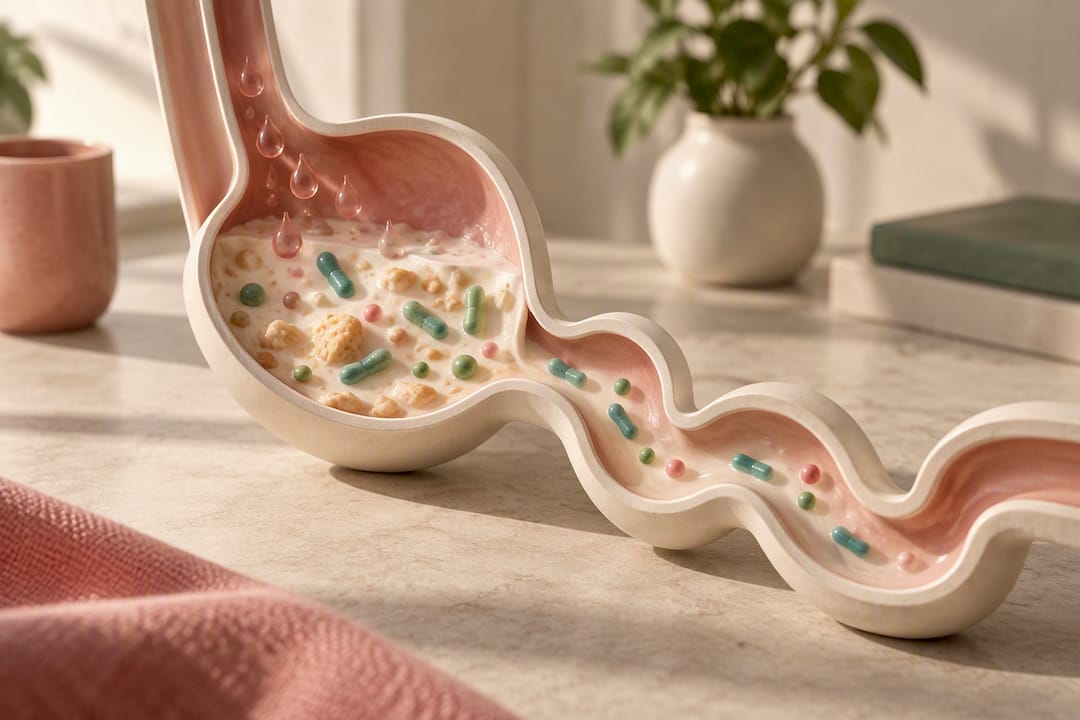
That said, plenty of clinical trials never controlled for time of day at all, and many still recorded real benefits. Harvard Health notes that consistent daily use and the right strain selection tend to matter more than the precise hour you swallow the capsule.
What this means practically:
- Acidic, empty-stomach conditions kill off more live cultures than a full stomach does.
- Solid foods and milk-based drinks appear to buffer stomach acid better than water alone.
- Benefits still show up across studies that never standardized timing, which tells you timing is a lever, not a requirement.
Statistic to remember: In simulated digestion testing, LGG counts came out higher when the strain was consumed alongside pasta or soy milk than when taken with no food at all.
Should You Take Probiotics With or Without Food?
The evidence generally leans toward taking probiotics with or shortly after a meal, especially for the non-enteric-coated capsules and powders that make up most of the market. Food buffers stomach acid long enough for more organisms to survive the trip through your digestive tract.
Not all foods offer equal protection. Fat and protein-rich foods, like dairy, seem to shield probiotic strains better than a plain glass of water or an acidic juice. Starchy solids, similar to the pasta used in the LGG survival study, perform well too. A carbonated soda or citrus drink, by contrast, adds acidity rather than buffering it, which works against you.
A few pairing ideas that fit an average morning or evening routine:
- Yogurt or a glass of milk alongside your capsule.
- A slice of whole-grain toast with breakfast.
- A small bowl of oatmeal or rice before bed.
- Avoid pairing your dose with black coffee, soda, or citrus juice.
Manufacturer instructions override general advice when the two conflict. Some enteric-coated products are formulated to survive regardless of food, and their labels may say so explicitly.
Pro Tip: If your probiotic label doesn’t mention food timing at all, default to taking it with a meal that includes some fat or protein. It’s the safer bet for uncoated capsules.
Is It Better to Take Probiotics in the Morning or at Night?
Morning with breakfast is the most common recommendation, mostly because it’s convenient and lines up with a time when your bowels tend to be more active. Prevention’s roundup of expert advice frames this as a convenience-driven suggestion, not a strict physiological rule.
Nighttime dosing works for some people too, and a few reports less daytime gas when they shift their dose before bed. Since individual response varies, the smartest approach is a short personal experiment:
- Pick one time of day and stick with it for two weeks.
- Note any gas, bloating, or energy changes you notice.
- Switch to the opposite time for another two weeks if the first didn’t feel right.
- Keep whichever time you’re most likely to remember daily.
Anchoring the dose to something you already do (brushing your teeth, making coffee) beats picking an “ideal” hour you’ll forget by Thursday. A pill organizer or a phone reminder closes the gap between intention and habit.
How Should You Take Probiotics While on Antibiotics?
Never take your probiotic at the exact same time as your antibiotic dose. Antibiotics don’t discriminate between harmful bacteria and the beneficial strains you’re trying to introduce, so taking them together can undercut the probiotic’s job before it starts.
Space the two doses by several hours; the CDC’s antibiotic guidance supports this separation as standard practice. Certain strains have real evidence behind them for this specific use. Systematic reviews summarized by the NCCIH show probiotics can lower the risk of C. difficile-associated diarrhea in people on antibiotics, though the effect size depends heavily on which strain, dose, and duration you use.
Practical steps for the antibiotic window:
- Separate probiotic and antibiotic doses by at least two to three hours.
- Ask your prescriber whether a strain like Saccharomyces boulardii or a specific Lactobacillus fits your prescription.
- Continue the probiotic for at least two weeks after finishing the antibiotic course, since that’s the window where evidence for reduced antibiotic-associated diarrhea is strongest.
Statistic to remember: Reviews cited by NCCIH describe a moderate-certainty reduction in C. difficile-associated diarrhea risk among antibiotic-treated patients who also took probiotics, though results vary by strain and study.
Who Should Avoid Probiotics, and What Does the FDA Say?
Most healthy adults tolerate probiotics without issue. The risk profile changes sharply for two groups: people who are immunocompromised, and preterm infants.
The FDA has warned that preterm infants given probiotics formulated with live bacteria or yeast face a risk of invasive, potentially fatal infections. The agency also notes that no probiotic product currently holds FDA approval as a drug for use in infants.
That FDA safety advisory exists precisely because a live microorganism, harmless in a healthy gut, can behave very differently in a fragile immune system or an underdeveloped one.
Before starting any probiotic, check where you fall:
- Pregnant or immunocompromised individuals should talk to a clinician first, not after symptoms appear.
- Anyone with a serious chronic illness, a central line, or a compromised gut lining needs medical guidance before adding live cultures.
- Preterm infants should never receive a probiotic without direct physician oversight, given the FDA’s specific warning.
- Healthy adults without these risk factors generally tolerate standard probiotic supplements well.
How Long Does It Take for Probiotics to Work?
Timelines vary by what you’re measuring. Antibiotic-related endpoints, like reduced diarrhea risk, can shift within days of starting a probiotic alongside treatment. Symptom changes like bloating or stool regularity typically take a few weeks of consistent use. Broader shifts in your gut microbiome’s composition tend to unfold over months, not days.
Here’s a rough sequence of what to expect:
- First few days: Some people notice mild, temporary gas or bloating as their gut adjusts; this is common and usually settles on its own, according to NIH’s consumer fact sheet.
- Two to four weeks: Watch for less bloating, more regular stools, or reduced digestive discomfort.
- Two to three months: Look for sustained improvement rather than day-to-day fluctuation.
- If nothing changes by three months, revisit the strain, dose, and your adherence with a clinician before assuming probiotics don’t work for you.
What Should You Check Before Choosing a Probiotic?
Enteric coating changes the entire timing conversation. Coated capsules are engineered to resist stomach acid, so they depend far less on being taken with food than an uncoated powder or standard capsule does.
Beyond coating, a handful of label details predict how well a product will actually perform:
- Strains listed by full genus, species, and strain identifier, not just a generic category name.
- CFU count guaranteed at expiration, not just at the time of manufacturing.
- Clear storage instructions, since some strains need refrigeration to stay viable while others are shelf-stable.
- Any delayed-release or enteric-coating claim printed directly on the label.
- A manufacturer contact listed for reporting adverse effects.
Pro Tip: If a label doesn’t state CFU at expiration, assume the count on the front is a manufacturing-date figure, not what you’re actually getting months later. Storage matters just as much as the dose.
A Hormone-Aware Take on Probiotic Timing
Gut and hormonal health run on overlapping timelines, which is why some wellness brands pair internal probiotic support with topical care rather than treating them separately. For readers managing PMS or bloating, anchoring a probiotic dose to a consistent morning routine tends to align better with cycle-related digestive shifts than an irregular schedule does.
— Zamanee
Building a Probiotic Routine That Actually Fits Your Cycle
If the sections above told you anything, it’s that consistency beats precision. Florvahealth’s Women's Probiotics and Digestive Enzymes are formulated for that kind of daily-use routine, designed to pair with a meal the way the evidence above recommends for non-enteric-coated products.

For readers dealing with bloating after meals, Florva’s digestive enzyme capsules are a simple option. None of this replaces medical advice. If you’re pregnant, immunocompromised, or managing a chronic condition, talk to a clinician before adding any new supplement to your routine. Otherwise, browse the product details on each collection page, pick a routine that fits a meal you eat daily, and give it a few weeks before judging the results.
Sources
For deeper reading beyond this guide, the FDA’s safety advisory on preterm infants covers the infant-specific risk in full. The LGG food matrix study details the digestion research behind meal-pairing advice. Cleveland Clinic’s guide on probiotic timing and NIH’s NCCIH safety summary round out the clinical context.
This article is general information, not a substitute for advice from a qualified doctor. Consult a qualified healthcare professional about your own circumstances before acting on anything here.
- FDA: Risk of invasive disease in preterm infants given probiotics
- Food matrix and timing influence survival of Lactobacillus rhamnosus GG during simulated digestion (PubMed)
- NCCIH: Probiotics usefulness and safety
FAQ
Is It Better to Take Probiotics at Night or in the Morning?
Neither time has a clear physiological advantage for most people. Cleveland Clinic’s guidance points out that the best time is whichever one you’ll remember every single day, since adherence outperforms micro-optimizing the exact hour.
What Should You Not Mix Probiotics With?
Avoid taking a probiotic at the exact same time as an antibiotic dose, since the antibiotic can kill the beneficial strain before it has a chance to establish itself. Separate the two by several hours, following CDC guidance on antibiotic use, and skip pairing your dose with very acidic drinks like soda or citrus juice.
What Are Signs That a Probiotic Is Working?
Look for less bloating, more regular stools, and reduced digestive discomfort over two to four weeks of consistent use. Mild, temporary gas in the first few days is common and usually settles, according to NIH’s consumer fact sheet.
When Should You Not Take Probiotics?
Preterm infants should not receive probiotics without direct physician oversight, given the FDA’s warning about invasive infection risk in this group. Anyone who is pregnant, immunocompromised, or managing a serious chronic illness should also consult a clinician before starting, since risk factors that don’t affect healthy adults can matter a great deal in these situations.


