

Start a short, repeatable weekly wellness check-in routine this week and you will notice the difference within a month. Pick a fixed day and time, choose a 1-minute, 5-minute, or 15-minute format, write down 3–5 prompts, and schedule a five-minute review at the end of each week. That is the whole system. Practitioners at Northwell frame the goal as cultivating awareness, not achieving perfection, and Gallup research ties manager attention to engagement directly to better team outcomes. Here is your copy-paste starter checklist:
- Set your calendar. Block the same slot every week (Monday morning or Friday afternoon work well for most teams).
- Invite participants. Keep the group small at first; 3–8 people is a manageable pilot size.
- Choose your format. Decide whether responses stay private (a shared doc only you see) or are discussed openly.
- Prepare 3 prompts. Start with body, mind, and energy. Add a fourth for workload if you lead a team.
- Set one success metric. Participation rate above 80% is a practical first target.
Key Takeaways
A consistent weekly wellness check-in, run in 5–15 minutes with clear confidentiality norms and one measurable goal, is the most reliable way to build lasting health awareness for individuals and teams.
| Point | Details |
|---|---|
| Start with a fixed schedule | Anchor your check-in to an existing habit and block the same slot every week. |
| Choose the right format | Use a 1-minute daily micro-check, a 5-minute weekly pulse, or a 15-minute group session based on your context. |
| Aim for 80% completion | Consistent 80% participation over time outperforms a perfect two-week streak followed by nothing. |
| Track three metrics | Monitor participation rate, self-rated energy or mood (1–5), and one operational KPI each week. |
| Florvahealth supports the follow-through | When check-ins surface recurring hormonal symptoms, Florvahealth’s PMS and skin support products offer a natural, non-medicated next step. |
Table of Contents
- Why do weekly wellness check-ins actually improve health and productivity?
- What formats and prompts work best for a weekly wellness check-in?
- How do you set up the routine step by step?
- How do you build a workplace culture where check-ins actually feel safe?
- When should you refer someone to a professional?
- Ready-to-copy templates and scripts for your first check-in
- How do you know if your check-in routine is working?
- How can women tailor check-ins to support hormonal health?
- What actually works when you run weekly wellness checks
- Florvahealth supports your weekly wellness routine from the inside out
- Sources
Why do weekly wellness check-ins actually improve health and productivity?
Weekly check-ins work because they create small course corrections before problems compound. Occasional missed workouts or poor sleep rarely derail progress. The trouble starts when those patterns go unnoticed for weeks. A brief, consistent check-in surfaces the drift early.
Board-certified practitioners at Northwell are clear on this: the purpose of a wellness self-assessment is to detect shifting health trends early, not to enforce a perfect standard. That framing matters. When people know they are building awareness rather than being graded, they show up honestly.
Stat to know: Gallup’s organizational research shows that manager focus on both performance and employee engagement correlates with better organizational outcomes. For team leaders, a weekly check-in is one of the lowest-effort, highest-signal tools available to stay connected to how your team is actually doing.
For individuals, the benefit is quieter but just as real. A weekly health assessment gives you a structured moment to notice what your body and mind are signaling, before those signals get loud enough to demand attention.
What formats and prompts work best for a weekly wellness check-in?
Three formats cover almost every situation. Pick the one that fits your schedule and your team’s culture, then stick with it for at least four weeks before switching.
The 1-minute daily micro-check
This is the entry point for anyone who has never done a wellness check-in before. Healthline recommends keeping it under a minute to preserve sustainability. Choose 1–2 prompts, answer them honestly, and move on. The goal is to make health awareness feel like a daily rhythm rather than an occasional reset.
Sample prompts (pick 1–2):
- How rested do I feel on a scale of 1–5?
- Where am I holding tension right now?
- Did I drink enough water today?
The 5-minute weekly pulse
This is the workhorse format for most people. A weekly wellness checklist framework recommends a five-minute review and targets roughly 80% completion rather than perfection. Run it solo on Sunday evening or as a team huddle on Monday morning.
Sample agenda:
- Rate your energy, mood, and sleep this past week (30 seconds).
- Name one thing that went well (30 seconds).
- Name one thing you want to do differently (30 seconds).
- Set one small, specific goal for the coming week (2 minutes).
- Note any follow-up needed (1 minute).
The 15-minute group check-in
Best for teams of 3–12 people. Healuno’s practitioner guidance recommends a 10–15 minute window for reflecting, tracking, and setting small goals. Keep it structured so it does not drift into a general meeting.
Sample agenda:
- One-word check-in round (each person says one word describing their week) — 3 minutes.
- Facilitator shares one team-level observation — 2 minutes.
- Open prompt: “What do you need this week to do your best work?” — 5 minutes.
- Wrap-up: any follow-up actions or referrals — 5 minutes.
| Format | Duration | Best for | Frequency |
|---|---|---|---|
| Daily micro-check | 1 minute | Individuals, wellness beginners | Daily |
| Weekly pulse | 5 minutes | Individuals or small teams | Weekly |
| Group check-in | 15 minutes | Teams of 3–12 | Weekly |
How do you set up the routine step by step?
Setup takes about 20 minutes the first time. Do it once, and the system runs itself.
Step 1: Anchor to an existing habit. Attach the check-in to something you already do, a morning coffee, the end of a team standup, or the first five minutes of a Friday wrap-up. Habit anchoring is the single most reliable way to keep a new routine alive past week three.
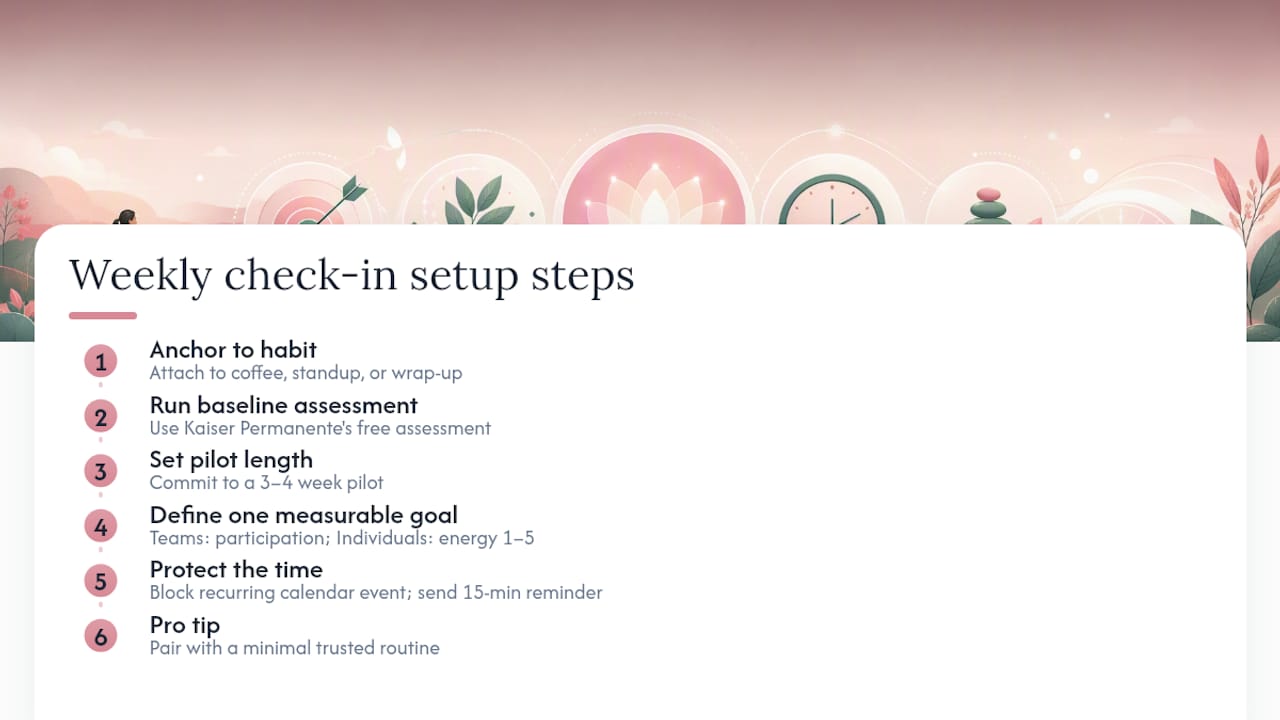
Step 2: Run a baseline assessment first. Before you start tracking progress, know where you are starting. Kaiser Permanente’s health assessment tool is a free, structured way to establish a personal baseline and identify which areas deserve the most attention in your prompts.
Step 3: Set your pilot length. Commit to a 3–4 week pilot. That is long enough to see a pattern but short enough to feel low-stakes. At the end of week four, spend ten minutes reviewing: Did participation hold? Did the prompts feel relevant? Adjust one thing and run another four weeks.
Step 4: Define one measurable goal. Participation rate is the easiest first metric for teams. For individuals, a self-rated energy score (1–5, logged weekly) works well. Keep the measurement simple enough that you will actually do it.
Step 5: Protect the time. Block it on the calendar as a recurring event. Send a reminder 15 minutes before. If a week gets skipped, restart the following week without guilt.
Pro Tip: Pair the check-in with a minimal routine you already trust. The smaller the activation energy, the more likely the habit sticks.
How do you build a workplace culture where check-ins actually feel safe?
Psychological safety is not a soft concept. Without it, check-ins become performative, people say “fine” every week, and you learn nothing useful.
Start with these norms from day one:
- Confidentiality by default. What is shared in the check-in stays in the check-in unless the person sharing chooses otherwise.
- Opt-in, not mandatory. Requiring participation signals surveillance, not care. Invite people; let them choose the depth of their response.
- Voluntary sharing. No one should feel pressure to disclose a health condition, a personal struggle, or anything they are not ready to share.
Facilitator do’s and don’ts:
- Do use open, nonjudgmental language (“How are you feeling about your workload?” not “Are you keeping up?”).
- Do keep the time boundary firm. A check-in that runs long becomes a meeting, and people stop attending.
- Do normalize a range of responses. “I’m doing great” and “I’m struggling” are both valid.
- Don’t probe for details someone has not offered.
- Don’t use check-in data to evaluate performance.
- Don’t skip your own check-in as the facilitator. Modeling participation builds trust faster than any policy.
Red flags that a check-in is causing harm:
- Participation drops sharply after the first two weeks.
- People give identical, flat responses every week.
- Someone expresses discomfort with the format privately.
If any of these appear, pause the group format, have a one-on-one conversation with the person who seems most affected, and revisit the norms before resuming.
When should you refer someone to a professional?
A wellness check-in is not a clinical tool, and it should never be treated as one. Knowing when to step back and point someone toward real support is the most important skill a facilitator can have.
Escalate immediately if someone:
- Expresses suicidal ideation or thoughts of self-harm.
- Describes an acute safety concern (their own or someone else’s).
- Shows signs of a mental health crisis (disorientation, severe distress, inability to function).
In those situations, do not wait. Call 911 if there is immediate danger. For non-emergency mental health crises, the 988 Suicide and Crisis Lifeline (call or text 988) is available 24/7 across the United States.
For ongoing concerns that fall short of a crisis:
- Direct the person to your organization’s Employee Assistance Program (EAP). Most U.S. employers offer EAP services that include free, confidential counseling sessions. The referral is simple: “Our EAP offers free, confidential support. Would you like me to share the contact information?”
- Respect privacy. You do not need to know the details of someone’s situation to make a warm referral. Share the resource and let the person decide.
- Document only what is necessary. If you make a referral, note the date and that a resource was shared, nothing more.
U.S. escalation resources:
- 988 Suicide and Crisis Lifeline: call or text 988
- Crisis Text Line: text HOME to 741741
- SAMHSA National Helpline: 1-800-662-4357 (free, confidential, 24/7)
- Your organization’s EAP: check your HR portal or employee handbook
Ready-to-copy templates and scripts for your first check-in
Team invitation email
Subject: New 5-minute weekly check-in starting [Date]
Hi team,
Starting [Day], I’m adding a brief 5-minute wellness check-in to the beginning of our [existing meeting] or as a standalone Monday morning slot. Participation is completely voluntary, and nothing shared leaves the group.
This week’s prompts:
- How is your energy on a scale of 1–5?
- What went well for you last week?
- What do you need this week to do your best work?
You can respond verbally, drop a note in the chat, or just listen. See you [Day] at [Time].
[Your name]
Individual opt-in message (for a self-care weekly schedule)
I’m starting a short weekly check-in with myself every [Sunday evening / Monday morning]. I’ll spend 5 minutes answering 3 questions about my energy, sleep, and one goal for the week. No apps required, just a note in my phone or a sticky note on my desk.
1-minute solo script
Answer these three questions out loud or in writing:
- Body: How does my body feel right now? (one word or a number 1–5)
- Mind: What is taking up the most mental space today?
- Next step: What is one small thing I can do today to support myself?
5-minute team script
- 0:00–0:30 Facilitator opens: “Let’s do a quick check-in. One word for how your week went.”
- 0:30–2:00 Round-robin one-word responses, no commentary.
- 2:00–4:00 Open prompt: “What do you need this week?”
- 4:00–5:00 Facilitator notes any follow-ups, closes the check-in.
Tracking table template
| Date | Format | Participation rate | Top concern noted | Follow-up action |
|---|---|---|---|---|
| [Date] | 5-min pulse | [%] | [e.g., workload] | [e.g., shared EAP link] |
| [Date] | 15-min group | [%] | [e.g., sleep] | [e.g., adjusted meeting time] |
Paste this into a shared Google Sheet or Notion page. Update it after each session. You will have a clear pattern within four weeks.
How do you know if your check-in routine is working?
Track three things: participation, self-rated wellbeing, and one operational signal.
Participation rate is the most honest early indicator. For individuals, “did I actually do it this week?” is the equivalent metric.
Self-rated energy or mood (a simple 1–5 score logged weekly) gives you a trend line over time. A weekly health check-in framework from Healuno recommends reflecting on what worked and setting small, specific goals each week. That reflection loop is where the score becomes useful: not as a grade, but as a signal.
One operational KPI keeps the routine grounded in real outcomes. For teams, on-time task completion or a reduction in last-minute sick-day requests are easy to track without new tools. For individuals, something like “did I get 7+ hours of sleep at least four nights this week?” works well.
Iteration cadence:
- Weeks 1–4 (pilot): Review participation and mood scores after each session. Tweak one prompt or one logistical element per week if needed.
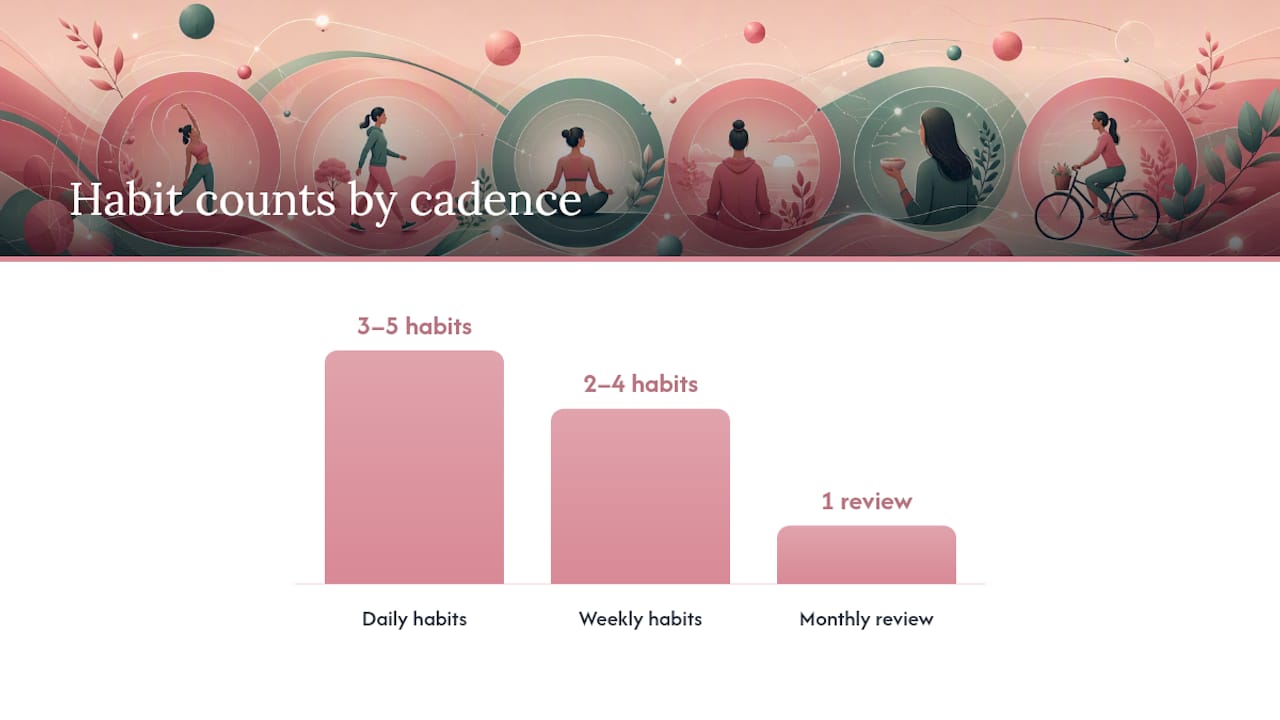
- Month 2 onward: Review the full tracking table monthly. Look for patterns, not single data points. A framework from MyHealthDesire recommends pairing 3–5 daily habits with 2–4 weekly habits and one monthly review for pattern recognition.
Pro Tip: *Aim for 80% completion rather than 100%. Chasing perfection is what kills wellness routines.
How can women tailor check-ins to support hormonal health?
For women tracking cycle-related symptoms, a weekly check-in becomes significantly more useful when it accounts for where you are in your cycle. Energy, mood, sleep quality, and physical symptoms like bloating or skin changes all shift across the four cycle phases. A prompt that feels irrelevant in week one of your cycle may be the most important one in week three.
Syncing wellness habits to your menstrual cycle is a practical way to make check-in prompts feel accurate rather than generic. Daily rituals that support hormones can also anchor the check-in to an existing morning or evening practice, which improves adherence.
Sample cycle-aware prompts (rotate based on phase):
- How is my energy compared to last week? Higher, lower, or the same?
- Am I noticing any bloating, skin changes, or mood shifts?
- How well did I sleep the last three nights?
- What does my body seem to need most right now: rest, movement, or nourishment?
- Is there anything I want to flag for my next healthcare appointment?
The fifth prompt is the one most people skip. It is also the most valuable. Tracking symptoms weekly gives you a concrete record to share with a clinician rather than trying to reconstruct a month’s worth of patterns from memory.
Pro Tip: Keep cycle-aware check-ins private by default. A personal note or a dedicated section in a journal works better than a shared team doc for this kind of tracking. Participation stays higher when people control who sees what.
When a symptom shows up consistently across multiple cycles, such as severe cramping, significant mood disruption, or persistent fatigue, that pattern warrants a conversation with a healthcare provider, not just a check-in prompt.
What actually works when you run weekly wellness checks
The routines that survive past the first month share three traits: a consistent schedule, a short format, and clear confidentiality rules. That combination sounds obvious, but most wellness initiatives fail on at least one of those three. The schedule slips because it was never anchored to an existing habit. The format expands because someone thought more depth would be more useful. The confidentiality rules were implied rather than stated, and one uncomfortable moment ended participation.
The pitfall worth naming directly: the 15-minute group check-in is the format most likely to drift into something that feels like a performance review. The fix is simple. State the norms out loud at the start of the first three sessions, not just once. “This is a space for awareness, not evaluation. Nothing shared here affects your performance record.” Say it until it is obvious.
Run a low-stakes pilot before you scale. Four weeks, one small group, one simple format. Measure participation. If it drops, you have useful information about what to change, and you have not committed an entire organization to a format that does not fit.
Florvahealth supports your weekly wellness routine from the inside out

A weekly check-in tells you what your body is signaling. Florvahealth’s range is built to help you act on those signals. It combines probiotic capsules, a pH-balanced intimate wash and gentle skin care into a minimal, inside-out routine that pairs with a weekly self-check.
When your check-in surfaces a pattern, such as bloating after meals or skin flare-ups before your period, Florvahealth’s digestive enzyme capsules or hydrocolloid pimple patches give you a simple, non-medicated option. The full Florvahealth range is available online, with no prescription needed.
Browse the Florvahealth range and find the support that fits what your check-ins are telling you.
This content is for general informational purposes only and is not a substitute for professional medical advice. Consult a qualified healthcare provider for any health concerns.
Sources
These are the primary sources behind the guidance in this article. Each one is worth bookmarking before you start your pilot.
- Am I Healthy … Really? An 8-Part Self-Assessment Guide | The Well by Northwell
- How to create a 1-minute daily health check-in habit — Healthline
- Take a health assessment | Kaiser Permanente
- Weekly Wellness Checklist: Body, Mind, Recovery | Basks
- Reset Your Habits: The Power of a Weekly Health Check-In — Healuno
- Managers’ focus on performance and engagement — Gallup News


