

O positive (O+) means your blood belongs to the O group in the ABO system and carries the Rh(D) antigen on your red blood cells. As the most common blood type in the United States, affecting roughly 38–40% of the population, it shapes what blood you can safely receive, who benefits from your donations, and what your clinician needs to know during pregnancy.
What you need to know right now:
- You can only receive O positive or O negative red blood cells in a transfusion
- Your blood can go to anyone with a positive blood type: A+, B+, AB+, and O+
- If you are pregnant or planning to be, your Rh-positive status matters for your care plan
- Donating blood as an O+ woman is one of the highest-impact things you can do for your community
- Get your blood type on your medical chart if it is not already there
Table of Contents
- What does “O positive” actually mean biologically?
- Who can receive O+ blood, and who can give it to you?
- What O+ means when you are pregnant
- How common is O+ in the United States?
- How to donate blood if you are O+
- Myths about O+ and what actually matters for your health
- When to talk to your doctor about blood type and related symptoms
- How blood health connects to hormonal symptoms
- O+ and organ transplantation: what you should know
- O+ blood in childbirth emergencies
- Does blood type affect how medications work or disease risk?
- Key Takeaways
- Blood type facts and the bigger picture of women’s health
- Florvahealth and cycle symptom support
- Useful sources and further reading
What does “O positive” actually mean biologically?
Your blood type is two facts in one. The “O” tells you which antigens sit on the surface of your red blood cells. Type A blood carries A antigens; type B carries B antigens; type AB carries both. Type O carries neither. That absence is exactly what makes O blood broadly compatible: your red cells do not trigger the immune attack that A or B antigens would cause in a mismatched recipient.
The “positive” is a separate piece of information. It means your red blood cells carry the Rh(D) protein, also called the Rhesus factor. If that protein is present, you are Rh positive. If it is absent, you are Rh negative. The Cleveland Clinic explains that blood bank specialists determine your full blood type by testing for both the ABO antigen and the Rh factor together.
Key antigen facts at a glance:
- Type O red cells: no A antigen, no B antigen
- Rh positive: Rh(D) protein present on the red cell surface
- Rh negative: Rh(D) protein absent
- Your blood type is inherited, the same way eye color is
Pro Tip: Ask your clinician or lab to note your blood type as “O positive” on your chart, not just your ABO group. Request a “type and screen” if you are pregnant or planning surgery — it captures both your ABO group and your antibody status in one draw.
Who can receive O+ blood, and who can give it to you?
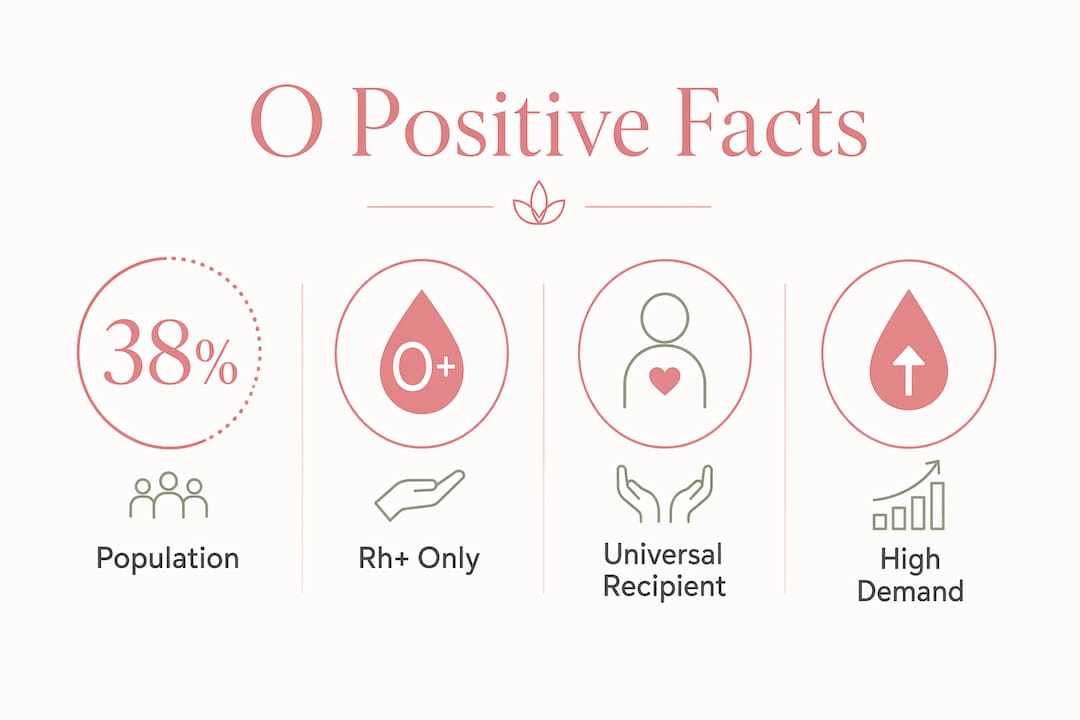
O+ recipients can only receive O positive or O negative red blood cells. That is the hard rule. On the giving side, O+ donors can transfuse red cells to anyone with a positive blood type: A+, B+, AB+, and O+.
Compatibility summary:
- O+ can receive from: O+ and O− donors
- O+ can donate red cells to: A+, B+, AB+, O+
- O− is the universal red cell donor (compatible with all eight blood types)
- AB plasma is the universal plasma donor — a completely separate matching system
That last point trips people up. The phrase “universal donor” technically applies only to O− red blood cells. Plasma and platelets follow different compatibility rules entirely, so O− donors are not universal for those components.
In trauma settings, hospitals often reach for O+ rather than O− when a patient’s blood type is unknown but the patient is male or a woman over 50. A quality improvement review found that O+ units accounted for nearly half of emergency transfusions and preserved scarce O− supplies with no harm to patient outcomes in the studied cohort. The logic: O− is too rare to use when O+ carries minimal clinical risk for most patients.
What O+ means when you are pregnant
Rh incompatibility is the pregnancy concern most directly tied to your Rh status. It arises when an Rh-negative mother carries an Rh-positive baby. If the mother’s immune system encounters fetal Rh-positive blood cells, it can produce antibodies that attack the baby’s red cells in a future pregnancy. Because O+ mothers are Rh positive, they do not face this particular risk themselves. The concern belongs to O− mothers.
Still, your blood type matters at every prenatal visit:
- Request a blood type and antibody screen at your first prenatal appointment. This is standard of care and tells your obstetric team your full compatibility profile.
- If you are Rh negative (not O+, but worth knowing for family members): Rho(D) immune globulin, commonly called RhoGAM, is given around week 28 and after delivery to prevent antibody formation.
- For newborn transfusions: O+ blood from a CMV-negative donor is often the safest option for immunocompromised newborns, making CMV-negative O+ donations especially valuable in pediatric care. Parents interested in newborn care practices can find additional context through postpartum resources that address neonatal health broadly.
- Repeat antibody screening is typically done again in the third trimester to catch any new antibody development.
How common is O+ in the United States?
About 38–40% of Americans have O positive blood, making it the single most common blood type in the country. The Cleveland Clinic confirms it is the most common type in the U.S. overall.

Common does not mean easy to keep in stock. Because O+ can go to any Rh-positive recipient, and because Rh-positive people make up more than 80% of the population, demand for O+ units is constant. Blood banks run through O+ inventory faster than almost any other type, particularly during mass-casualty events or seasonal donation dips.
How to donate blood if you are O+
O+ donors are among the most requested. Here is how to make your donation count:
- Choose your donation type. Whole blood is the standard option, eligible every 56 days. Power Red (double red apheresis) collects two units of red cells in one visit and is especially efficient for O+ donors because red cells are your highest-value component.
- Check eligibility. Most centers require you to be at least 17 years old, weigh at least 110 pounds, and be in general good health. Power Red has additional height and weight minimums — confirm with your local center.
- Find a center. The American Red Cross, Vitalant, OneBlood, and Carter BloodCare all have online locators. Many offer appointment scheduling.
- Prepare the day before. Drink extra water, eat iron-rich foods, and avoid fatty meals before your appointment.
- What to bring: a photo ID, your donor card if you have one, and a list of any medications.
After donating: rest for 10–15 minutes, drink fluids, and avoid heavy lifting for a few hours. Power Red donors typically wait 112 days between donations.
Myths about O+ and what actually matters for your health
Myth vs. fact:
- Myth: Your blood type determines your best diet. Fact: Scientific reviews do not support blood-type diets. No clinical evidence shows O+ individuals benefit from a specific eating pattern based on blood type alone.
- Myth: O+ people have distinct personality traits. Fact: No peer-reviewed research links ABO blood type to personality. This idea is popular in some cultures but has no biological basis.
- Myth: O+ protects against or increases risk of specific diseases in a meaningful, actionable way. Fact: Some population-level associations exist, but they are not strong enough to drive individual health decisions.
What does matter for women: iron status and anemia. Heavy menstrual periods are one of the leading causes of iron deficiency in women of reproductive age, and low iron directly affects energy, skin clarity, and hormonal balance. None of that is blood-type-specific, but it is blood-health-specific.
Pro Tip: Ask your clinician for a complete blood count (CBC) and a ferritin level, not just a blood type. Ferritin is the most sensitive early marker of iron depletion and often drops before standard hemoglobin does.
When to talk to your doctor about blood type and related symptoms
Red flags that warrant a conversation:
- Heavy menstrual bleeding (soaking through a pad or tampon every hour for several hours)
- Unexplained fatigue, dizziness, or shortness of breath
- Pallor, brittle nails, or hair loss without a clear cause
- A history of transfusion reactions or multiple transfusions
- Pregnancy, especially if you have not had a blood type and antibody screen
Tests to request:
- Blood type and antibody screen (type and screen)
- Complete blood count (CBC)
- Ferritin and serum iron panel
- Prenatal antibody monitoring (first and third trimester)
Questions to bring to your next visit:
- “Is my blood type documented in my chart, including my Rh factor?”
- “Should I have a ferritin level checked given my cycle history?”
- “If I become pregnant, what antibody monitoring will you recommend?”
- “Am I a candidate for Power Red donation, or is whole blood better for my health right now?”
How blood health connects to hormonal symptoms
Low iron from heavy periods can show up as fatigue, brain fog, and worsened PMS — symptoms that overlap significantly with hormonal imbalances. Florvahealth addresses this overlap through lifestyle and symptom support: probiotics to support gut health and hormone metabolism, pH-balanced washes for intimate care during cycle changes, and targeted relief patches for PMS discomfort.
What Florvahealth supports:
- Cycle-related bloating and PMS symptoms
- Gut-microbiome balance, which influences estrogen clearance
- Skin changes tied to hormonal fluctuations
What requires a clinician: blood type testing, transfusion decisions, anemia diagnosis, prenatal Rh management, and any lab-guided treatment. Florvahealth products are lifestyle tools, not substitutes for medical testing.
O+ and organ transplantation: what you should know
Blood type compatibility in organ transplantation is stricter than in transfusion. For solid organs like kidneys and hearts, O+ recipients can generally receive organs from O+ or O− donors. However, O+ donors can only give to O+ or AB+ recipients in most organ-matching protocols, unlike the broader red cell donation rules.
The practical implication: O+ patients on transplant waiting lists may wait longer because O+ organs are in high demand from both O+ and O− recipients who need O-type organs. Discussing your blood type with your transplant coordinator is the right first step if this applies to you.
O+ blood in childbirth emergencies
Postpartum hemorrhage is one of the leading causes of maternal mortality worldwide, and blood type logistics matter in those moments. When a laboring patient’s blood type is not on file or cross-matched blood is unavailable, O+ is increasingly the go-to emergency release for Rh-positive women. American Red Cross protocols support using O+ in these situations to preserve O− for cases where Rh status is unknown or the patient is Rh negative.
For O+ women: having your blood type documented in your hospital chart before labor begins means clinicians can cross-match blood faster and may not need emergency-release units at all.
Does blood type affect how medications work or disease risk?
For most medications, blood type has no clinically meaningful effect on how drugs are absorbed, metabolized, or cleared. Pharmacogenomics — the field that studies how genes affect drug response — focuses on liver enzymes and receptor variants, not ABO or Rh type.
Where blood type does show up in research is disease association studies. Some data suggest O type individuals may have modestly lower risk of certain cardiovascular events and slightly higher susceptibility to cholera and norovirus. These are population-level signals, not individual predictions, and no current clinical guideline recommends changing medications or screening protocols based on ABO type alone. If you have specific concerns about disease risk, a conversation with your primary care provider about your full health history is far more useful than your blood type.
Key Takeaways
O positive is the most common U.S. blood type, and knowing yours shapes transfusion safety, pregnancy care, and donation impact in ways that are directly relevant to your health decisions.
| Point | Details |
|---|---|
| Compatibility rule | O+ recipients can only receive O+ or O− red blood cells; O+ donors give to all positive types. |
| Pregnancy action | Request a blood type and antibody screen at your first prenatal visit, regardless of Rh status. |
| Donation value | O+ donors are high-priority; Power Red apheresis doubles your red cell contribution per visit. |
| Iron and hormones | CBC and ferritin tests, not blood type alone, reveal the iron deficiency behind cycle-related fatigue and PMS. |
| Florvahealth support | The PMS & Bloating Relief Kit addresses cycle symptoms while you pursue medical testing for blood-related concerns. |
Blood type facts and the bigger picture of women’s health
The conversation around O positive tends to stop at compatibility charts. What gets less attention is how blood health, specifically iron status and anemia, threads through nearly every hormonal symptom women are told to simply live with. Fatigue before your period, skin that breaks out mid-cycle, bloating that does not respond to diet changes: these are not random. They often trace back to how well your body is managing iron, inflammation, and the hormonal cascade that follows.
The medical facts here are clear and worth acting on. Get your blood type documented. Donate if you are eligible. If your periods are heavy, ask for a ferritin level, not just a hemoglobin. And do not let the myth of blood-type diets distract you from the lab tests that actually tell you something.
What I find most useful about understanding O positive specifically is that it reframes blood health from something passive into something you can act on, whether that is walking into a donation center or walking into a prenatal appointment with the right questions written down.
Florvahealth and cycle symptom support
If your blood work comes back showing low iron or your clinician confirms anemia, the medical path is clear. But the days between diagnosis and feeling better are real, and that is where lifestyle support earns its place.
Florvahealth’s PMS & Bloating Relief Kit is built for exactly this gap: cycle-related bloating, fatigue, and discomfort that sit alongside whatever your clinician is treating. The kit combines targeted relief patches, probiotics for gut-hormone balance, and pH-balanced intimate care into one system. None of it replaces a blood test or a transfusion. All of it addresses the symptoms that make the weeks around your period harder than they need to be. Visit Florvahealth to see the full range of cycle and hormonal support products, and bring your lab results to your next clinician visit before starting any new supplement.
Useful sources and further reading
- American Red Cross — O Blood Type: Donation guidance, compatibility overview, and supply context for O positive and O negative donors.
- Cleveland Clinic — Blood Types: Clear clinical explainer of ABO and Rh systems, compatibility rules, and what blood type means for your health.
- Cleveland Clinic — Universal Blood Donor Type: Explains component-specific compatibility (red cells vs plasma vs platelets) and the limits of “universal donor” language.
- Vitalant — Type O Blood: Donation priorities for O+ and O− donors, including CMV-negative newborn transfusion context.
- OneBlood — O Positive Blood: Power Red apheresis guidance and why O+ donors are prioritized for double red donations.
- Wiley/Transfusion — Quality Improvement Review: Peer-reviewed review of O+ use in emergency transfusions and its role in conserving O− supply.
- Carter BloodCare — O Positive: Regional blood center overview of O+ importance in emergency and trauma settings.
This article is general health information, not medical advice. Confirm your blood type, transfusion needs, and prenatal care plan with a qualified clinician or your primary care provider.


