

The skin microbiome is the living community of bacteria, fungi, viruses, and mites that colonizes every inch of your skin’s surface. It supports the skin barrier, trains the immune system to tell friend from foe, and blocks harmful microbes from taking hold. When that community falls out of balance, a state called dysbiosis, the disruption tracks closely with acne, atopic dermatitis, psoriasis, and rosacea. Targeted, microbiome-aware treatment is now an active clinical research direction, not a fringe idea.
TL;DR:
- Beneficial skin bacteria produce molecules that support skin barrier function, enhance hydration, and regulate immune responses, with their composition heavily influenced by local environment and age.
- Dysbiosis, characterized by reduced microbial diversity and overgrowth of species like Staphylococcus aureus, is strongly linked to conditions such as eczema, acne, and rosacea, but causality remains unproven.
- Targeted microbiome therapies, including strain-specific probiotics and prebiotics, are advancing but remain in early research stages, with broad antimicrobials increasingly discouraged for disrupting beneficial microbes.
- A gentle, pH-balanced cleanser and barrier-supporting ingredients help preserve microbial diversity, while lifestyle factors like diet, stress management, and antibiotic use substantially influence skin microbiome health.
- The gut-skin connection exists through immune and metabolic pathways, with supporting evidence suggesting that systemic gut health benefits skin health, though more research is required for definitive clinical recommendations.
Table of Contents
- What Makes Up the Skin Microbiome and Skin Health?
- How Do Skin Bacteria Protect and Regulate the Skin?
- Why Does the Skin Microbiome Change by Site, Age, and Environment?
- How Does Dysbiosis Lead to Acne, Eczema, and Rosacea?
- Does the Gut–Skin Axis Really Affect Skin Health?
- How Do Scientists Study the Skin Microbiome?
- What Are the Best Microbiome-Friendly Skincare Options?
- How Do You Build a Microbiome-Supportive Skincare Routine?
- Florvahealth’s Approach to Evidence-Based Skin Support
- An Honest Outlook on Where Microbiome Science Is Headed
- Support Your Skin Microbiome From the Inside Out
- Sources
- FAQ
What Makes Up the Skin Microbiome and Skin Health?
Your skin carries a denser, more varied population of microbes than most people realize. Every square centimeter hosts millions of organisms across four biological kingdoms, and which ones dominate depends heavily on where on the body you’re looking.
Bacteria make up the bulk of the community. Three genera do most of the work:
- Cutibacterium (formerly Propionibacterium), which thrives in oily, sebum-rich zones like the face, chest, and back
- Staphylococcus, including the largely beneficial S. epidermidis and the more troublesome S. aureus
- Corynebacterium, common in moist folds like the armpits and groin
These three genera account for the majority of bacterial sequences found on healthy skin, according to research published in PMC, though the exact ratio shifts dramatically by body site.
Fungi add a second layer. Malassezia species dominate sebaceous skin and are generally harmless commensals, though overgrowth is linked to conditions like seborrheic dermatitis and some forms of dandruff.
Mites round out the visible residents. Demodex folliculorum and Demodex brevis live in hair follicles and sebaceous glands on nearly every adult face. Small numbers are normal; a marked increase in density correlates with certain rosacea presentations, though the mite is more likely a contributor than the sole cause.
Viruses, mostly bacteriophages that infect the resident bacteria, are the least studied but potentially the most influential piece of the puzzle. Phages can quietly regulate bacterial population size the way a predator regulates prey, and some human papillomavirus (HPV) strains live on skin without causing visible lesions in most people.
The niche you’re looking at changes everything. Skin scientists generally split the body into three microenvironments:
- Sebaceous sites (face, chest, upper back): lipid-rich, low diversity, dominated by Cutibacterium and Malassezia
- Moist sites (armpits, groin, webs of the toes): higher diversity, favors Staphylococcus and Corynebacterium
- Dry sites (forearms, palms, legs): the most diverse and variable population of all, often mixing skin-associated and environmental bacteria
That’s counterintuitive to a lot of people. Dry skin isn’t a microbial desert. It’s actually the most ecologically diverse terrain on the body, because there’s no dominant lipid source to give any single organism a competitive edge. Oily skin, by contrast, behaves more like a monoculture farm: Cutibacterium feeds on sebum, thrives, and crowds out most competitors.
How Do Skin Bacteria Protect and Regulate the Skin?
The skin microbiome isn’t a passive tenant. It actively participates in three biological jobs that would otherwise fall entirely to your own cells: barrier maintenance, immune calibration, and pathogen exclusion.
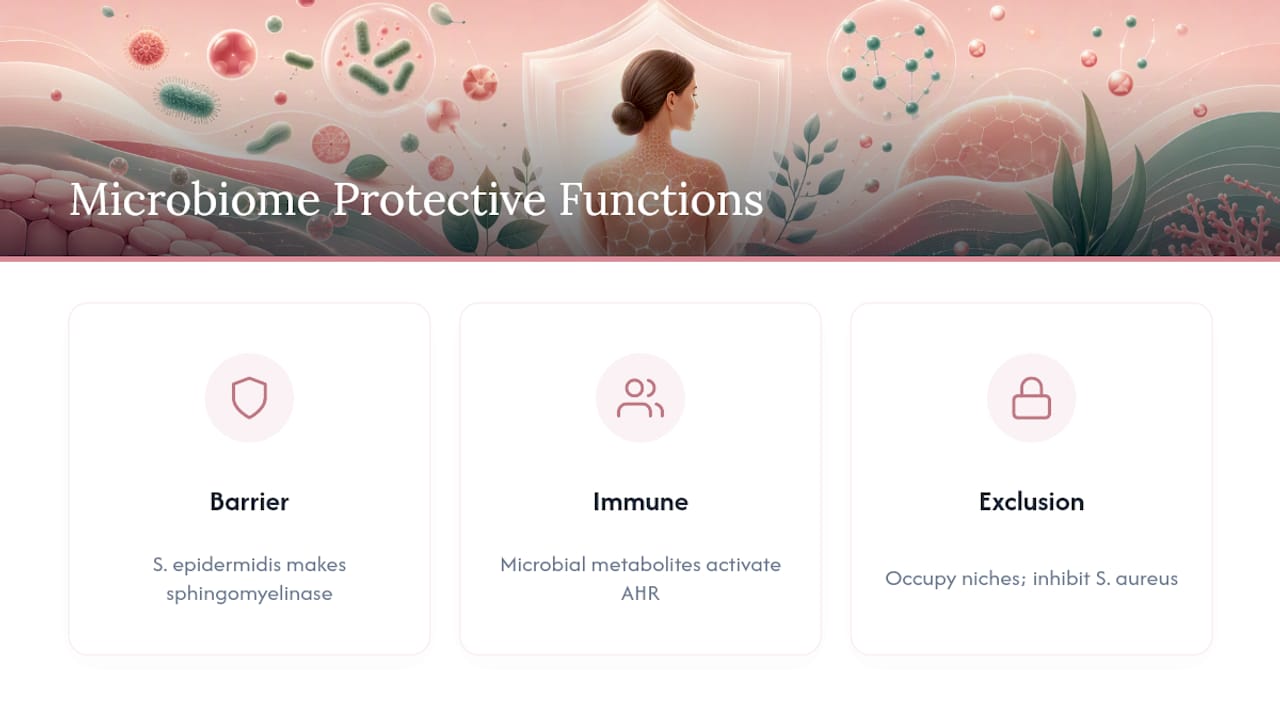
Barrier support happens at the molecular level. Staphylococcus epidermidis produces an enzyme called sphingomyelinase that helps convert lipid precursors into ceramides, the fatty molecules that hold skin cells together and prevent water loss. Studies summarized in PMC’s review of skin barrier function show that this microbial contribution measurably improves hydration and reduces transepidermal water loss in both animal and human models. Commensal bacteria also produce free fatty acids that acidify the skin surface, typically to a pH between 4.5 and 5.5, an environment hostile to many pathogens but comfortable for beneficial species.
Immune signaling runs through specific molecular channels. One of the more elegant mechanisms involves the aryl hydrocarbon receptor (AHR), a protein inside keratinocytes that responds to microbial metabolites by triggering genes involved in cell differentiation and barrier repair. Commensal bacteria also produce antimicrobial peptides and small molecules that keep the innate immune system in a state of “watchful readiness” rather than full alarm. That distinction matters clinically: a microbiome that’s too quiet leaves the skin vulnerable to infection, while one that constantly triggers inflammation contributes to chronic redness and flares.
Statistic Callout: Skin harbors many bacterial species across its various sites, and the specific mix at any single location is shaped as much by local chemistry (pH, lipid content, moisture) as by which microbes happen to land there first.
Colonization resistance is the microbiome’s quietest but most practical function. When beneficial bacteria occupy every available nutrient niche and receptor site, incoming pathogens simply have nowhere to attach. S. epidermidis strains secrete compounds that directly inhibit S. aureus growth, a form of chemical competition that dermatologists increasingly view as a first line of defense against staph colonization. This is why stripping the skin with harsh antiseptics can backfire: killing off the competitive commensals sometimes clears space for more aggressive organisms to move in.
The practical takeaway is that a healthy microbiome behaves less like a shield and more like a densely packed neighborhood. Nothing new gets to build there because the lots are all occupied by cooperative tenants.
Why Does the Skin Microbiome Change by Site, Age, and Environment?
Not all microbiome variation is a problem, and not all of it is something you can control. Understanding which factors are fixed and which are modifiable helps set realistic expectations for any skincare routine.
Location on the body is the single biggest driver. The scalp, underarms, and soles of the feet carry distinct microbial signatures shaped by local oil production, moisture, friction, and sun exposure. A swab from your forearm and a swab from your scalp will look like they came from two different people.
Age reshapes the entire ecosystem. Puberty triggers a surge in sebum production, which expands the sebaceous niche and lets lipid-loving species like Cutibacterium and Malassezia flourish, one reason acne so often begins in the teenage years. Aging skin moves the opposite direction: sebum output declines, microbial diversity narrows, and the resulting imbalance contributes to a phenomenon researchers call “inflammaging,” a low-grade chronic inflammation that shows up as slower wound healing and thinner, more reactive skin.
Environmental and behavioral factors round out the list of modifiable influences:
- Humid climates favor moisture-loving bacteria; dry climates favor a more even bacterial-fungal mix
- Air pollution and particulate exposure are associated with shifts toward pro-inflammatory bacterial profiles
- Frequent use of topical antibiotics or antiseptic washes can reduce microbial diversity for weeks after a single course
- Overwashing with high-pH soap strips protective lipids and pushes surface pH upward, favoring less desirable bacteria
Pro Tip: If you’ve recently finished a course of antibiotics, oral or topical, give your skin a few weeks of gentle, fragrance-free care before introducing new active ingredients. The microbiome needs time to rebuild diversity, and layering exfoliants or strong actives onto a freshly disrupted barrier tends to backfire.
Hormonal shifts deserve their own mention here, because they intersect with nearly every other variable on this list. Rising androgens don’t just affect oil production; they change the chemical environment that bacteria depend on, which is part of why breakouts cluster around specific points in the menstrual cycle for many women.
How Does Dysbiosis Lead to Acne, Eczema, and Rosacea?
Dysbiosis simply means the microbial community has shifted away from its typical, functional balance, usually toward lower diversity and overgrowth of one or two species at the expense of the rest. Four inflammatory skin conditions show particularly well-documented microbial signatures.
Atopic dermatitis shows one of the clearest patterns in the literature. During flares, microbial diversity drops sharply and Staphylococcus aureus often blooms to dominate the skin surface, sometimes making up more than half of all bacteria present. That overgrowth correlates with flare severity, and S. aureus toxins are known to directly damage the skin barrier and provoke inflammation, a feedback loop that research on skin disease and the microbiome describes as a defining feature of the disease.
Acne is more nuanced than a simple bacterial overgrowth story. Cutibacterium acnes lives on virtually everyone’s skin, including people with completely clear complexions. What differs in acne-prone skin isn’t the presence of the bacteria but the balance of specific strains. Some C. acnes lineages appear to trigger stronger inflammatory responses than others, which helps explain why two people with similar oil production can have very different acne experiences.
Psoriasis and rosacea show real but less consistent microbial shifts across studies:
- Psoriatic plaques tend to show reduced bacterial diversity and altered ratios of Cutibacterium to Staphylococcus, though findings vary between research groups
- Rosacea has been linked to increased Demodex mite density and shifts in bacterial populations within hair follicles, but the field hasn’t settled on a single unifying mechanism
- Chronic wounds present their own version of dysbiosis: bacteria organize into biofilms, structured communities encased in a protective matrix that resist antibiotics and immune clearance far better than free-floating bacteria do, which is a major reason some wounds stall in the healing process for months
A caution belongs here that gets skipped in a lot of consumer-facing content: correlation is not causation. Finding an altered microbiome in diseased skin doesn’t prove the microbiome caused the disease. It’s just as possible that inflammation changes the skin’s chemistry first, and the microbial shift follows as a consequence. Untangling that sequence requires longitudinal studies that track the same skin over time and interventional trials that manipulate the microbiome directly to see whether disease outcomes change. Those trials are still limited in number, which is why most dermatology guidance describes microbiome findings as “associated with” rather than “caused by” specific conditions.
Does the Gut–Skin Axis Really Affect Skin Health?
The gut and skin communicate more directly than most skincare marketing suggests, and the connection runs through measurable biological pathways rather than vague wellness claims.
Gut bacteria ferment dietary fiber into short-chain fatty acids (SCFAs), compounds that circulate through the bloodstream and influence immune cell behavior well beyond the digestive tract. When gut bacterial diversity drops or the intestinal lining becomes more permeable, a state often called increased intestinal permeability, inflammatory signals can spread systemically and show up as skin symptoms. PMC’s review of the gut-skin connection notes that dysbiosis, whether it originates in the gut or on the skin itself, weakens barrier integrity and raises susceptibility to inflammation and infection.
The evidence for oral probiotics improving skin outcomes is encouraging but still developing. Small trials have shown benefits for specific strains in specific conditions, mostly atopic dermatitis and certain forms of acne, but results vary by strain, dose, and study design, and not every probiotic product on the market has been tested in a rigorous trial. This is a case where the mechanism is well understood even though the clinical evidence hasn’t fully caught up.
Hormones add another layer to this internal picture:
- The luteal phase of the menstrual cycle raises androgen sensitivity in oil glands, increasing sebum output and shifting the sebaceous microbiome toward lipid-loving species
- Pregnancy alters estrogen and progesterone levels dramatically, which can either calm or worsen acne depending on the individual’s hormonal baseline
- Menopause brings falling estrogen, thinner skin, reduced sebum, and often a less diverse microbial population, contributing to increased dryness and sensitivity
Anyone who’s noticed their skin acting differently around specific points in their cycle isn’t imagining it. The biology behind stress and acne flares works through a similar internal signaling system, where cortisol and other stress hormones alter oil production and immune tone in ways that ripple out to the skin surface.
How Do Scientists Study the Skin Microbiome?
Reading a headline about a new skin microbiome study is easy. Understanding what that study can and can’t actually tell you requires knowing a bit about how the research gets done.
-
Sample collection method shapes the results. Swabbing the surface captures loosely attached bacteria and misses anything embedded deeper. Tape-stripping pulls up several layers of the outer skin and captures a more complete surface picture. Biopsies reach follicles and glands but are invasive and rarely used outside clinical research settings. A study using swabs and a study using biopsies on the same patch of skin can report meaningfully different microbial profiles.
-
16S rRNA sequencing is the workhorse method for most published skin microbiome research. It identifies bacteria down to the genus level by reading a specific, highly conserved gene, and it’s relatively inexpensive and fast. Its limitation is resolution: it usually can’t distinguish between different strains of the same species, which matters enormously for something like acne, where strain-level differences in C. acnes appear to drive different inflammatory outcomes.
-
Shotgun metagenomics sequences all the genetic material in a sample, which allows strain-level identification and reveals which functional genes the microbial community carries, not just which species are present. It costs more and requires heavier computational analysis, but it’s increasingly the standard for research aiming at therapeutic applications.
The practical caveats matter as much as the methods themselves. Skin is what researchers call a low-biomass environment, meaning there’s relatively little microbial DNA to work with compared to, say, a gut sample. That makes contamination from reagents, lab surfaces, or even the researcher’s own skin a real risk, and it’s part of why findings on skin microbiome methodology published in Nature Reviews Microbiology stress rigorous negative controls. Reproducibility across labs remains an ongoing challenge, and translating a taxa-level finding, “condition X shows more of bacterium Y”, into an actual therapy is a much longer road than headlines usually suggest.
What Are the Best Microbiome-Friendly Skincare Options?
The shift in dermatology research over the last decade has moved away from “kill the bad bacteria” and toward “cultivate the good ones.” That reframing changes what a smart therapeutic strategy actually looks like.
Topical bacteriotherapy, applying live beneficial bacteria directly to skin, has moved from theory into early clinical trials. Specific Staphylococcus hominis and S. epidermidis strains have shown safety and early efficacy signals for atopic dermatitis and hydration support, according to research published in the Journal of Clinical Investigation. These remain early-phase findings, not established standard-of-care treatments, but they represent a genuinely different approach than anything in a conventional skincare aisle.
Prebiotics and postbiotics work from opposite ends of the same idea. Prebiotics are compounds that feed beneficial bacteria already present on skin, while postbiotics are the beneficial byproducts those bacteria produce, things like short-chain fatty acids, without requiring the live organism itself. Plant-derived prebiotic research has shown some promising selectivity: certain plant extracts promoted Staphylococcus epidermidis growth while simultaneously inhibiting Staphylococcus aureus and Cutibacterium acnes in laboratory studies published in Scientific Reports. That selective action, feeding the helpful species while starving the harmful ones, is exactly the mechanism dermatology researchers want more of.
Here’s why targeted modulation is winning out over broad-spectrum antimicrobials in current research direction:
- Broad-spectrum antibacterial ingredients don’t discriminate between harmful and beneficial species, often clearing the field for opportunistic overgrowth once treatment stops
- Targeted approaches, strain-specific probiotics, selective prebiotics, metabolite-based postbiotics, aim to rebalance the ecosystem rather than sterilize it
- Ecological balance, not the absence of microbes, is now considered the actual marker of healthy skin, a principle emphasized in research on bioactive compounds and microbiome modulation
Pro Tip: A product labeled “microbiome-friendly” isn’t a regulated term with a legal definition. Look instead for practical clues: a pH between 4.5 and 5.5, no harsh sulfates or triclosan, and ingredient lists that include prebiotic or fermented components rather than broad antibacterial agents.
Regulatory oversight hasn’t fully caught up with the marketing here. There’s no standardized testing requirement for a brand to call its product microbiome-friendly, which means claims vary widely in how much real evidence backs them. Approaches favoring targeted, strain-specific, or metabolite-based actives over harsh antimicrobials tend to align more closely with where the current research is actually heading.
How Do You Build a Microbiome-Supportive Skincare Routine?
Translating the science into a daily routine doesn’t require a lab coat. It requires a few consistent habits and the judgment to know when a problem needs more than a routine adjustment.
-
Choose a gentle, pH-balanced cleanser. Skin’s natural surface sits around pH 4.5 to 5.5. Cleansers formulated closer to that range preserve the acidic environment that favors beneficial bacteria over pathogens, rather than a standard bar soap sitting closer to pH 9 or 10.
-
Reserve antiseptics and antibacterial washes for when you actually need them. Daily use of strong antimicrobial products on healthy skin does more ecological damage than benefit; save them for active infections under a clinician’s direction.
-
Prioritize barrier-supporting ingredients. Ceramide-forming lipids, cholesterol, and fatty acids help rebuild the same structures that commensal bacteria naturally support through enzymes like sphingomyelinase.
-
Diversify your diet where you can. A wider range of plant fiber sources feeds a more diverse gut bacterial population, which research on the gut-skin connection ties to better systemic inflammatory control.
-
Manage stress and prioritize sleep. Both affect cortisol levels, which in turn influence oil production and immune signaling in skin, tying directly back into the inside-out framework connecting hormones and skin health.
Statistic Callout: A single course of oral or topical antibiotics can suppress microbial diversity on skin for several weeks afterward, which is one practical reason to introduce new active skincare ingredients gradually rather than all at once during that recovery window.
Know when to stop self-managing. See a dermatologist if you notice a rash that spreads rapidly, signs of infection like increasing warmth, swelling, or pus, or a chronic condition, eczema, rosacea, persistent acne, that isn’t responding to consistent over-the-counter care after several weeks. Microbiome science is genuinely useful for daily maintenance, but it isn’t a substitute for diagnosis when something is clearly wrong.
Florvahealth’s Approach to Evidence-Based Skin Support
Some wellness brands build their product lines around an inside-out principle where skin clarity connects to gut health, hormonal balance, and topical care, not any single one of those in isolation. Such brands often focus on probiotics aimed at digestive and hormonal balance, pH-balanced intimate washes, and turmeric-based topical cleansers, reflecting gut-skin and barrier-support mechanisms described throughout this piece.
Readers interested in the mechanics of that gut-hormone-skin relationship can dig further into how probiotics support broader wellness or explore practical skincare adjustments across hormonal shifts. Both resources expand on the internal-external connection at the center of Florvahealth’s product philosophy.
Author background and any Florvahealth-sponsored clinical trials or case studies: to be added.
An Honest Outlook on Where Microbiome Science Is Headed
Personalized microbiome medicine gets talked about like it’s right around the corner. It isn’t, at least not in the way the marketing implies. Precision modulation, engineered probiotic strains, metabolite-based treatments tailored to an individual’s specific microbial profile, is a genuinely promising research direction, but the honest timeline for widespread clinical validation is measured in years, not product cycles.
What frustrates me about a lot of coverage of this topic is the gap between “early trial shows a signal” and “solved problem.” Strain-level clinical trials take time, and a single small study, however exciting the result, isn’t the same as a body of evidence robust enough to justify sweeping product claims. The field needs more long-term, strain-specific trials before “microbiome-friendly” becomes a term with real regulatory teeth behind it.
My advice for readers navigating this now: treat evidence-based topical care and gut-supportive habits as your daily foundation, and treat a dermatologist as your partner for anything that looks like a diagnosable condition rather than routine maintenance. The two aren’t competing approaches. They’re complementary, and conflating them is where a lot of consumer confusion starts.
— Zamanee
Support Your Skin Microbiome From the Inside Out
Most skincare treats the microbiome as an afterthought, something to protect passively while the “real” ingredients do the work. Florvahealth built its system around the opposite assumption: skin clarity starts with what’s happening internally, in gut bacteria, hormone regulation, and inflammation, before it ever shows up on the surface.

That’s the thinking behind the brand’s probiotic and wellness product line, paired with a pH-balanced skincare collection built for hormonal skin rather than a generic one-size-fits-all cleanser. If you’re managing a diagnosed condition like moderate to severe acne or eczema, pair these products with your dermatologist’s guidance rather than replacing it. The evidence for gut-skin interventions is real but still developing, and Florvahealth’s product descriptions reflect that honestly rather than overpromising a cure.
If your routine currently leans on harsh antibacterial washes or you’re curious what a gentler, pH-aware cleanser feels like, the Electric Facial Cleanser is a reasonable place to start exploring the collection.
Sources
- The skin microbiome and its role in skin disease (PMC)
- The human skin microbiome: from metagenomes to therapeutics (Nature Reviews Microbiology)
- The Skin Microbiome and Bioactive Compounds: Mechanisms of Modulation (Molecules)
This article is general information, not a substitute for advice from a qualified doctor. Consult a qualified healthcare professional about your own circumstances before acting on anything here.
FAQ
How Do You Reset Your Skin Microbiome?
There’s no single “reset button,” but reducing harsh antiseptic use, switching to a pH-balanced cleanser, and giving skin several weeks without disruptive actives allows microbial diversity to gradually recover on its own.
How Do You Know if Your Skin Microbiome Is Unhealthy?
Signs of dysbiosis include persistent redness, unusual sensitivity to products that previously worked fine, recurring breakouts in the same areas, or a chronic condition like eczema that keeps flaring despite consistent care; a dermatologist can assess this more precisely than any at-home test.
How Can I Heal My Gut for Better Skin?
Increasing dietary fiber diversity, considering evidence-backed probiotic strains, and reducing unnecessary antibiotic use all support the gut bacterial diversity that research on the gut-skin axis links to better skin barrier function and lower systemic inflammation.
How Can I Help My Skin Microbiome Heal After Damage?
Stick to gentle, fragrance-free products during recovery, avoid unnecessary antiseptics, and prioritize barrier-supporting ingredients like ceramide-forming lipids, which give beneficial commensal bacteria like S. epidermidis the stable environment they need to reestablish themselves.
Does Diet Really Affect the Skin Microbiome?
Yes, indirectly: gut bacteria ferment dietary fiber into short-chain fatty acids that influence systemic immune signaling, and a diverse, fiber-rich diet is consistently associated with lower inflammatory activity that shows up on skin.


