

Yes — consistent evening routines can reduce common PMS symptoms by lowering evening cortisol, improving sleep quality, and stabilizing blood sugar. That’s not a wellness platitude; it’s how your nervous system actually works during the luteal phase. Cardiologist Dr. Sanjay Bhojraj explains that poor sleep during PMS keeps the body locked in high cortisol, raising blood sugar and triggering inflammation — the exact conditions that amplify mood swings, bloating, and restlessness. Sleep expert Jordan Burns adds that predictability is the core mechanism: repeating the same evening sequence lets the brain shift from alertness to restorative states faster. Florvahealth’s inside-out wellness approach is built on exactly this principle.
Three things you can do tonight:
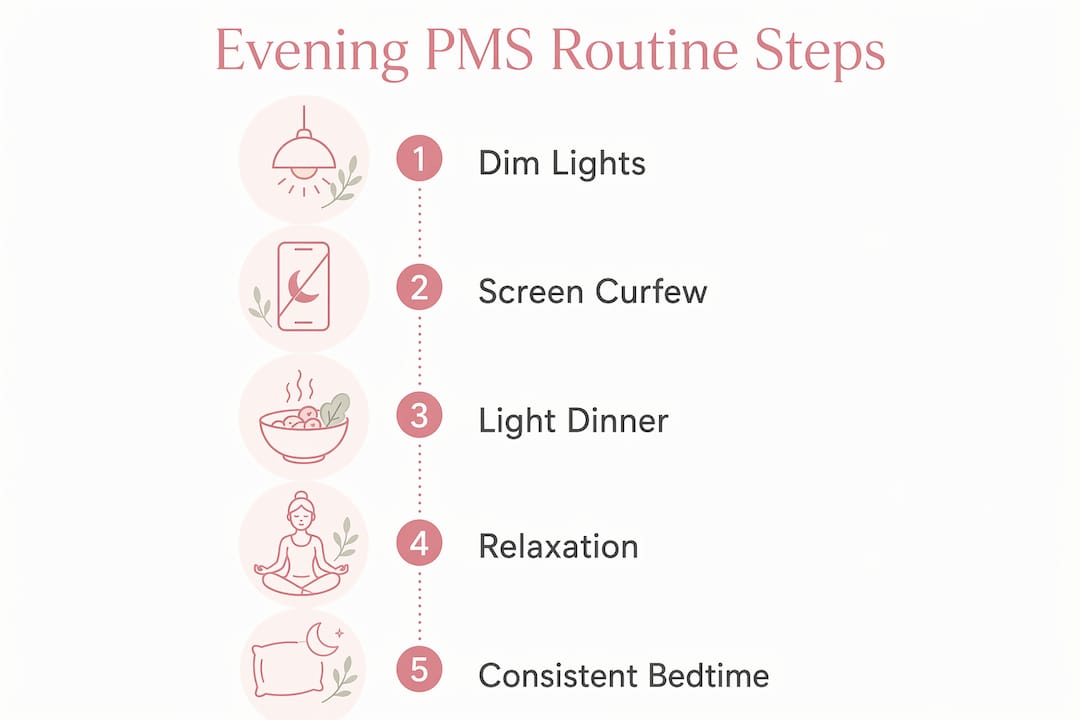
- Set a screen curfew 60 minutes before bed (blue light suppresses melatonin and delays sleep onset)
- Take a warm bath 60–90 minutes before your target bedtime, then let your body cool
- Take magnesium glycinate (200–400 mg) 30–60 minutes before sleep to support muscle relaxation and GABA production
Table of Contents
- Why evening routines reduce PMS: the science behind it
- The highest-impact evening elements for PMS relief
- Three plug-and-play evening routines for PMS
- When will you actually feel a difference?
- Evening habits that make PMS worse
- When to see a clinician instead
- What the evidence actually says
- Key Takeaways
- An honest perspective on what routines actually change
- Florvahealth’s inside-out support for PMS
- Further reading and authoritative sources
Why evening routines reduce PMS: the science behind it
Your menstrual cycle and your circadian rhythm are not separate systems. They talk to each other constantly. Circadian rhythm shapes hormones and menstruation directly — when your internal clock is disrupted, hormonal transitions become rougher, and PMS symptoms intensify. Consistent evening cues anchor that internal clock, smoothing the hormonal shifts of the luteal phase.
The cortisol piece is where most people miss the connection. During the luteal phase, progesterone drops earlier than expected, estrogen fluctuates, and cortisol tends to stay elevated longer — especially when you’re sleep-deprived. That combination keeps your nervous system in a low-grade fight-or-flight state right when your body needs to wind down. An evening routine interrupts that loop by giving the nervous system a calm, familiar rhythm to hold onto when hormones are shifting.
Circadian entrainment also works in both directions. A 2026 Springer study links daytime light exposure and exercise timing to better fluid homeostasis, which reduces bloating and negative mood associated with PMS. Your evening routine amplifies those daytime habits — and vice versa. Think of it as a feedback loop: the more consistent your evening cues, the more your body’s hormonal recovery improves overnight. For a deeper look at how daily rituals support hormones, Florvahealth’s education library covers the physiology in plain language.
The highest-impact evening elements for PMS relief
These are the routine elements with the clearest physiological rationale for reducing PMS symptoms, ordered by impact:
- Screen curfew (60+ minutes before bed): Blue light suppresses melatonin and keeps cortisol elevated. Even one hour of screen time before bed raises insomnia risk by 59%.
- Warm bath 60–90 minutes before bed: Triggers the body’s natural cooling response, which signals sleep onset. Particularly useful during the luteal phase when body temperature runs higher.
- Blood-sugar-stabilizing evening meal: Protein, complex carbs, and healthy fats at dinner prevent the glucose spikes that raise cortisol overnight. Skipping dinner or eating late makes PMS anxiety measurably worse.
- Gentle restorative movement: Legs-up-the-wall pose, slow hip openers, or 4-7-8 breathing produce a physiological downshift even when mental calm feels out of reach.
- Magnesium glycinate (200–400 mg): Supports GABA production, reduces muscle tension, and improves sleep quality during the luteal phase.
- Sleep environment: Bedroom temperature of 65–68°F and blackout curtains support melatonin production and reduce the restlessness that spikes before menstruation.
| Evening element | Mechanism | Quick how-to |
|---|---|---|
| Screen curfew | Stops melatonin suppression | Phone in another room by 9 PM |
| Warm bath | Triggers cooling → sleep onset | 20 min bath, 60–90 min before bed |
| Magnesium glycinate | Supports GABA, reduces cramping | 200–400 mg, 30–60 min before bed |
| Dim lighting | Lowers cortisol, signals night | Amber bulbs or lamp only after 8 PM |
| 4-7-8 breathing | Activates parasympathetic system | 4 counts in, 7 hold, 8 out — repeat 4x |
| Cool bedroom | Supports natural temp drop | Set thermostat to 65–68°F |
Pro Tip: You don’t need a six-step checklist to get results. Pick one or two anchor activities — the same cues every night, in the same order — and your nervous system will start anticipating calm. A single consistent anchor (dimming lights or five minutes of breathing) is often more effective than a long routine you abandon by day three.
Three plug-and-play evening routines for PMS
Sleep-focused routine (20 minutes)
Use this on restless luteal-phase nights when falling asleep is the main problem. Start well before your target bedtime: dim all lights and put screens away, take a warm bath or shower, then take magnesium glycinate with a small cup of chamomile tea as you get into bed. The bath-then-cool sequence is the engine here. Swap tart cherry juice for chamomile if you want an extra melatonin nudge.
Bloating and digestion-focused routine (15 minutes)
Best used in the 3–5 days before your period when bloating peaks. Eat a light, balanced dinner by 7 PM — grilled fish or lentils with vegetables, nothing heavy or processed. After dinner, take a slow 10-minute walk outside to support digestion and lower post-meal cortisol. Follow with legs-up-the-wall pose for 5 minutes. This combination supports fluid homeostasis, which the Springer circadian research links directly to reduced PMS bloating when paired with consistent daytime habits.

Mood and relaxation-focused routine (30 minutes)
For evenings when irritability or anxiety is the dominant symptom. Begin with a physical reset: change clothes, wash your face, or step outside briefly to signal that the workday is done. Then spend 10 minutes journaling — one thing that went well, one thing you’re releasing, one small moment of ease. Follow with 10 minutes of slow stretching focused on hips and lower back, and close with 4-7-8 breathing for 5 minutes. The journaling step matters more than it sounds: it offloads looping thoughts before they compound overnight anxiety.
When will you actually feel a difference?
Some benefits show up the first night. Sleep onset tends to improve quickly when you remove screens and lower bedroom temperature, because those changes directly affect melatonin timing. Nighttime anxiety often softens within the first few days of a consistent wind-down sequence.
Mood stability and reduced bloating take longer. Most women notice a real shift after one to two full cycles of consistent practice. By six to eight weeks, the routine becomes habit, and the symptom reduction tends to be measurable rather than subtle.
Timeline at a glance:
- Tonight: Faster sleep onset, lower nighttime anxiety
- 1–2 cycles: Reduced mood swings, less bloating, more stable mornings
- 6–8 weeks: Habit consolidation, consistent symptom reduction
Start adjusting your wind-down 3–5 days before your usual luteal-phase symptoms peak. Progesterone changes begin raising body temperature and disrupting sleep architecture before you feel the emotional symptoms — getting ahead of that window makes the routine more effective. Track your progress with a simple nightly log: date, bedtime, sleep quality (1–5), and top PMS symptom severity. Patterns become visible fast.
Evening habits that make PMS worse
Avoid these triggers because they raise cortisol, disturb melatonin, and destabilize blood sugar — the exact conditions that amplify PMS:
- Alcohol after dinner: Disrupts sleep architecture in the second half of the night, when hormonal repair happens. Even one drink can fragment sleep during the luteal phase.
- Caffeine after 2 PM: Caffeine has a half-life of roughly five to six hours. An afternoon coffee delays melatonin onset and keeps the nervous system alert when it needs to downshift.
- Heavy late meals: Spiking blood sugar at 9 PM raises cortisol overnight and worsens morning fatigue and irritability.
- Intense evening workouts: High-intensity exercise elevates cortisol and core temperature for hours. Swap for walking, yoga, or stretching after 7 PM.
- Bright overhead lighting: Signals daytime to the brain and suppresses melatonin. Switch to lamps or amber-toned bulbs after 8 PM.
Simple swaps: herbal tea (chamomile, lemon balm, spearmint) instead of alcohol or late caffeine; a light walk after dinner instead of a gym session; amber light filters on devices if a full screen curfew isn’t realistic yet. If you’re combining magnesium or other supplements with prescription medications, check with your clinician before adding anything new. For a full breakdown of common PMS triggers, Florvahealth’s guide covers lifestyle factors in detail.
When to see a clinician instead
Try routines first — but see a provider if symptoms are severe, disabling, or sudden. Evening habits won’t resolve PMDD, a sleep disorder, or a thyroid issue.
Red flags that warrant professional care:
- Suicidal ideation or thoughts of self-harm at any point in your cycle
- Severe functional impairment at work, school, or home during the luteal phase
- Sudden, large mood swings that feel out of proportion or new
- Persistent insomnia despite two to three weeks of behavioral changes
- Suspicion of PMDD (symptoms severe enough to disrupt daily life every cycle)
When you book an appointment, bring a cycle-symptom diary, a sleep log, your current medications and supplements list, and a clear symptom timeline. Primary care, gynecology, or behavioral sleep medicine are all appropriate starting points depending on whether your primary complaint is physical, hormonal, or sleep-related. If there is immediate danger, call 988 (Suicide and Crisis Lifeline) or 911. Telehealth options for hormonal health can also connect you with a provider quickly if in-person access is limited.
What the evidence actually says
Multiple clinical resources and experts support the core claim: evening routines reduce cortisol, improve sleep architecture, and support hormonal stability during the luteal phase. The practical steps recommended here are low-risk and evidence-aligned.
Dr. Sanjay Bhojraj’s cortisol-inflammation framework, Jordan Burns’s predictability research, the Avogel circadian-menstrual overview, and the 2026 Springer entrainment study all point in the same direction: the body’s hormonal recovery happens overnight, and the quality of that recovery depends heavily on what you do in the two hours before sleep.
One honest limitation: most of the evidence is mechanistic. High-quality randomized trials specifically testing multi-component evening routines against PMS outcomes remain limited. Individual responses vary — what resolves bloating for one person may not touch mood swings for another. These routines complement medical care; they don’t replace it. For broader context on holistic PMS management, Florvahealth’s 2026 guide is a solid next read.
This article is general wellness information, not medical advice. Confirm any supplement or treatment approach with a qualified provider for your specific situation.
Key Takeaways
Evening routines reduce PMS symptoms by lowering cortisol, improving sleep quality, and stabilizing blood sugar — benefits that compound across one to three cycles of consistent practice.
| Point | Details |
|---|---|
| Start with one anchor | A single consistent cue (dim lights or breathing) trains the nervous system faster than a long checklist. |
| Screen curfew matters most | Removing screens 60+ minutes before bed directly restores melatonin and reduces sleep onset time. |
| Begin before symptoms peak | Start wind-down adjustments 3–5 days before your usual luteal-phase onset for the strongest effect. |
| Seek care for severe symptoms | Red flags like PMDD signs, persistent insomnia, or sudden mood changes need clinical evaluation, not more routine tweaks. |
| Florvahealth inside-out support | The Florvahealth PMS & Bloating Relief Kit pairs with evening routines as a complementary nutritional and topical support system. |
An honest perspective on what routines actually change
The conventional advice around PMS routines tends to undersell one thing: the order of operations matters more than the individual steps. Most guides hand you a list of healthy habits and leave you to figure out the sequence. What actually works is building the routine backward from your bedtime, not forward from dinner. Anchor the end point first — your consistent sleep time — and work outward from there. That single shift changes how the nervous system interprets the whole sequence.
There’s also a tendency to frame evening routines as self-care, which makes them feel optional. They’re not optional during the luteal phase. They’re closer to active recovery: targeted behaviors that lower physiological arousal so your body can do the hormonal repair work it needs to do overnight. The women who see the clearest results aren’t the ones with the most elaborate routines. They’re the ones who protect two or three consistent cues, every night, regardless of how the day went.
Florvahealth’s inside-out support for PMS
The routines in this guide work. They work even better when your body has the nutritional building blocks to support hormonal repair overnight.

Florvahealth’s PMS & Bloating Relief Kit is built for exactly this: women who are already doing the behavioral work and want targeted inside-out support to go further. The kit combines probiotic and gut-support elements with topical relief, addressing the gut-hormone connection that evening routines alone can’t reach. It’s not a replacement for the habits above — it’s what fills the gaps they leave. Visit florvahealth.com to see the full hormone and PMS balance system. Before adding any new supplement to your routine, check with your provider, especially if you’re currently taking prescription medications.
Further reading and authoritative sources
- PMS Evening Routines That Calm Tension and Anxiety — Practical evening ritual guidance with a nervous-system framing; the source for many of the somatic tools in this article.
- How Circadian Rhythm Shapes Hormones and Menstruation — Avogel’s clear overview of the circadian-menstrual connection.
- Circadian Entrainment and Women’s Health (Springer, 2026) — The primary research source on daytime habits and fluid homeostasis.
- Sleep Foundation: Bedtime Routine for Adults — Authoritative overview of sleep hygiene and routine structure.
- How to Create an Evening Ritual for Hormonal Balance — Florvahealth’s step-by-step guide to building evening rituals for hormonal health.
- Easy Hormone Health Morning Routine for Women — Daytime complements to the evening habits covered here, including light exposure and meal timing.


